
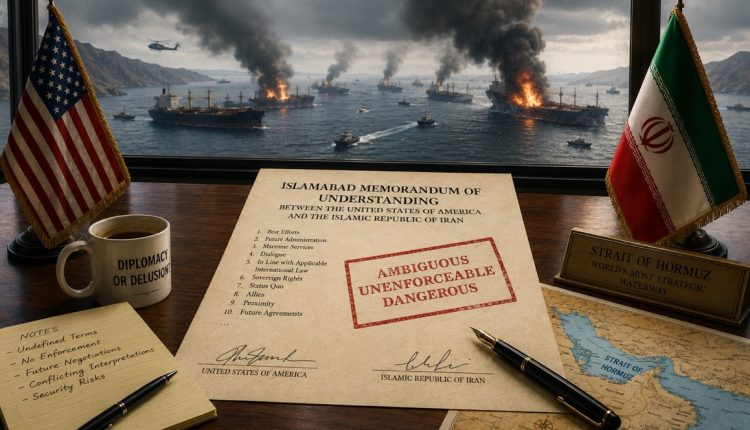
The Memorandum of Misunderstanding strikes back
In the past, American diplomacy was entrusted to people who had spent decades studying foreign languages, history, international law, and the countries they were sent to negotiate with. They knew the difference between a carefully crafted ambiguity and a dangerous one. Today, experience seems to be an optional credential in a State Department that has been gutted by Marco Rubio.
No wonder the latest diplomatic “triumph” touted by the administration — the “Islamabad Memorandum of Understanding between the United States of America and the Islamic Republic of Iran,” — deserves a more accurate title: the Memorandum of Misunderstanding.
This document is so weak it’s difficult to know where to begin. It reads less like a negotiated diplomatic instrument than a preliminary political wish list assembled by multiple drafters with different styles and little editorial integration.
From a legal drafting perspective, its flaws are both structural and stylistic. It suffers from virtually every classic defect contract lawyers are trained to avoid: undefined terms, vague standards, internal inconsistencies, uncertain obligations, missing enforcement mechanisms, poor sequencing, grammatical (and ungrammatical) ambiguity, and promises to accomplish matters beyond the unilateral legal authority of either party, such as terminating Security Council resolutions.
The document is built around elastic concepts such as “allies,” “status quo,” and “proximity”; it repeatedly postpones essential terms for future negotiation rather than resolving them before execution; and it relies on future agreements to supply certainty that the memorandum itself should have provided. The cumulative effect is a document unusually susceptible to conflicting interpretations and future disputes, the very outcome careful legal drafting is intended to prevent. Its central provision requires Iran to use its “best efforts” to ensure the safe passage of commercial shipping. A first-year law student knows that “best efforts” is one of those weasel phrases lawyers distrust. It sounds reassuring until someone asks what, exactly, it requires. Then the litigation begins.
A striking ambiguity concerns the future legal and operational status of the Strait of Hormuz. Paragraph five provides only that Iran will conduct a “dialogue” with the Sultanate of Oman to define the future administration and maritime services in the Strait, in discussion with other Persian Gulf littoral states and “in line with applicable international law and the sovereign rights of coastal states.” This language raises more questions than it answers. Does the memorandum contemplate joint Iranian-Omani administration of the Strait, an international authority, or merely coordination of navigational services? Will existing transit rights under international law remain unchanged, or are the parties contemplating a new legal regime? What role, if any, will the other littoral states have beyond participating in discussions? The provision also fails to distinguish between “administration” of the Strait, “maritime services,” and the exercise of sovereignty, each of which carries distinct legal implications under international law. Most significantly, because the agreement leaves these issues to future discussions without establishing any governing principles or decision-making process, it creates uncertainty over the status of one of the world’s most strategically important waterways precisely when clarity is most essential.
Vice President J.D. Vance, who has no experience as an international negotiator, led the American delegation. He was joined by Special Envoy Steve Witkoff, whose career has been in New York real estate and investment, and Jared Kushner, whose background is likewise in real estate and finance rather than diplomacy. This raised questions about their mission and the administration’s judgment in selecting negotiators.
Imagine negotiating the future of the Mayo Clinic without physicians at the table. Or trying to settle a Boeing-Airbus subsidy dispute without trade lawyers. Negotiating the legal status of the Strait of Hormuz — a maritime choke point wrapped in decades of international practice, custom, and treaties — would seem to call for career diplomats, naval strategists, and experts in the law of the sea. Instead, the administration assembled a team that looked less like a diplomatic delegation than the advance party for a corporate merger.
Predictably, Iranian units reportedly attacked three commercial vessels on Tuesday, July 7th, along the southern shipping lane, prompting President Trump to order airstrikes against Iranian targets, effectively ending the ceasefire. The situation deteriorated further over the weekend when Iran’s Navy announced it had fired on another vessel in the strait and declared that the waterway would remain closed “until the end of U.S. interference in the region.”
Whether those events flowed directly from the memorandum is almost beside the point. The whole purpose of diplomacy is to ensure that governments argue over words instead of exchanging fire. This time it appears to have accomplished the opposite.
Tehran treats the language about Iran’s role in discussions concerning the “future administration and maritime services” of the strait as recognition of a governing authority over navigation. Washington described the same language as protecting freedom of passage. A provision that accommodates two opposing interpretations, even if barely, is not a diplomatic achievement. It is a failed, unfinished negotiation disguised as a successful, completed one, reflecting Trump’s desperate need for an end to a war that the United States has been losing. Experienced diplomats surely recognize that unresolved ambiguity rarely remains unresolved. Experienced lawyers know that undefined language eventually finds a courtroom. In the Persian Gulf, it is finding something considerably more destructive.
One can almost picture the drafting session. Someone asks what “best efforts” actually requires. Another replies that everyone understands the phrase well enough. Someone else raises the meaning of “future administration.” The discussion is postponed because the negotiators are eager to announce success before resolving the disagreement. The disagreement, of course, does not disappear simply because it is swept under a Persian rug.
The shipping industry understood that immediately. Executives called their insurers long before politicians finished congratulating themselves. Insurance companies have a habit of translating diplomatic optimism into actuarial tables. Their interpretation of treaty language appears not in press releases but in insurance premiums.
Supporters of the agreement will argue that some ambiguity was unavoidable — that without it there would have been no agreement at all. That may be true. But clarity has an annoying tendency to expose fundamental disagreements before signatures are exchanged. Ambiguity merely postpones them until the costs are much higher.
The signing ceremony, one must admit, was flawless. Flags were carefully arranged. Cameras captured warm handshakes. Speeches celebrated a historic breakthrough and a durable peace. Then everyone went home and began explaining, to entirely different audiences, what they believed the agreement actually meant. Military activity that followed became its unofficial commentary.
History has seen this pattern before. Diplomacy exists to settle disagreements with words before soldiers, sailors, or insurers are forced to interpret those words for themselves.
A memorandum drafted by seasoned diplomats might have produced a heated debate behind closed doors. That would have been inconvenient. It might even have delayed the signing. Instead, this one produced unanimous smiles in the conference room and renewed conflict in the Strait of Hormuz.
That is why history is unlikely to remember it as a Memorandum of Understanding.
It will remember it as the Memorandum of Misunderstanding.
