
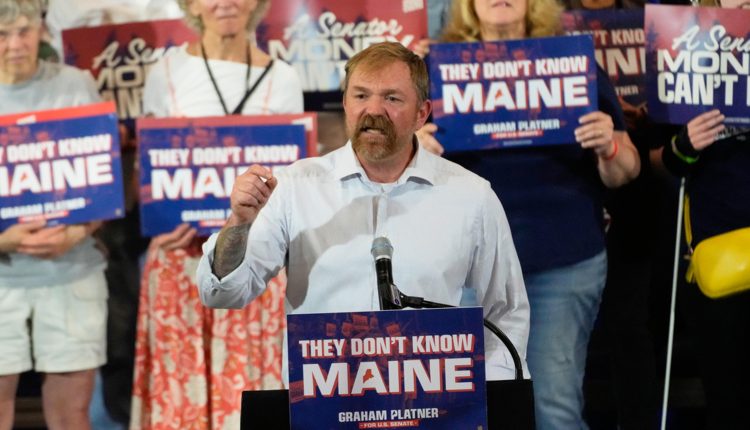
The Platner allegations ground a career
The allegations against Maine Senate candidate Graham Platner moved into the national spotlight again thanks to Politico’s recent reporting about Jenny Racicot’s accusations. In addition, Racicot sat down with CNN’s Jake Tapper and, in a lengthy interview broadcast on Monday, July 6, publicly described what she says happened between them in 2021.
Sexual-assault allegations usually provoke the same type of questions, in this case: Why did she let him remain in the house after the alleged sexual assault? Why didn’t she call the police? Why are some memories vivid while others seem uncertain or incomplete?
Racicot says that Platner arrived at her home intoxicated after she had told him not to come, ignored her objections, and that a nonconsensual encounter followed. She says he later claimed not to remember what had happened. Platner denies any nonconsensual conduct.
She described repeatedly telling him that she was not interested, that she had had a long day, and that her back hurt. She recalled smelling alcohol and seeing what she described as a blank stare that led her to conclude he was heavily intoxicated.
Some aspects of her account will strike skeptics as difficult to reconcile. Racicot recalled that it was “probably pretty late at night” when Platner entered her unlocked home after she had texted him not to come over. Probably? Isn’t it clear whether it’s night or day?
She allowed Platner to stay overnight because she believed he was too intoxicated to drive safely. That may seem like an odd kindness to someone who just sexually assaulted you. She did not contact police while he slept. Why not? Wasn’t that the perfect opportunity to get him out of this life?
She was also uncertain about precisely how an antique sewing kit beside her couch had been knocked over during what she described as an altercation, saying he may have backed into it or she may have pushed him into it. At one point, she said she remembered “potentially” pushing him away with her legs. Not too much clarity there.
She spoke of a “sexual assault,” not rape, although in other clips available online, she responds to a leading question from Tapper that Platner had raped her. Which was it, and if not rape, what kind of sexual assault? An assault can be as minimal as unwanted touching or as serious as forced penetration. It’s understandable that the victim may not want to get into the details, but it would help to at least give the viewers an idea.
At one point, Tapper appears to try to put words in her mouth: “And you were saying, no, don’t, no, don’t, over and over and over.”
Her response: “I remember, you know, obviously I’ve had to recall a lot of this. This is something that I tried for many years to forget. And so small details, you know, might get past me. But yes, I remember very specifically saying, I’m not into this.”
Not into what? And it appears she was not saying “no, don’t, no, don’t, over and over and over.” That ambiguity is concerning because consent is the pivot point of the whole situation.
These details may appear inconsistent with how a victim of sexual assault is expected to behave. But expectations about victim behavior often clash with the evidence. Research on trauma and victimization has long shown that delayed reporting, fragmented recollections, and decisions that seem puzzling in retrospect are common. People confronted with frightening or confusing experiences do not necessarily respond in ways that outsiders find logical or predictable.
None of this exempts an allegation from scrutiny. Questions about memory, timing, and post-incident conduct are legitimate subjects of inquiry. The key is not whether Racicot behaved as others think she should have behaved, but whether there is corroborating or contradictory evidence. That’s a very important issue because Platner is being driven out of the race, decreasing the chances that Democrats will win the Senate and the consequences that may follow.
No police report was filed at the time of the alleged incident. Again, women who are raped or sexually assaulted sometimes do not call police for fear of renewed victimization by the system and other valid reasons.
The text messages Racicot says she sent, telling Platner not to come over and later informing him the encounter had not been consensual, have not been made public. Reporting suggests that some communications may have been deleted years ago as she attempted to move past the episode.
Politico reported having reviewed emails exchanged with a therapist, spoken with a former partner to whom Racicot says she disclosed the incident years earlier, and examined messages she sent warning others about Platner before he became a candidate for office.
Perhaps the most significant corroborating detail is a set of Facebook messages from 2023 in which Racicot reportedly told another woman that she had “ended up in a bad situation” with Platner and that “he doesn’t listen to you when drunk.” Those statements do not by themselves prove that an assault occurred. They do, however, suggest that her concerns about Platner were not first raised at a critical time in his Senate campaign.
That’s significant because Racicot’s credibility increases if she actually supports Platner politically, as she claims, and was hesitant to come forward because of the effect it would have on the election.
Contemporaneous disclosures can strengthen reliability by indicating consistency over time. They cannot, by themselves, prove what happened during a private encounter years ago. Conversely, the absence of a police report or preserved text messages does not disprove an allegation. It just narrows the body of evidence available for evaluation.
People inevitably bring their instincts to cases like this. Some will find Racicot persuasive, and both Anderson Cooper and Jake Tapper have so declared her to be, fortifying Racicot’s more ratings-grabbing narrative. Others will regard aspects of her behavior as difficult to reconcile with their understanding of how someone in her position would act. Those reactions are human, but they are not evidence.
What remains is an incomplete record: enough to make it difficult to parry the claims as frivolous, but not enough to determine with full confidence what occurred behind closed doors. That uncertainty is often the unavoidable consequence of allegations arising from private events, years after the fact, with little surviving documentary evidence and no clear explanation for why they are now presented to the public, close to the time when Platner is set to face Republican incumbent Susan Collins unless he withdraws.
It is possible that, if Racicot is sympathetic to Platner’s political vision but not to his personal failings, she wants both to alert the electorate and to give the Democrats the opportunity to present another candidate before the deadline, which is about three weeks away. Platner already said that “mindful of the political reality” the reporting will inflict, “we are taking the time to reflect on the best path forward.”
Despite the uncertainty, the political consequences appear increasingly clear. The question of what exactly happened in a private home years ago may never be answered with certainty, but cumulative allegations of the magnitude Platner has faced rarely wait for definitive resolution before reshaping partisan realities.
Between his Totenkopf tattoo and accusations of abusive, threatening, manipulative, or otherwise troubling conduct by at least four women, the tide has turned decisively against this charismatic oyster farmer. As Democratic officials, donors, and supporters withdraw endorsements and financial backing, Platner’s political career appears, at least for the moment, to have run aground.
