
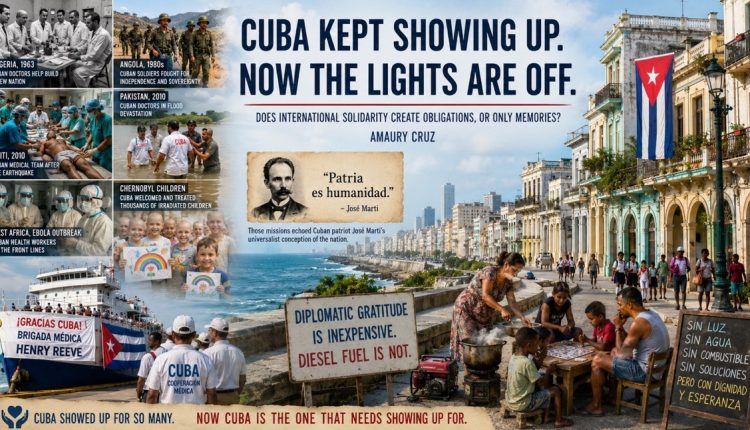
Cuba kept showing up. Now the lights are off.
Does international solidarity create obligations, or only memories?
Havana loses power without ceremony. No warning, no countdown — just silence where there was noise, darkness where there was light. Families mid-conversation go quiet. An elevator stops between floors. Somewhere a generator coughs to life, and people wait, because waiting is what you do now.
While they wait, some of them are asking a question that nobody in the international press seems particularly eager to answer: where is everybody?
This is not a rhetorical question. It is a specific one, with a specific history behind it.
Cuba spent sixty years being there for other people. Not in the diplomatic, press-release sense — actually there. Cuban doctors were in Algeria in 1963, the year the country became independent, setting up clinics before the paint was dry on the new government. Cuban soldiers bled in Angola and Ethiopia out of revolutionary internationalism and anti-imperialist solidarity. Cuban medical teams landed in Haiti after the earthquake, in Pakistan after the floods, in West Africa during Ebola. After Chernobyl, Cuba took in thousands of irradiated children and treated them for free, at a time when Cuba itself was struggling to keep the lights on.
Cuba spent sixty years being there for other people. Not in the diplomatic, press-release sense — actually there.
More than 300,000 Cuban military personnel served in Angola alone, with lasting consequences. Many scholars credit Cuban forces with helping prevent the defeat of the People’s Movement for the Liberation of Angola against rival factions backed by outside powers, including apartheid South Africa and, indirectly, the United States. Nelson Mandela repeatedly praised Cuba’s role, arguing that its actions helped weaken South Africa’s regional dominance and advanced the cause of Namibian independence. That is not a small thing to have done.
So here is the uncomfortable arithmetic: Cuba gave an enormous amount, for a very long time, to a great many countries. And now, facing one of the worst energy crises in its modern history, those countries are largely absent.
Some will say this is unfair framing. And fine — let’s be precise. Angola has its own poverty. South Africa has its own blackouts. Mozambique has its own crises. Most of the countries Cuba helped are poor, and poor countries can’t easily send oil tankers. Understood.
But that explanation covers only part of the gap.
Venezuela actually did repay Cuba, for years — subsidized oil in exchange for Cuban doctors and technical workers. It was imperfect and transactional, but it worked, until American sanctions and Venezuela’s own implosion made it stop working. Mexico briefly stepped in. Same result. Russia sent a tanker earlier this year — one tanker, consumed within weeks, not followed up. Algeria has sent some fuel. Not enough.
What’s left is a network of goodwill that turns out to be worth less than anyone wants to admit. Countries vote for ending the American embargo on Cuba at the UN every year, reliably, nearly unanimously. Leaders give speeches about Cuban solidarity and internationalism. And then the session ends, everyone goes home, and Cuba still doesn’t have fuel –– only crushing sanctions.
Diplomatic gratitude is inexpensive. Diesel fuel is not.
There’s a term for what Cuba built over six decades, and that term is moral capital. The problem with moral capital is that it doesn’t run turbines. Moral capital sometimes does produce material outcomes—aid, loans, diplomatic cover, preferential agreements, and investment. The hitch is that Cuba’s accumulated moral capital has proven insufficient to overcome current economic constraints.
Even the United States was offered Cuban assistance. After Hurricane Katrina devastated the U.S. Gulf Coast in 2005, Cuba publicly offered to send a large contingent of medical personnel to assist victims in Louisiana. President George W. Bush did not accept the help. Initially, the Cuban government proposed sending approximately 1,100 doctors, and later expanded the offer to 1,586 physicians, along with dozens of tons of medicines and medical supplies. According to Cuban statements, the doctors were assembled and prepared for rapid deployment, particularly to affected areas around New Orleans.
One can argue that the world has changed, that sanctions regimes and financial markets have made it prohibitively costly to help Cuba, that countries aren’t so much ungrateful as hands-tied. This is probably true. It is also, from the perspective of people in the provinces who have told me they endure full-day blackouts, not particularly consoling. A source living in Miramar, what was once a posh neighborhood, said that the stench of accumulated garbage and the swarms of flies are inhuman. Even garbage removal and pest control run on petroleum.
Cuba’s government will tell you the Americans are guilty, and the Americans certainly bear much of the blame. But that framing also lets every other country off the hook, and the question of what solidarity actually obligates people to do — when their partner is the one in distress — is one worth sitting with.
The older residents in Havana remember the Special Period after the Soviet collapse. They describe it with a particular weariness, the memory of a crisis survived through endurance and deprivation. This feels like that, they say, but there are differences. The Special Period came after Cuba’s main patron dissolved. The current crisis comes after Cuba spent decades coming to the aid of others.
Perhaps Cuba’s interventions were driven as much by geopolitics as by altruism. If so, expectations of repayment become more complicated. States pursue interests, after all, and gratitude often has a short half-life in international politics. If the latter, then the expectation of repayment becomes more complicated. A skeptical analyst could argue that nations rarely accumulate obligations in the way individuals do. In truth, Cuba devoted decades to international solidarity as a key aspect of its revolution.
But even governments that want to help Cuba face banking restrictions, insurance complications, and political costs. Solidarity today often collides with a global financial architecture largely controlled outside the developing world, particularly the United States, which has been trying to strangle the island nation for decades.
Still, the doctors went. The teachers went. The soldiers went. Those missions echoed Cuban patriot José Martí’s universalist conception of the nation, captured in the maxim Patria es humanidad —”The homeland is humanity.” Whether or not later governments fully embodied that ideal, Cuba came to define itself as a nation that showed up when others were in need.
Now Cuba is the one that needs showing up for.
