
Statement of the Buddhist Coalition for Democracy about Cuba
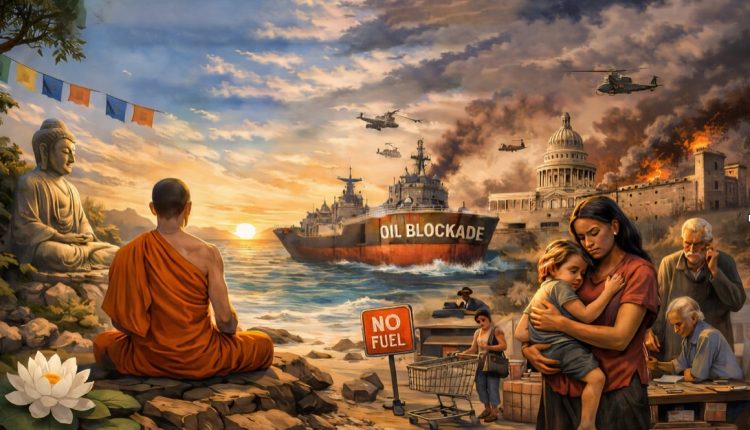
For more than two generations, except for a brief détente under Obama, the United States has pursued an escalating campaign of economic warfare against Cuba: a near-total trade embargo, financial isolation, extraterritorial sanctions, and other punishing restrictions––the antithesis of the Eightfold Path. An official memorandum stated the policy’s aim plainly: to deprive the island of money and supplies in order to “bring about hunger, desperation, and overthrow of [the] government.” The Trump administration has intensified these measures, including a new twist: a total oil blockade though the combined use of international pressure and U.S. military force.
Cuba produces only forty percent of the oil it needs. The remaining 60 percent came mostly from Venezuela, Mexico and, to a very small extent, Algeria and Russia. The United States terminated shipments from Venezuela after assuming control of its oil industry, and pressured Mexico to end its shipments. The “shadow fleet” carrying Russian oil cannot supply the island because ships are intercepted in the Caribbean Sea. These unwholesome acts arise from craving (tanhā) for land, resources, prestige, and clinging to identity (“empire,” “civilization,” “manifest destiny”). As a result, Cuba is in a downward spiral and is likely to suffer a complete collapse in a matter of weeks that is predicted to cause widespread illness and death.
From a Buddhist standpoint, this pressure cooker approach with the oil embargo as the seal is ethically inverted. Buddhism begins with the recognition of dukkha (suffering) and seeks its cessation. Deliberately manufacturing suffering as an instrument of policy contradicts that aim. In Buddhist ethics, intentional harm is unwholesome (akusala); exploiting deprivation as leverage conflicts with compassion (karuṇā); and desirable ends do not purify destructive means. Intention is karmically vital.
Beyond the oil blockade and economic embargo, U.S. policy has encompassed support for assassination plots, economic sabotage, propaganda, and armed incursions. Such activities arise from aversion and the desire for control rather than renunciation or goodwill. The pressure cooker and these other unskillful actions (akuśala) have not produced democracy, liberalization, or improved human rights. They have produced shortages, preventable deaths, degraded healthcare, malnutrition, and chronic insecurity for ordinary people. Predictably, they have also reinforced a siege mentality within Cuban leadership and furnished ready scapegoats for domestic failures. Decades of hostility (dvesha) have entrenched authoritarianism more than weakened it.
Coercion is the opposite of right conduct (sīla), and unwholesome causes do not yield wholesome results. These results include the breakdown of Cuba’s renowned health care system, with a severe scarcity of medicines and basic supplies, the paralysis of public and private transportation, and the loss of tourism upon which a significant portion of the population depend for their livelihoods. In Havana, trash is already piling up, food prices are soaring, schools are canceling classes, and hospitals are suspending surgeries. The country is affected by wide-spread electrical blackouts which also effect the operation of its water and sanitation systems.
Viewed through Buddhist principles—non-harm (ahiṃsā), compassion (karuṇā), right intention, and right action (sammā-kammanta)—the policy is profoundly unethical. Six decades of evidence suggest that manufacturing dukkha entrenches trauma and hostility rather than liberating societies. A humane alternative would ground policy in dialogue, dignity, and the genuine alleviation of suffering.
We oppose the continuation and escalation of this failed strategy and call for policies grounded in human dignity and dialogue with the goal of the genuine alleviation of suffering––in other words, right action (sammā-kammanta).
