
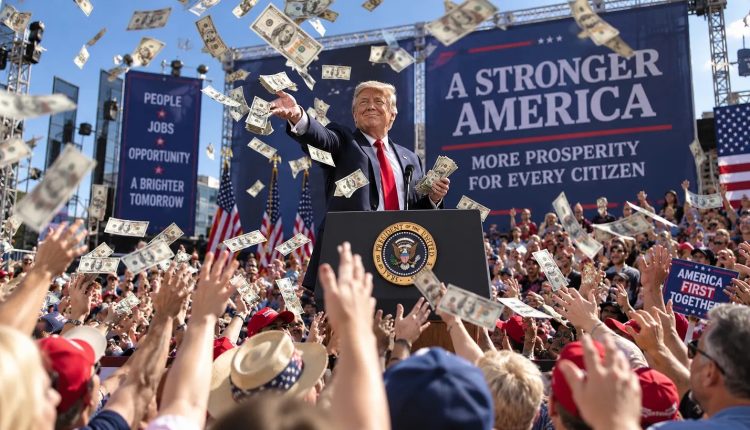
Did Trump commit another crime in plain sight?
Trump has promised a specific $5,000 cash payment to every adult citizen, expressly conditioned on his political party retaining both houses of Congress.
I was watching CNN Newsroom with Victor Blackwell and two guest analysts. One was Charlie Dent, a former Republican Congressman from Pennsylvania recognized for his independent approach, respect across party lines, and leadership roles on key committees and caucuses; the other was Chuck Rocha, the Democratic strategist known for wearing cowboy hats on air and for pleading guilty in 2013 to embezzling funds from the United Steelworkers Union. They are often paired on CNN, perhaps for the contrasts they bring to the small screen. They are both intelligent and articulate.
They faltered, however, when the discussion veered to Trump’s most recent promise of direct financial assistance to the American people: $5,000 checks, which he called “the Trump dividend,” to every adult citizen in the United States if the Republicans retain control of both the House and the Senate after the midterm elections.
The very competent Mr. Blackwell and his two guests went on to discuss the political implications of Trump’s proposal, but, like almost everyone else on TV and in other media I have seen or read, they never addressed the most startling question: has Trump again committed a crime in plain sight?
As an exception that proves the rule, Barbara McQuade, a clear-headed former federal prosecutor, said in Newsweek that the language of 18 U.S.C. § 597, which makes it a crime to buy votes, would “seem to fit what Trump is offering.”
This would likely not be protected by the presidential immunity the Supreme Court invented in 2024, which is “limited at the outer perimeter of a president’s official duties,” she said. “This promise came from Trump as a political party member, not as president,” she explained. To be fair, not everyone agrees or thinks that an investigation will go anywhere.
But Federal law, 18 U.S.C. § 597, is clear. It provides that anyone who makes or offers an expenditure to another person to vote, refrain from voting, or vote for or against a candidate may be fined and imprisoned for up to one year — or up to two years for a willful violation. The statute also criminalizes the voter’s soliciting, accepting, or receiving such payment.
Note that the offer by itself is a violation.
Granted, that statute creates a textual question. Suppose someone says:
“I’ll give you $100 if you vote Republican.”
The speaker has not expressly identified “any candidate.”
But an overlapping second federal statute closes that loophole. 52 U.S.C. § 10307(c) makes it a crime knowingly and willfully to “pay[] or offer[] to pay or accept[] payment either for registration to vote or for voting” in an election containing a federal candidate. It does not require proof that the payment was conditioned only upon voting for a particular named candidate; an offer to any person either to vote or withhold his vote will do. The maximum penalty is five years’ imprisonment and a $10,000 fine.
Arguably, a Supreme Court precedent runs the other way. In Brown v. Hartlage, 456 U.S. 45 (1982), the Court held that the First Amendment protected a candidate’s promise to reduce public officials’ salaries if elected, distinguishing that public campaign pledge from a private payment offered in exchange for an individual’s vote. The Court emphasized that the promised benefit would extend even to citizens who did not vote for the candidate and that it was conditioned on the election’s collective result rather than any particular vote. Trump’s proposal has those characteristics as well. But it also differs from Brown: instead of promising a change in public policy that would indirectly benefit taxpayers, Trump has promised a specific $5,000 cash payment to every adult citizen, expressly conditioned on his political party retaining both houses of Congress. The question is whether that difference is legally sufficient to take the promise outside Brown‘s First Amendment protection.
Besides the federal bribery prohibitions, election laws in various states and the District of Columbia also contain numerous prohibitions against using money or other things of value to induce voting or influence how votes are cast.
That includes the state where I live, where Section 7-25-60 of the South Carolina Code prohibits to (1) procure, or offer or propose to procure, another, by the payment, delivery, or promise of money or other article of value, to vote for or against any particular candidate or measure; or (2) vote, offer, or propose to vote for or against any particular candidate or measure for the consideration of money or other article of value paid, delivered, or promised, vote or offer or propose to vote for or against any particular candidate or measure.
Again, notice that simply promising the bribe constitutes a violation.
Article V, § 7 of the Delaware Constitution; Section 104.061(2) of the Florida Statutes; New York Election Law § 17-142, Article II, § 3 of the New York Constitution; Pennsylvania Constitution, Article VII, § 7; Colorado Revised Statutes § 1-13-720 ; Arizona Revised Statutes § 16-1014; and Texas Penal Code § 36.02(a)(1), despite slight drafting differences, target the same transaction: exchanging something of value for the exercise, or nonexercise, of the franchise. The Texas statute is particularly relevant because that’s the state where Trump made his promise: “A person commits an offense if he intentionally or knowingly offers, confers, or agrees to confer on another, or solicits, accepts, or agrees to accept from another: any benefit as consideration for the recipient’s decision, opinion, recommendation, vote, or other exercise of discretion as a public servant, party official, or voter.”
Trump’s proposal is different. No voter is privately offered money for casting a ballot a particular way. The offer is public and nationwide, and payment depends on the election results rather than on how any individual votes: if Republicans retain both houses of Congress, every adult citizen gets $5,000.
Of course, promising voters something worth money is not ordinarily vote buying. Candidates routinely promise tax cuts, government benefits, debt relief, and other policies that could put money in voters’ pockets. Such promises may influence how people vote, but that doesn’t make them bribes.
The “Trump dividend,” however, doesn’t argue that Republican policies would improve voters’ finances; Trump specified a cash amount and made its payment dependent on an electoral outcome: Republican control of Congress. The question is whether that crosses the line from campaign promise to vote buying.
Any potential prosecution would face obstacles beyond the obvious one: the DOJ would never prosecute Trump. If it did, the government would have to establish that the promise satisfies the elements of 18 U.S.C. § 597 or 52 U.S.C. § 10307(c), including their intent requirements. It would also have to confront an unusual feature of the proposal: an adult citizen could vote against every Republican on the ballot — or cast no ballot at all — and still receive $5,000 if Republicans prevail. Conversely, someone who votes for every Republican candidate receives nothing if the party fails to retain both chambers. Presidential immunity is another issue.
Then there is the practical question of who could bring a case. A federal criminal prosecution would have to come from the Justice Department, and obviously, I repeat, that won’t happen. A state prosecution presents a different problem. A state prosecutor would have to show not only that Trump’s conduct violates that state’s law, but that the state has jurisdiction over an offer broadcast nationwide. If the offer itself is the crime, the question becomes whether a nationally made offer can be treated as one made to voters within that state.
None of this answers the basic question. An offer doesn’t necessarily fall outside a vote-buying statute because it is made publicly to millions of voters rather than privately to one. Federal law and the laws of numerous states prohibit exchanging money for votes. Whether those laws also reach Trump’s unusual offer is another matter.
These issues were lacking in the television discussion. A president has told the country that a $5,000 payment will flow to adult citizens if his party retains Congress. Before asking whether such a proposal is good electoral politics or whether the government could afford it, there is another question worth asking: at what point does a promise of cash tied directly to the outcome of an election cease to be an ordinary campaign promise and become the kind of inducement the vote-buying laws prohibit?
