
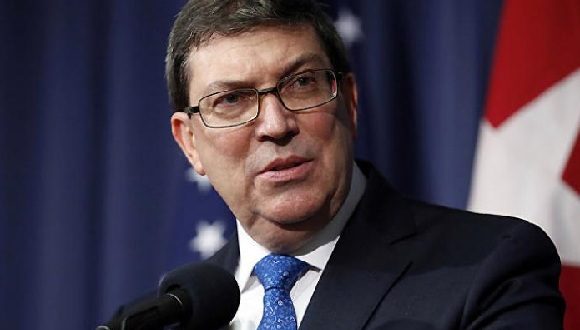
 Cuban Foreign Minister Bruno Rodríguez
Cuba says talks with Washington have stalled as US pressure intensifies
Rodríguez accused Washington of trying to sabotage an upcoming United Nations debate on the embargo by discouraging member states from participating.
Cuba’s government says any hope of improving relations with Washington has hit a dead end.
Speaking in Havana, Foreign Minister Bruno Rodríguez stated that talks with the United States have not made significant progress, despite ongoing contacts between the two governments. According to Rodríguez, Cuba is still open to dialogue but will not accept threats or attempts to control the island’s political future.
Rodríguez said, “The dialogue has not advanced,’ arguing that although discussions have generally been respectful, they have occurred alongside an increasing campaign of sanctions, diplomatic pressure, and public statements questioning Cuba’s sovereignty.
His comments come as the Trump administration has sharply increased its policy efforts toward Cuba during President Donald Trump’s second term. The administration has expanded sanctions, targeted Cuba’s energy sector, imposed restrictions on senior Cuban officials, and continued tightening measures that Havana claims are meant to deepen the country’s economic crisis.
For over sixty years, the United States has maintained an economic embargo against Cuba, a policy strongly condemned each year by the international community at the United Nations. Cuban officials contend that the embargo—not just internal economic issues—has become the main barrier to the country’s development by restricting access to financing, trade, fuel, medical supplies, and investment.
Rodríguez accused Washington of trying to sabotage an upcoming United Nations debate on the embargo by discouraging member states from participating. Cuba has requested the special session, saying the issue has become more urgent as US sanctions keep expanding.
According to the Cuban government, the latest restrictions have greatly disrupted fuel imports, worsening an already delicate energy situation. The island has faced extended blackouts, transportation shortages, and increasing difficulties in keeping hospitals, schools, and essential services running normally.
Rodríguez argued that these measures have real human impacts, emphasizing that ordinary Cubans—not government officials—face the heaviest burden of US policy.
His concerns mirror warnings from senior United Nations officials, who have voiced alarm about the humanitarian effects of shortages impacting healthcare and vulnerable populations. UN human rights representatives have called for a reconsideration of sanctions that hinder access to essential medicines and medical equipment, especially when they worsen living conditions.
Despite increasing economic challenges, Cuba has started implementing major economic reforms. Earlier this month, the National Assembly approved measures aimed at expanding opportunities for private businesses, attracting foreign investment, and offering more flexibility within the country’s socialist economic system.
While recognizing the need for economic modernization, Cuban leaders have repeatedly stressed that these reforms are meant to strengthen — not replace — the country’s political system. Havana has rejected outside calls for regime change, insisting that Cuba’s future should be decided solely by the Cuban people.
The government has also taken several humanitarian steps in recent months, including releasing more than 2,000 prisoners. Although critics argued that not all political detainees were included, Cuban officials described the move as part of broader efforts to ease humanitarian concerns while continuing domestic reforms.
Meanwhile, Washington has shown little sign of easing its stance. The Trump administration has imposed additional sanctions on President Miguel Díaz-Canel and other top Cuban officials while expanding restrictions against Cuba’s state energy sector. Secretary of State Marco Rubio has argued that decades of economic mismanagement by the Cuban government—not US sanctions—are mainly responsible for the island’s hardships.
Havana rejects that argument, asserting that no economy can grow normally under one of the world’s longest-standing systems of economic sanctions. Cuban officials argue that the embargo, strengthened by newer financial and energy restrictions, has become a form of economic warfare aimed at forcing political change through economic hardship.
For now, both governments seem firmly committed to their positions. Cuba states it remains ready to continue diplomatic talks based on mutual respect and sovereign equality, while Washington keeps relying on sanctions as its main policy tool.
With neither side showing signs of changing course, the chances for a major improvement in US-Cuba relations remain as far off as ever, leaving ordinary Cubans to bear the biggest burden of an unresolved conflict that has lasted over sixty years.
