
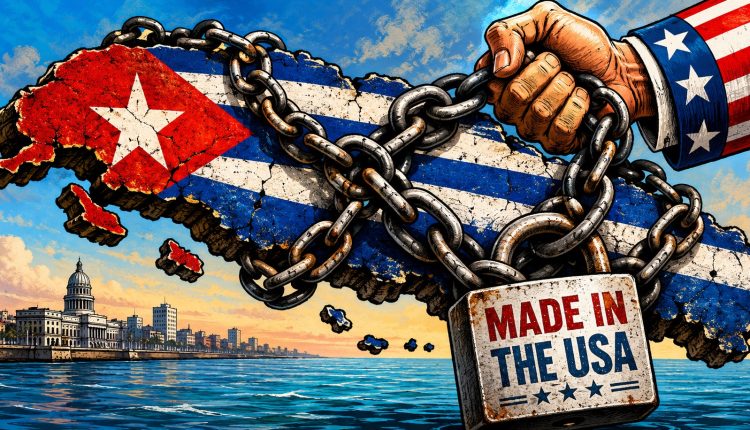
Sanctions and sovereignty: Rethinking U.S. policy toward Cuba
Cuba’s future should be determined by Cubans—not by external pressure designed to “sink” the country’s economy into collapse.
For more than six decades, U.S. policy toward Cuba has been defined by isolation, sanctions, and a persistent effort to pressure political change on the island. As outlined by the Council on Foreign Relations backgrounder on U.S.–Cuba relations, the embargo—first imposed in the early 1960s—remains one of the longest-standing sanctions regimes in modern history. Its stated goal has been to promote democracy and weaken the Cuban government. Its real-world effects, however, tell a far more complicated—and troubling—story.
There is no serious analysis of Cuba’s current economic crisis that can ignore its own leadership’s failures. Decades of centralized economic planning, inefficiencies in state-run enterprises, limited space for private initiative, and delayed reforms have all contributed to stagnation. Cuban officials themselves have acknowledged these shortcomings, and recent efforts to expand small private businesses and restructure the economy suggest an awareness—albeit slow—of the need for change.
But acknowledging Cuba’s internal mistakes does not justify the continuation of a policy that, by design, deepens the suffering of ordinary people.
The embargo restricts trade, limits access to international financing, and deters foreign investment due to the risk of U.S. penalties. While humanitarian exemptions technically exist, in practice, they are often undermined by bureaucratic hurdles and financial restrictions. The result is a system that constrains Cuba’s ability to import essential goods, from medical supplies to food, and raises the cost of nearly everything the country needs to function.
Supporters of the embargo argue that these measures are necessary to pressure the Cuban government into political reform. Yet after more than sixty years, the evidence suggests otherwise. The Cuban political system remains intact, while the Cuban people bear the brunt of economic hardship. If the policy’s objective is regime change, it has failed. If its effect is widespread economic strain, it has succeeded.
The United States has, at times, experimented with a different approach. The normalization efforts under President Barack Obama demonstrated that engagement—expanded travel, diplomatic dialogue, and limited economic opening—can create space for greater exchange and understanding. While those efforts were later reversed, they offered a glimpse of an alternative path: one that prioritizes connection over coercion.
It is also important to recognize the broader international context. The U.S. embargo against Cuba is overwhelmingly opposed by the global community, as evidenced by repeated votes in the United Nations General Assembly calling for its end. This isolation on the world stage underscores a simple reality: Washington’s Cuba policy is not only controversial but increasingly out of step with international norms.
None of this absolves the Cuban government of responsibility. Economic reform on the island must go deeper and faster. Greater transparency, expanded private enterprise, and more responsive governance are essential if Cuba is to achieve sustainable growth and improve living standards. Criticism of U.S. policy and of Cuban governance are not mutually exclusive; both are necessary for an honest assessment.
What is indefensible, however, is the notion that the United States has the right to economically suffocate a neighboring country in pursuit of political objectives. The language of policy often obscures this reality, but the impact is clear: restricted access to resources, constrained development, and prolonged hardship for millions of people.
Cuba’s future should be determined by Cubans—not by external pressure designed to “sink” the country’s economy into collapse. Constructive engagement, not punitive isolation, offers the only realistic path forward. Ending the embargo would not solve all of Cuba’s problems, but it would remove a significant obstacle to progress and open the door to a more humane and effective relationship.
After more than six decades, it is time to ask a simple question: if a policy has failed to achieve its stated goals while inflicting widespread harm, why continue it? The answer increasingly appears to be inertia rather than strategy.
A new approach—grounded in respect for sovereignty, recognition of shared interests, and a commitment to improving the lives of ordinary people—is not only overdue. It is necessary.
