
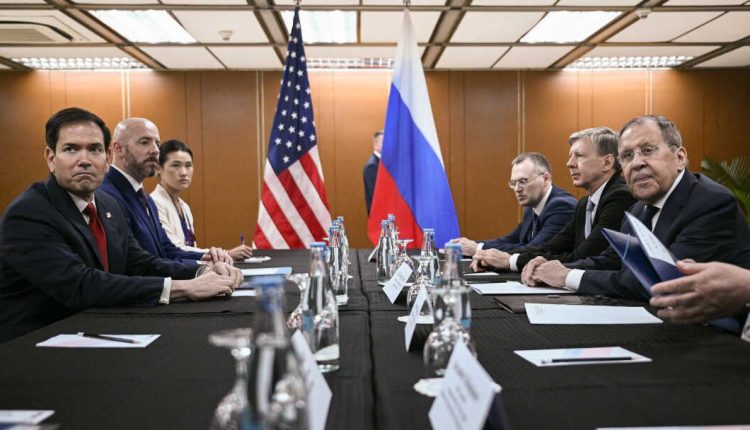
When anti-communism becomes selective
For decades, Marco Rubio has built his political career on a forceful premise: authoritarian governments threaten freedom, hostile regimes must be confronted, and the United States should not make concessions to dictators who attack democratic nations.
He has repeatedly made that argument against Cuba and Venezuela. His uncompromising opposition to the Cuban government helped turn him into a national political figure, and since January 2025, he has served as President Donald Trump’s secretary of state. But Rubio now faces a particularly uncomfortable test: Is he willing to defend those same principles when his own president appears to be abandoning them?
When Russia launched its full-scale invasion of Ukraine in 2022, Rubio and other Cuban American Republicans from Miami had an opportunity to put their convictions into practice in a conflict that directly affected the sovereignty of a democratic nation. Several did so.
In April 2024, Representatives Mario Díaz-Balart and Carlos Giménez voted in favor of legislation that would provide additional security assistance to Ukraine. Giménez said Ukrainians were running out of “time, bullets and weapons” and needed arms to defend themselves. Representative María Elvira Salazar also condemned Russia’s invasion, though she placed greater emphasis on Europe’s responsibility and on making U.S. assistance conditional.
The principle they defended was clear: No powerful nation should be allowed to invade its neighbor, seize its territory, and impose its will by force without facing significant consequences.
Yet the Trump administration is now easing pressure on Moscow. In October 2026, Trump exempted Russia from sanctions under the Lindsey O. Graham Sanctioning Russia and Iran Act, which had received bipartisan support. The exemption, which took effect on October 16, applied to Russian officials, oligarchs, banks, state-owned companies, and other entities. Trump justified the decision, arguing that imposing sanctions would interfere with efforts to negotiate an end to the war.
The decision drew criticism from both parties. Seventeen Democrats and five Republicans in the House of Representatives urged the administration to enforce the sanctions “to the fullest extent and without delay.” Another bipartisan group of senators questioned the administration’s approach to Russian energy and called for imposing the planned sanctions.
Questions also arose about U.S. intelligence support for Ukraine. Although Trump said the United States was continuing to share intelligence, Ukrainian President Volodymyr Zelenskyy said the flow of information had been briefly interrupted and then restored. This assistance is essential to Ukraine’s ability to detect Russian missile launches.
These decisions pose a direct question to Rubio: How does he reconcile easing pressure on Russia with his longstanding advocacy of a tough policy toward authoritarian governments?
As secretary of state, Rubio is not merely a spectator in U.S. foreign policy. He is part of the administration responsible for these decisions and has a duty to defend the country’s interests. His position does not require him to automatically endorse every presidential decision. The public has a right to know whether he agrees with the new approach toward Moscow, whether he has raised objections within the administration, and how he justifies any departure from positions he has defended for years.
Rubio and his allies have argued that making concessions to hostile governments can have dangerous consequences. They have invoked that argument to defend sanctions on Cuba, to pressure the government in Havana, and to confront regimes aligned with Moscow.
If that principle is valid, it should also apply to Vladimir Putin.
The same question applies to Miami’s Cuban American Republicans in Congress. Díaz-Balart warned that abandoning Ukraine would embolden Putin and other aggressors. Giménez supported tougher measures against Russia’s energy sector and called for supplying Ukraine with the weapons it needed to defend itself. Salazar condemned Russia’s invasion and called for greater European involvement and greater accountability from the United States.
Do they still hold those positions now that President Trump is easing pressure on Moscow? Do they support the sanctions exemption? Have they demanded explanations? If they disagree with the administration, are they willing to say so publicly? All are legitimate questions.
For Cuban Americans, the issue also has a historical dimension. Many in this community fled Cuba because they opposed a government they considered repressive. For decades, they have insisted that the world must not normalize authoritarianism. Their experiences deserve respect, and their concerns about Cuba should not be dismissed.
But condemning authoritarianism in Havana while justifying Moscow’s aggression would weaken the moral argument this political stance has advanced for years. Opposition to communism loses its force when it becomes a weapon against political adversaries and is no longer applied to authoritarian governments favored by one’s own leaders.
Russia is not the Soviet Union, and its invasion of Ukraine is not comparable to Cuba’s political system. The countries and circumstances differ. Yet those differences do not exempt political leaders from explaining why they apply certain standards to some governments while adopting a different position toward others.
No one is asking Rubio or Miami’s Republicans to abandon their party. All we’re asking is how Washington’s current decisions square with the convictions they have defended for decades.
If Putin’s aggression was unacceptable before, why should it be any less so now? If Russian energy revenues help finance the war, why should easing economic pressure be acceptable? And if standing up to dictators is a matter of principle, should that principle depend on Donald J. Trump?
Anti-communism has long defined the political identity of many in Miami’s Cuban American community. For Marco Rubio, who has made that stance a hallmark of his public career, U.S. policy toward Russia raises a question he cannot avoid: Will he continue to defend the principles that brought him to the forefront of national politics, even if doing so means disagreeing with the president he serves?
