
The smell of sulfur is still there
Twenty years after Hugo Chávez shocked the United Nations, the joke may be on us.
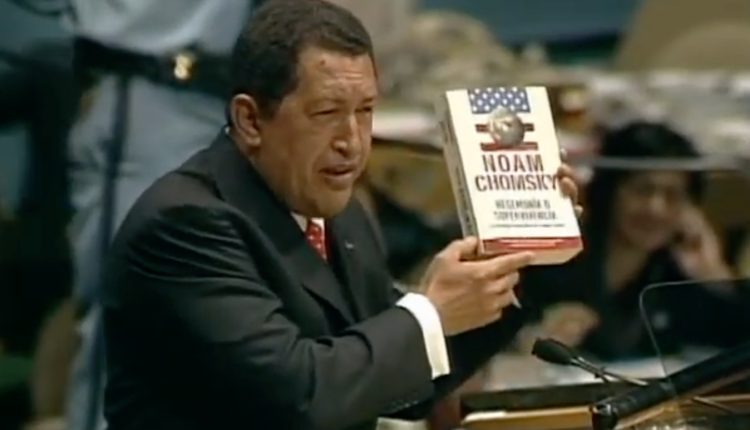
Twenty years ago, Hugo Chávez walked to the podium at the United Nations General Assembly and did something almost unthinkable in international diplomacy. He mocked the world’s most powerful man.
George W. Bush had spoken from the same podium the day before. When Chávez took his turn, he crossed himself and declared that the place still smelled of sulfur.
The audience laughed. The headlines exploded.
And Chávez became the cartoon character American political culture wanted him to be: the fiery Venezuelan caudillo, the anti-American provocateur, and the man who had brought his theatrical revolution to New York.
But Carlos Ron, a former Venezuelan diplomat, in a provocative essay marking the speech’s 20th anniversary, reminds us of something largely forgotten. The sulfur was the punchline. The speech was the argument. And the argument deserves another hearing.
Forget the theatrics
Chávez held up a copy of Noam Chomsky’s Hegemony or Survival and delivered a warning that sounded radical in 2006 but is considerably harder to dismiss today.
What happens when one country becomes so powerful that it begins to believe the rules of the international system apply to everyone except itself?
That was the question.
Chávez accused Washington of conflating democracy with American power and attacked the idea that democracy could be delivered by bombs and military occupation. The United Nations’ own account of the speech records his demands for Security Council reform, expanded membership, and eliminating the veto.
You didn’t have to like Chávez to understand the question. You didn’t have to agree with his socialism. You didn’t even have to like the man.
But you had to be willing to ask whether the international system was as democratic as its most powerful country claimed it was.
Two decades later, that question is still sitting on the table.
Look at the United Nations
The United Nations was established after the Second World War with the stated goal of preventing another catastrophe.
Yet five countries—the United States, Russia, China, Britain, and France—retain permanent seats on the Security Council and the power to veto substantive resolutions.
Chávez called the veto anti-democratic.
That may have sounded like revolutionary rhetoric in 2006. It sounds considerably less exotic when you watch the Security Council today.
In September 2025, all 14 other Security Council members voted for a Gaza ceasefire resolution. The United States voted against it, and the resolution failed because it is a permanent member with veto power.
In June of that year, the vote was the same: 14 countries voted in favor, and the United States voted against. The resolution was blocked.
That doesn’t resolve the immensely complicated political and military questions surrounding Gaza. It does demonstrate something simpler: One country can still say no to the rest of the Security Council.
Chávez wanted that system changed. Twenty years later, it hasn’t been.
In fact, the United Nations is still negotiating how to make the Security Council more representative. The UN’s current reform process explicitly recognizes the need for greater representation of developing countries and underrepresented regions, including Africa, Asia-Pacific, and Latin America and the Caribbean.
So perhaps Chávez wasn’t talking nonsense after all. Perhaps he was asking an inconvenient question too soon.
The American century isn’t over—but the world has changed
The United States has not collapsed. It has not ceased to be a superpower. American military, financial, and diplomatic influence remain enormous.
But the world of 2006 is gone.
China’s rise has transformed the global economy. India has emerged as a major international power. Brazil and other countries of the Global South are demanding greater influence. BRICS has expanded. Countries that once accepted Washington’s leadership as a fact of international life now have alternatives.
None of this means that China, Russia, or anyone else should simply inherit Washington’s place at the top. That would miss the point. Replacing one dominant power with another is not liberation. It is merely changing the name on the throne.
The real question is whether the world can move toward a system in which sovereignty matters even when the country exercising it is small, poor, or politically inconvenient.
That was the deeper meaning behind Chávez’s appeal to the Global South.
And what about Cuba?
For those of us in South Florida, there is an obvious reason to pay attention.
Cuba has spent more than six decades under pressure from U.S. policy. Whatever one’s opinion of the Cuban government—and there is plenty to debate—the island’s relationship with Washington is also a case study in American overreach.
The United States can restrict trade. It can impose sanctions. It can restrict financial transactions. It can pressure companies in other countries that do business with Cuba.
Washington can call its policy whatever it wants, but the Cuban people experience its consequences regardless of the label. And that is why the broader argument about sovereignty matters.
It should be possible to criticize the Cuban government without believing the United States has a divine right to determine Cuba’s future. It should be possible to oppose American sanctions without defending every action Havana takes. It should be possible to say both things at once.
That is precisely the kind of nuance that vanishes when foreign policy becomes tribal.
Chávez got one thing particularly right
Perhaps the most important part of the 2006 speech had nothing to do with sulfur.
Chávez distinguished between the American government and the American people. That distinction matters.
Americans did not invade Iraq. The American government did.
Americans did not design the sanctions imposed on foreign countries. Their government did.
Americans do not sit on the United Nations Security Council and exercise the veto. Their government does.
And ordinary Americans—like ordinary Cubans, Venezuelans, Palestinians, Israelis, Russians, and people everywhere else—often have remarkably little control over the foreign-policy decisions made in their names.
That is why the real divide should never be reduced to Americans versus everybody else. It should be about power.
Who has it? Who exercises it? Who benefits from it? And who pays the price?
Twenty years later, the sulfur hasn’t disappeared
Carlos Ron is right about one thing that deserves to be shouted rather than whispered: We have spent twenty years laughing at Chávez’s sulfur joke while ignoring the argument that came before and after it.
That was convenient. It allowed us to dismiss the messenger and avoid the message.
Chávez was far from infallible. His government deserves scrutiny. His political record deserves debate. His rhetoric could be bombastic.
None of that answers the question he put before the world: Who gets to make the rules?
The United Nations is still struggling with that question. The Security Council is still struggling with that question. The Global South is still struggling with that question. And Washington is still struggling with the reality that the world does not belong to Washington.
So forget the sulfur and theatrics for a moment. Listen to the question. Twenty years later, it still hasn’t gone away.
Maybe the sulfur wasn’t coming from Chávez at all. Maybe it came from a world order already burning.
