
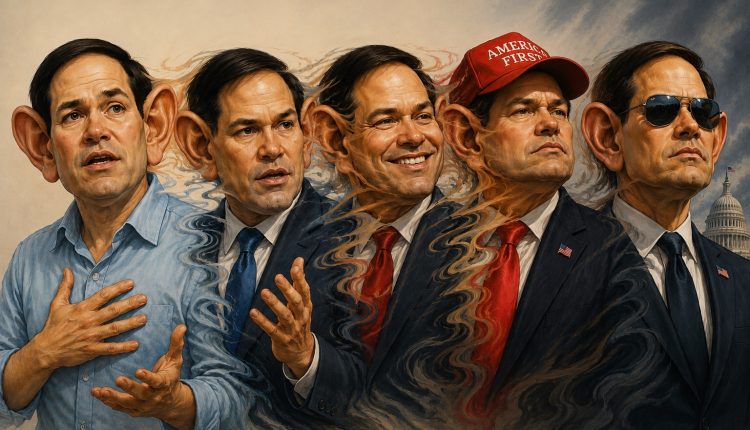
Marco Rubio, the shape-shifter
His alliance with Donald Trump is perhaps the clearest example. Rubio once warned against Trump’s temperament and worldview. Today, he echoes them.
How many versions of Marco Rubio are there?
That question has lingered for years, but it feels newly urgent as Rubio ascends to the heights of American power. Once marketed as a principled conservative with a compelling immigrant story, Rubio has instead revealed himself to be something far more adaptable—and far less anchored. His career is not defined by ideology or conviction, but by a consistent willingness to become whatever is best (for him) at that moment in politics.
This is not a recent development. As Manuel Roig-Franzia, a Rubio biographer, observed in an opinion piece for The New York Times, Rubio’s public life has long been a study in contradiction. He has cycled through political identities with remarkable ease: from champion of immigration reform to hard-line restrictionist; from critic of interventionist excess to enthusiastic backer of aggressive foreign policy; from skeptic of Donald Trump to one of his most reliable enforcers. These are not minor recalibrations. They are wholesale reinventions.
What ties these transformations together is not growth, but ambition.
Rubio’s defenders might argue that adaptability is a political virtue—that leaders must evolve. But evolution implies a coherent trajectory. Rubio’s record suggests something else entirely: a pattern of calculated repositioning, guided less by principle than by proximity to power. When the Republican Party demanded reform, Rubio obliged. When it demanded retrenchment, he pivoted. When Trumpism took hold, Rubio did not resist it; he absorbed it.
His alliance with Donald Trump is perhaps the clearest example. Rubio once warned against Trump’s temperament and worldview. Today, he echoes them. Whether defending controversial military actions, backing policies he once opposed, or aligning himself with a more nationalist, unilateral vision of American power, Rubio has demonstrated a striking willingness to subordinate past positions to present opportunities.
Even his personal narrative has not been immune to this fluidity. The oft-repeated story of his family as exiles from the Cuban Revolution—so central to his political identity—proved to be a lie. When challenged, Rubio did not so much correct the record as reinterpret it, reshaping facts to preserve the usefulness of the myth.
None of this seems to have slowed his rise. In fact, it might explain it. In a political climate that favors loyalty over consistency and values performance over principle, Rubio’s ability to adapt has become a strength. He reads the room, adjusts as needed, and capitalizes on opportunities.
But there is a cost to this kind of politics. A public figure who can be anything risks standing for nothing. Voters are left to wonder which version of Rubio they are seeing at any given moment—and which version might emerge next.
That uncertainty may serve Rubio well in the short term, particularly as he positions himself for future ambitions. Yet it raises a deeper question about leadership in an era defined by volatility and spectacle: Is adaptability a strength when it becomes indistinguishable from opportunism?
Marco Rubio has spent his career proving he can belong anywhere. The more pressing question is whether he believes in anything at all.
