
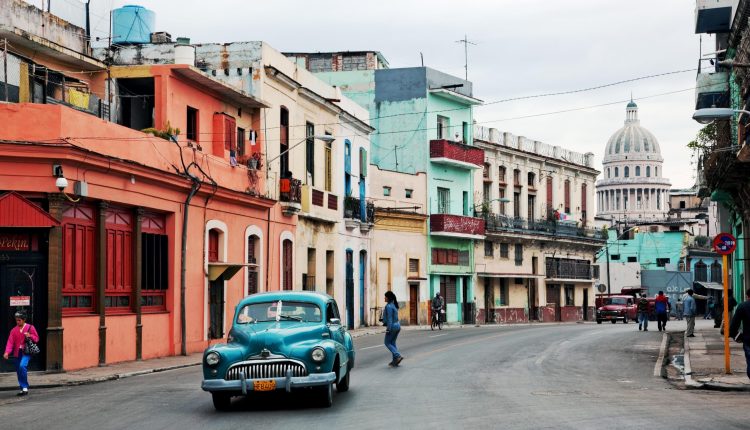
 Image by Falkenpost from Pixabay.
Cuba is not Miami’s to rebuild
Something revealing is emerging in Miami’s growing conversation about Cuba’s “day after.” Everyone seems to have a plan.
But Cuba’s future should not be a prize awarded to whoever has the best transition plan. It should not be a business opportunity wrapped in a political manifesto. And it certainly should not be a project whose terms are dictated from Washington.
The irony is that some of the loudest voices demanding freedom for Cuba sometimes seem unwilling to extend Cuba the most basic freedom of all: the freedom to determine its own destiny.
Freedom accords, transition laws, economic stabilization programs, chambers of commerce, investment strategies, and detailed road maps outline what should happen when Cuba’s current political system eventually changes. Wealthy Cuban Americans are already discussing the billions they could invest on the island.
It is understandable that Cuban Americans care deeply about Cuba. Many who left the island decades ago still consider it home. And it is certainly understandable that Cuban businesspeople want to invest in Cuba.
But one question seems missing from much of this discussion: Who gave anyone outside Cuba the right to decide what Cuba must become?
It’s an uncomfortable question raised, even if indirectly, by Nora Gámez Torres’ recent Miami Herald column on the growing plans for Cuba’s “day after.” Her reporting describes a Miami-based planning industry preparing for a post-communist Cuba. Some proposals envision a free-market democracy, a constitutional government, private investment, and a transition involving Cubans both on and off the island. Others debate whether officials and institutions from the existing system should play a role.
All are legitimate subjects for discussion. But there is a fundamental principle that should take precedence over all of them: Cuba belongs to Cubans. Not to Washington, Miami, or wealthy Cuban Americans. Not to the Cuban government. And not to any political organization, exile group, businessman, or think tank that believes it has already written the blueprint for the island’s future.
This is where a recent essay by Venezuelan writer and former diplomat Carlos Ron, discussed in a recent article by Progreso writer Felipe Pagliery, is particularly relevant. Writing on the 20th anniversary of Hugo Chávez’s famous 2006 speech before the United Nations, Ron returns to the moment when Chávez stood at the same podium where George W. Bush had spoken the previous day and declared that “it still smells of sulfur.”
The line became famous. But Ron argues the more important message was Chávez’s challenge to American hegemony and his insistence on national sovereignty.
You do not have to like or be a Chávez supporter to understand the point. The question is bigger than him.
Who gets to decide?
The United States has enormous power. It has economic, military, and political influence. But power does not automatically confer the moral right to dictate how another country should organize itself.
The same principle applies to Cuba.
Washington has spent decades trying to influence Cuba’s political and economic direction. Successive administrations have justified sanctions and restrictions as tools to pressure the Cuban government to pursue political change. Regardless of one’s opinion of the Cuban government, there is a distinction between criticizing its policies and claiming the right to determine the country’s political future.
They are not the same thing.
And being pro-Cuba does not require being pro-Cuban government. A person can love Cuba, criticize its government, and defend its sovereignty while demanding political freedoms. Those positions are not contradictory. That’s why the discussion needs to move beyond the old Miami-versus-Havana argument.
Heck! I am glad that Cuban Americans want to invest in Cuba. The truth is that Cuba desperately needs investment in infrastructure, functioning electrical systems, productive agriculture, housing, transportation, and economic opportunity.
But investment should not become ownership of the country’s political future.
The wealthy Cuban American families mentioned in Gámez’s article may have enormous financial resources. One group cited in the article estimates that 100 wealthy Cuban American families could represent approximately $200 billion in combined net worth.
That is a lot of money. And money can build a power plant, rebuild a road, and create factories. But money cannot legitimately purchase sovereignty. This is where the phrase “Cuba’s oil,” used by economist Rafael Romeu in the Herald article to describe the resources of Cubans abroad, deserves scrutiny.
Cubans who have migrated are unquestionably an enormous reservoir of talent, experience, and capital. But they are not a substitute for Cubans on the island.
The people who remained in Cuba have lived through the shortages, blackouts, rationing, economic collapse, and a political system and emigration that have transformed the country. They have also built families, businesses, communities, and lives under extraordinarily difficult circumstances. Their voices cannot be treated as one constituency among many in a Miami-designed transition. They must be central.
Perhaps even more important, the discussion should recognize that there is no single Cuban voice. There are Cubans who want socialism. There are others who want capitalism. Some Cubans want democracy modeled after the United States, and others want something entirely different.
Some Cubans oppose the government but do not want Washington running the country, and some have left and want to return. And there are Cubans who have never left and have no intention of allowing anyone from Miami—or Washington—to tell them what their country should look like.
That diversity is not a problem to be eliminated. It is Cuba.
Gámez’s article acknowledges the tension. A Harvard Cuba Working Group has argued that Cubans on the island must be central to the process, while others who do not live there have proposed different approaches. The article also cites survey data indicating that many Cubans on the island favor some form of exile participation in a transition.
That is important. But participation is not the same thing as control.
Cubans abroad should be welcome to participate. They should be welcome to invest and return — to debate, organize, advise, and contribute. But they should not arrive assuming that because they have money, political connections, or a Miami address, they have already been appointed architects of the new Cuba.
Neither should Washington.
The lesson from Chávez’s U.N. speech is the broader question of whether sovereignty remains relevant: Does a powerful country have the right to behave as though it owns the world?
If the answer is no, then the principle cannot suddenly disappear when the subject is Cuba.
Cuba should be free to make its own mistakes and its own reforms. It should be free to decide how much government it wants, how much private enterprise it wants, and which economic system best serves its people.
And if Cubans decide they want massive foreign investment, American companies should be able to compete for that investment under both Cuban and U.S. law.
If Cubans decide they want something else, that should be their decision too.
I am pro-Cuba.
That means I want Cuba to prosper. I want Cubans to live without fear. I want families to have enough to eat and access to electricity. I want Cubans to speak, travel, worship, and work freely, and to build businesses without unnecessary government interference. I would love to see political prisoners released and political differences settled without violence.
But wanting those things does not give me—or anyone else—the right to dictate how 10 million Cubans should obtain them.
The fact is that the Cuban government does not own Cuba. Neither does Miami, and definitely not Washington.
Cuba belongs to the Cuban people. If there is truly going to be a “day after,” perhaps the first rule should be: Let Cubans decide what comes next — without U.S. interference.
