
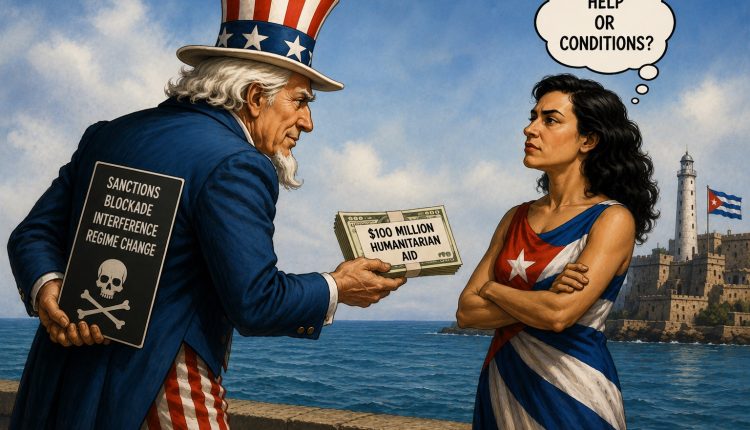
The $100 million “Offer” to Cuba
It’s a familiar scenario: a benevolent United States offers aid to suffering people, while an unyielding Cuban government refuses assistance out of ideology or pride.
(Note: Hours after we published this opinion piece written by our editor, the Miami Herald reports that Cuba has signaled willingness to accept a proposed $100 million in U.S. aid, but only under standard, unconditional humanitarian terms. In a pointed response, President Miguel Díaz-Canel said that if the United States truly delivers the assistance “in full conformity with universally recognized practices for humanitarian assistance,” Cuba would neither block nor resent it—despite what he described as the contradiction of accepting aid from a government that simultaneously imposes harsh economic sanctions. The statement underscores Havana’s position: it is open to receiving the funds, but rejects any political strings attached, framing the offer as acceptable only if it respects sovereignty and humanitarian norms rather than serving as leverage.)
***
When Marco Rubio announced that the United States had offered Cuba $100 million in humanitarian aid—only to have it allegedly rejected—he wasn’t just making a policy statement. He was shaping a narrative.
It’s a familiar scenario: a benevolent United States offers aid to suffering people, while an unyielding Cuban government refuses assistance out of ideology or pride. It’s clear, persuasive—and deeply misleading. Because the most important question is the one that rarely gets asked: what exactly were the terms?
Aid That Bypasses the State Is Not Neutral
According to U.S. officials, the proposed aid would be distributed not through Cuban institutions, but via the Catholic Church and “independent” organizations approved by Washington.
That is more than just a technical detail. It’s the whole story.
No sovereign government—whether in Havana, Washington, or elsewhere—is indifferent to who controls the distribution of resources within its borders. To suggest otherwise is to abandon even the pretense of realism.
Cuban Foreign Minister Bruno Rodríguez Parrilla dismissed the alleged offer as a “fable,” but even accepting Washington’s version, Havana’s skepticism is understandable given the proposal’s structure. Aid that intentionally excludes the state is not just humanitarian—it is political by design.
Sanctions First, Aid Later—A Contradiction by Design
The contradiction at the heart of this episode is hard to ignore.
On one hand, Washington is tightening sanctions—restricting Cuba’s access to fuel, finance, and foreign currency, including measures targeting entities like GAESA. On the other hand, it portrays itself as a humanitarian benefactor providing relief from the very conditions those policies help create.
This isn’t a coincidence. It’s a calculated strategy.
Economic pressure is intended to destabilize; humanitarian aid, offered selectively, aims to reframe that pressure as concern. The result is a policy that can both squeeze and sympathize—punish and posture—simultaneously.
Cuban officials argue that lifting or even easing restrictions, especially on fuel, would have a more immediate and meaningful impact than a one-time $100 million package. You don’t have to endorse Havana’s broader politics to see the logic in that claim.
The Narrative Machine
Outlets like The Miami Herald have played a key role in amplifying the U.S. framing, often highlighting the size of the offer while downplaying its conditions and the wider policy context.
This is not just omission—it is narrative construction.
Readers are shown a government “refusing aid,” not one weighing the political costs of accepting aid under externally imposed terms. They see the headline figure—$100 million—but not the control mechanism built into it.
The effect is to limit the range of acceptable interpretations. Skepticism turns irrational; refusal becomes cruelty.
Sovereignty Is Not a Cuban Exception
Strip away the politics, and the core principle is simple: states oppose external efforts to operate within their borders without their consent or control.
The United States would never allow a foreign government to distribute aid directly to American communities while bypassing federal or state authorities—especially if that government openly seeks political change.
Why, then, is Cuba expected to behave differently? Labeling Havana’s stance as uniquely unreasonable isn’t analysis; it’s a double standard.
A More Honest Conversation
None of this makes the Cuban government a model of effective governance. Its economic mismanagement, strict controls, and lack of transparency have played a major role in the crisis its people now face. But acknowledging those failures does not mean accepting a simple morality play where Washington provides pure humanitarian relief and Havana irrationally refuses it.
What we’re seeing is not a mistake. It’s a battle of power.
If the United States truly wants to reduce suffering in Cuba, it has much stronger tools than a conditional aid package: it can adjust sanctions, loosen financial restrictions, and expand access to fuel and trade.
Until then, offers like this will keep appearing more as political tools than genuine humanitarian gestures—aimed as much at public perception as at policy outcomes. And Cuba’s refusal, whether one agrees with it or not, will remain not only understandable but also predictable.
