
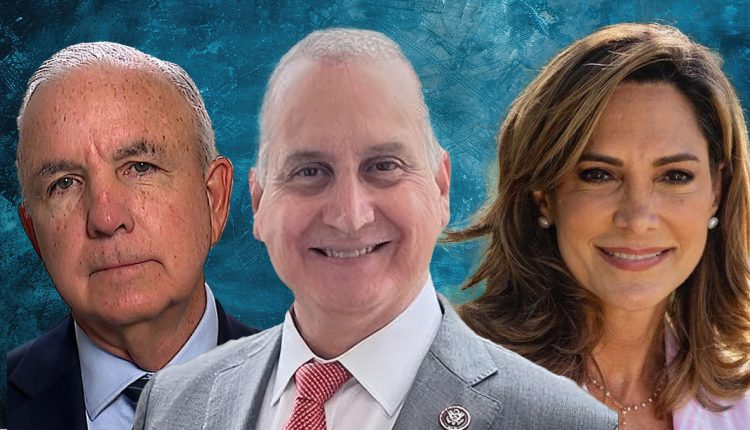
Three cowardly lions and the Wizard of Oz
Suddenly, some Republicans who once couldn't get close enough to Trump are discovering the political benefits of a little social distancing.
Since his brother Lincoln’s death, Mario Díaz-Balart has said very little.
That is hardly surprising. Díaz-Balart has never been known for making political waves, and these days he appears to be keeping an especially low profile. Meanwhile, in South Florida, the consequences of the Trump administration’s policies are impossible to miss: immigrants and asylum seekers face an increasingly aggressive deportation apparatus, the cost of living remains a major concern, and access to health care is a political battleground.
Yet Díaz-Balart remains firmly aligned with President Donald Trump.
His political formula seems remarkably simple: stay in office, stay out of trouble, and stay close to the Republican leadership. In Washington, that may be enough. But what, exactly, is the point of having a congressman if he won’t speak out when policies coming out of Washington affect his own constituents?
Then there’s Carlos Giménez.
Giménez has certainly been busy issuing statements and participating in congressional initiatives. But if you follow his public messaging, one theme emerges again and again: socialism and communism. His congressional office has repeatedly made the fight against those ideologies a centerpiece of his political message. In July, for example, Giménez joined Republican leadership to warn about the “rise of socialism.”
Apparently, in the Giménez political universe, nearly every problem has the same answer: blame communism.
Immigration? Communism.
Democrats? Communism.
Cuba? Definitely communism.
And if you’re looking for an explanation of what Giménez himself is doing in Congress, good luck finding it amid all the red flags.
Then there is the third member of South Florida’s Cuban-American congressional triumvirate, María Elvira Salazar.
Salazar has built her political persona around being a fighter, a truth-teller, and a voice for her constituents. But politics has a funny way of testing those slogans. For years, Salazar has been among the more visible Republican defenders of the Trump movement. However, on immigration, the political winds appear to have shifted.
And suddenly, so has the message.
Last week, Salazar launched a campaign ad criticizing Trump’s immigration agenda. The move was significant because it marked a much sharper break with the president than the positions she had generally taken during his second term.
The Miami Herald reported on the ad and on Trump’s response. Trump said he still supported Salazar and claimed that she was in Congress because of his support.
Think about that for a moment. Salazar is running an ad criticizing the president’s immigration policies, while the president reminds voters that he helped put her in Congress.
That is some political tightrope.
Instead of pretending her record is black and white, the better question is this: When political pressure rises, which María Elvira Salazar will voters get?
The one who stands with Trump? The one who criticizes Trump? Or the one who tries to stand somewhere in the middle, hoping nobody notices the difference?
Remember the Cowardly Lion in The Wizard of Oz?
Well, Miami has its own political version of the story.
Three Republican members of Congress who have spent years operating comfortably in the Trump era now have to explain where they stand as the president’s policies hit closer to home.
And the Wizard?
He’s still behind the curtain. Except this time, the curtain is made of campaign ads, endorsements, carefully calibrated statements, and political survival.
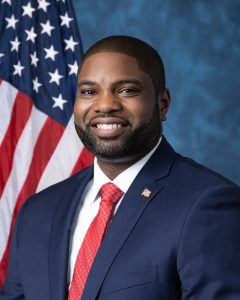
That brings us to Byron Donalds.
Trump endorsed Donalds in the Florida governor’s race, and for a time, his campaign website prominently featured Trump’s endorsement and imagery. But in September 2026, much of that Trump branding disappeared from the site. The Guardian reported that nearly all references to Trump had been removed, including prominent pictures and slogans, leaving only a more limited reference among other endorsements.
Coincidence? Maybe. But the timing is certainly interesting.
Trump’s numbers have been falling. A Reuters/Ipsos poll conducted in September put his overall approval at 32%, a career low in that poll, with only 17% approving of his handling of cost-of-living issues.
And suddenly, some Republicans who once couldn’t get close enough to Trump are discovering the political benefits of a little social distancing.
Which brings us back to South Florida.
For years, these politicians have relied on a simple political calculation: embrace Trump, repeat the talking points, condemn communism, and count on the Cuban-American electorate to keep the Republican congressional delegation safely in place.
But politics changes when the consequences of political loyalty start landing on your own constituents.
That’s when the silence becomes noticeable. That’s when the campaign ads shift. That’s when Trump’s name mysteriously vanishes from a website.
And that’s when voters are entitled to ask a simple question: Were these politicians representing their constituents in Washington — or were they representing Washington to their constituents?
Because if the answer changes depending on the polls, the advertisements, and the political weather, then the real mystery may not be who is behind the curtain. It’s who will still be standing there when the curtain falls.
