
Four Florida political races: Who will win?
Voting is important.
With only weeks left before the election, I’ve been following four key Florida races: the U.S. Senate race, the governor’s race, the Florida attorney general’s race, and a congressional duel in South Florida.
Polls have been conducted, analyzed, and followed by more polls. Money has poured into some of these contests. The Senate race, for example, could help determine which party controls the U.S. Senate. Yet despite all the polling, political spending, and endless speculation, nobody really knows how these four races will turn out.
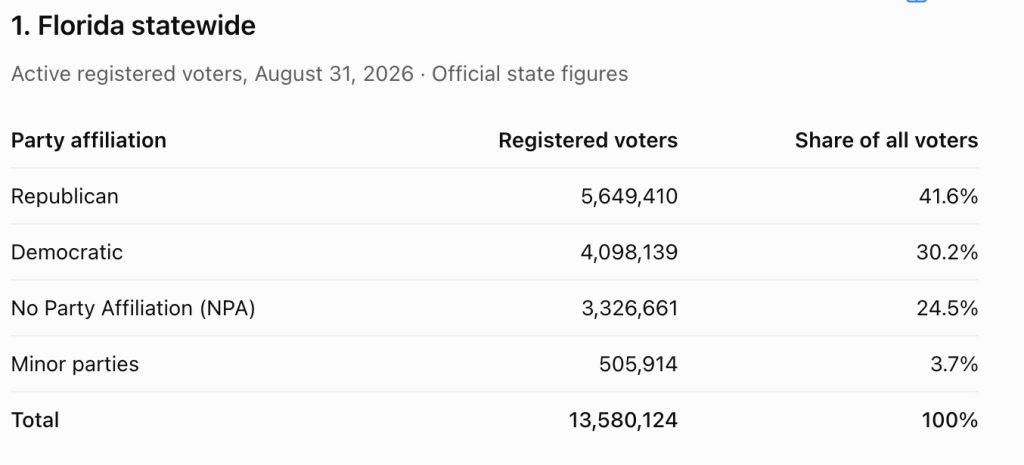
Another important fact: voter registration heavily favors Republicans across all four contests. However, the No Party Affiliation (NPA) voters — many of whom we call independents — could ultimately determine the outcomes.
On paper, all four races are Republicans’ to lose. But one wild card remains: President Donald Trump. He maintains a firm grip on the Republican Party, yet his widespread unpopularity, particularly amid concerns about the war and the rising cost of living, could prove a serious liability. Could Trump drag down Republican candidates in places he won just two years ago?
To explore that question, I used artificial intelligence to help develop what I consider the most objective scenarios for all four races.
What follows are the results. As you will see, even AI cannot confidently predict the outcomes. The numbers favor Republicans, but that advantage could be overcome if Democrats turn out in large numbers and independent voters break decisively for Democratic candidates.
If neither happens, however, the Republican advantage remains formidable. Looking at the situation as objectively as possible — while remembering that this is Florida, a state with its own peculiar political dynamics — suggests Republicans have the upper hand.
But elections are not decided by registration numbers alone. Turnout, independent voters, candidate quality, and the political climate can all shift the equation.
Here’s what artificial intelligence produced when analyzing the four races and their possible outcomes.
Four Florida Races, One Unusual Political Year
Florida voters face four key elections this November: the U.S. Senate race between Republican Ashley Moody and Democrat Angie Nixon; the gubernatorial race between Republican Byron Donalds and Democrat David Jolly; the attorney general race between Republican James Uthmeier and Democrat José Javier Rodríguez; and the congressional race between Republican incumbent María Elvira Salazar and Democratic challenger Eliott Rodriguez.
The candidates, the offices, and the issues differ. But all four races raise a broader question: How much will the national political climate influence elections in a state where Republicans have established a substantial advantage in voter registration and in recent statewide contests?
As of October 11, the polls generally favor Republicans in all four races. Yet the margins, the differences among individual surveys, and the broader political environment suggest that the outcomes are not entirely predictable.
![]() A changing national environment
A changing national environment
 A changing national environment
Midterm elections traditionally serve, in part, as a referendum on the party in the White House. The president’s popularity, the state of the economy, and voters’ satisfaction with the administration can influence contests far beyond Washington.
This year presents an unusual set of circumstances for Republicans. President Donald Trump faces widespread dissatisfaction with the cost of living, while the war with Iran and its economic consequences have created additional political challenges for his administration.
A Reuters/Ipsos poll reported on October 9 found that 78% of Americans blamed Trump’s policies for rising living costs. That included majorities of both Democrats and Republicans. The survey also found substantial dissatisfaction with the administration’s handling of the economy. These findings do not establish how Floridians will vote, but they illustrate the political headwinds facing the president’s party.
Economic dissatisfaction can sway voters who otherwise identify with the governing party. Higher gasoline prices, housing costs, insurance premiums, groceries, and other household expenses may matter more to some voters than traditional partisan loyalties. The consequences of war can also extend beyond foreign policy, particularly when energy prices rise or when families become concerned about the financial and human costs of military involvement.
But an important distinction exists between dissatisfaction with a president and a willingness to vote against a particular candidate. Some Republican voters may disapprove of specific administration policies yet still support Republican candidates. Others may distinguish between federal and state responsibilities. Democratic enthusiasm does not automatically translate into turnout.
The national environment creates an opportunity for Democrats. Whether they can capitalize on it in Florida remains an open question.
The Senate: Ashley Moody vs. Angie Nixon
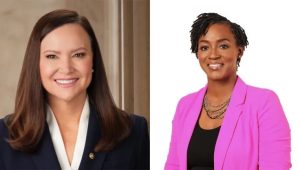
Ashley Moody, the Republican incumbent appointed to fill Marco Rubio’s vacant Senate seat, is seeking election to the remainder of the term. Her Democratic opponent is Angie Nixon.
October polling averages placed Moody ahead by about six percentage points, though individual surveys showed a narrower contest. Results vary by pollster, survey dates and the voters included in the sample.
Moody benefits from Florida’s Republican registration advantage and the state’s recent Republican electoral performance. Nixon’s opportunity depends on Democratic turnout, support from independent voters, and whether dissatisfaction with the national administration influences voters’ choices.
The Senate contest is also part of the broader struggle for control of Congress. Florida alone will not determine which party controls the chamber, but it will influence the national result.
Possible outcomes: Moody wins by a comfortable margin, Moody wins narrowly, or Nixon pulls off an upset by assembling a coalition of Democratic and independent voters. Available polling favors Moody, but it does not rule out the other possibilities.
The governor’s race: Byron Donalds vs. David Jolly![]()
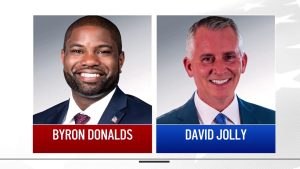
The contest to succeed term-limited Republican Governor Ron DeSantis features Republican Byron Donalds and Democrat David Jolly, a former Republican member of Congress.
The polling picture is mixed. Some surveys show Donalds ahead by several points, while others place the candidates within the margin of error, including a recent poll that found them tied.
Donalds benefits from the state’s recent Republican voting history and the party’s registration advantage. Jolly’s candidacy poses a different challenge for Republicans because he is a former Republican running as a Democrat. His background may appeal to some voters dissatisfied with the direction of the Republican Party, while potentially complicating his relationship with certain Democratic constituencies.
The economy could be especially important in a gubernatorial election. Florida voters face questions about housing affordability, property insurance, transportation, education and the cost of living. National economic conditions may influence their judgments, but voters will also evaluate candidates’ records, proposals and ability to govern.
Possible outcomes: Donalds wins in line with the broader polling trend; the race remains close and is decided by turnout and undecided voters; or Jolly wins by converting dissatisfaction with the Republican administration into a statewide coalition. At present, Donalds is favored, but the tight polls make a competitive election plausible.

Attorney general: James Uthmeier vs. José Javier Rodríguez
The attorney general contest pits Republican James Uthmeier against Democrat José Javier Rodríguez.
Recent polling shows Uthmeier ahead, but the lead varies considerably. One October survey placed the Republican two points ahead, while another found a ten-point margin. The latest close result also left a substantial share of voters undecided.
The attorney general is not simply another partisan office. The office has responsibilities in state law enforcement, consumer protection, litigation and the defense of state laws. The candidates’ records, priorities and views on the appropriate use of the office’s authority are relevant to the choice facing voters.
National political dissatisfaction may influence the contest, but it is not possible to quantify how much of the candidates’ support is attributable to Trump, state issues, or their individual records. The polling differences also caution against treating any single survey as a definitive forecast.
Possible outcomes: Uthmeier wins by a comfortable margin, Uthmeier wins narrowly, or Rodríguez wins if undecided voters and turnout patterns break sufficiently in his favor. The available evidence favors Uthmeier, though the race remains less settled than a single ten-point poll might suggest.
Congressional District 27: María Elvira Salazar vs. Eliott Rodriguez
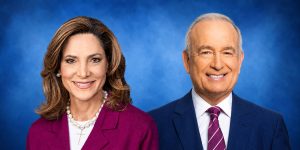
The contest between Republican incumbent María Elvira Salazar and Democratic challenger Eliott Rodriguez warrants particular attention because the district’s registration numbers and polling indicate a more competitive race than Florida’s statewide Republican advantage might suggest.
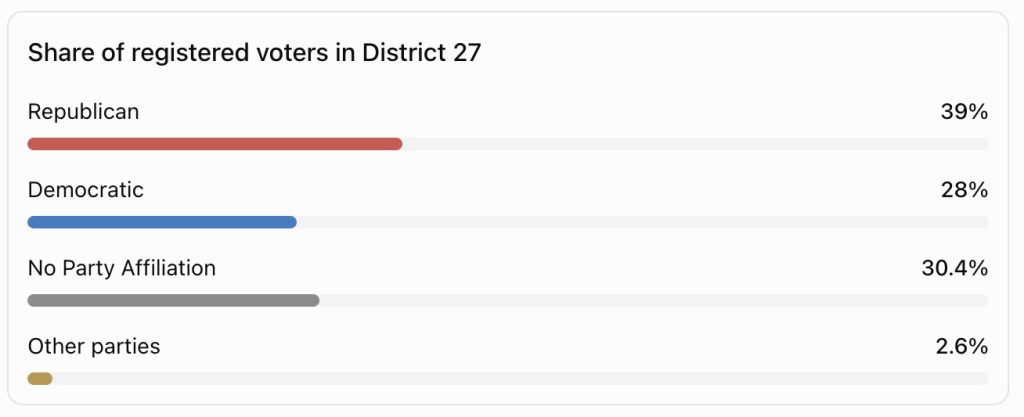
District-level figures available in September showed approximately 151,400 registered Republicans, 108,600 Democrats, and 118,000 voters with no party affiliation. Republicans therefore outnumbered Democrats by roughly 42,800 registrations, while independent and unaffiliated voters represented about 30% of the district’s electorate.
Those figures give Salazar a registration advantage, but they do not indicate how those voters will cast their ballots. NPA voters are not a unified political bloc, and registration totals cannot replace turnout data or candidate preferences.
 The polling has been tight. Surveys conducted in late August and September found either a tie or a narrow Salazar advantage in the initial candidate matchups. One survey showed Rodriguez ahead after respondents heard descriptions of the candidates and their records. That latter finding must be interpreted cautiously because it reflects responses after exposure to campaign-style information, not necessarily the vote that would occur on Election Day.
Salazar’s positions on immigration and the Trump administration could be relevant in a district with a large Hispanic electorate. Her supporters may view her experience and Republican alignment as advantages, while critics may see the same alignment as a liability amid dissatisfaction with federal immigration policies and the economy.
Rodriguez must translate his challenge into votes. That requires strong Democratic turnout and sufficient support from independents and some voters registered as Republicans. Salazar, meanwhile, must retain enough of her existing coalition to withstand any shift in the political climate.
Possible outcomes: Salazar holds the seat, potentially by a narrow margin; Rodriguez wins a close contest by drawing support from independents and increasing Democratic turnout; or a broader anti-administration swing produces a more decisive Democratic victory. Salazar remains the candidate with the structural registration advantage, but available polling suggests the race merits attention.
Three possible scenarios for November
The results of these four contests need not align. A voter may support a Republican governor and a Democratic congressional candidate, or oppose the president while continuing to support a Republican state official.
Three broad scenarios illustrate the possibilities:
1. Republicans retain all four races.
This outcome would align with current polling averages and the Republican registration advantage. It could occur if dissatisfaction with Trump does not translate into enough defections to shift individual races, or if Republican voters turn out at higher rates than Democrats.
2. Democrats win one or more close contests.
This scenario becomes more plausible if economic dissatisfaction persists, the war remains politically costly, and Democratic voters turn out in large numbers. Close races could hinge on relatively small shifts in turnout or voter preferences. A Democratic victory in one contest would not necessarily predict a victory in the others.
3. A broader anti-administration swing produces multiple Democratic victories.
A larger shift against the president’s party could make races that typically favor Republicans far more competitive. Such a result would likely require more than dissatisfaction alone: Democrats would need to mobilize their voters, win over enough independents and persuade some voters who supported Republicans in previous elections to change their votes.
This third scenario is possible, but the polls available as of October 11 do not establish that it will occur. The current evidence continues to favor Republicans in all four races.
The verdict must wait for the voters
Florida’s Republican registration advantage is real. So is the evidence that the political environment has grown more difficult for the president’s party.
Neither fact should be taken as a prediction of the final results. Polls are snapshots, not election returns. They are affected by sampling, methodology, undecided voters, and turnout assumptions. Campaigns can shift the dynamics, and national trends do not affect every district or every candidate equally.
The most defensible conclusion is that Republicans remain favored in these four Florida contests, though the degree of uncertainty varies. The Senate and governor races have shown particularly close results. The attorney general contest shows a meaningful spread across individual polls. And Salazar’s congressional race combines a Republican registration advantage with polling that suggests a serious challenge.
A strange political year can upend normal electoral expectations. Whether this one will do so in Florida is the question that voters—not the polls—will ultimately answer.
