
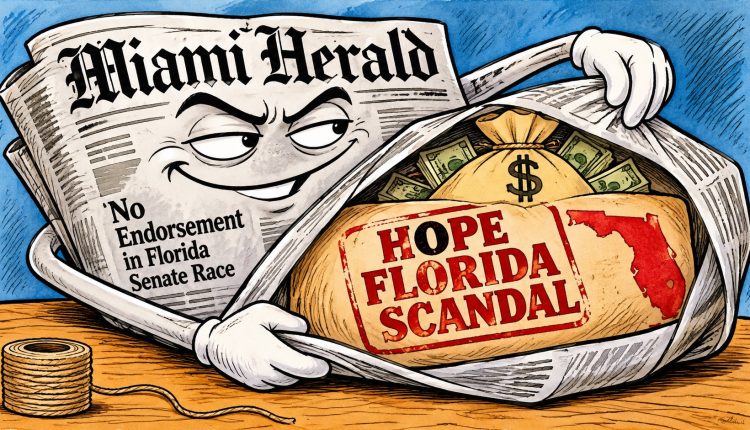
The Miami Herald acts like a fish wrapper when it comes to what’s best for Florida
For years, Progreso Weekly has criticized the Miami Herald for its double-standard coverage of the Miami area, particularly when it comes to the Cuban American community. Those of you who have been with us since the Francisco Aruca years will remember one of our most successful weekly columns, which we called the B.S. Detector.
With our Bilingual Scam Detector, we placed the same Miami Herald articles side by side, one in English and the other in Spanish, written by the same author. We then showed readers how the newspaper would publish essentially the same article with a different meaning in each language. Sometimes it meant removing a word or an entire paragraph; other times, translating something in a way that changed its meaning. The objective, as we saw it, was to please the Cuban community.
For those who might question the legitimacy of that column, I can tell you that the Herald’s bigwigs hated it because it exposed the newspaper’s hypocrisy. And we had help. Journalists working at the Miami Herald contributed to our efforts. Yes, Herald reporters were telling us they disagreed with what was happening at the newspaper where they worked, and they were pointing out precisely why.
The Detector came to mind recently following the elections, when voters across the country made it clear they had had enough of MAGA and its leader, President Donald Trump. They voted overwhelmingly to change the direction in which this country was heading.
In Florida, I was not surprised to see that the Herald declined to endorse either candidate in the race for the U.S. Senate seat Marco Rubio vacated when he became secretary of state. I say I wasn’t surprised because of what I have learned over the last three decades studying the Herald and examining why it takes the positions it does. And let me add that I say this despite having been, over the years, a great admirer of the newspaper’s excellent reporting staff, most of whom are now working elsewhere.
But the executives at the Herald, beginning with Alberto Ibargüen, the publisher who succeeded David Lawrence, took a decidedly different direction when dealing with my Cuban brothers and sisters in Miami. Ibargüen, a turnaround specialist, was brought in to improve the newspaper’s bottom line and satisfy investors and their Wall Street expectations.
From that moment on, in my view, the Herald began sacrificing its journalistic responsibilities to its financial interests. It took more money out of the newspaper’s operations and directed it toward investor returns. At the same time, when a story threatened to provoke a negative reaction from a particular community group — Cuban Americans, for example — the newspaper seemed willing to bend its coverage to accommodate that audience, even at the expense of the broader public interest. The goal was to avoid rocking the boat, protecting readership and, ultimately, the numbers.
In other words, money trumped (no pun intended) people.
That brings us to Angie Nixon, the progressive candidate who came within two percentage points of defeating Ashley Moody, whom Gov. Ron DeSantis had appointed to replace Rubio when he left for Washington.
Why do I bring this up?
In the Miami Herald’s case, neither candidate received an endorsement. The explanation the newspaper offered for sitting out this race made little sense to me — unless, of course, you have been following the Herald since the Ibargüen days.
Regarding Moody, the Herald wrote that “her record raises red flags.” It went on to explain: “As attorney general, she backed a Texas effort challenging 2020 election results in four states, supported legislation that would make voting harder, and authorized a deputy to sign off on the Medicaid settlement at the center of the Hope Florida scandal.”
The Herald was referring to the controversy involving a $10 million portion of a Medicaid-related settlement that was directed to the Hope Florida Foundation, an organization associated with First Lady Casey DeSantis. The money subsequently passed through two nonprofit organizations before $8.5 million reached a political action committee that opposed the 2024 recreational marijuana ballot initiative.
The controversy raised serious questions about the use of Medicaid settlement funds for political purposes. A grand jury later described the arrangement as a misappropriation of funds, although it brought no criminal indictments, and a state appeals court subsequently ruled that the grand jury had exceeded its authority in making certain findings and accusations.
The Miami Herald knew the story. Its reporters had spent weeks investigating and reporting on the controversy. Yet, when it came time to decide which of the two candidates deserved its support, the newspaper played Pontius Pilate and washed its hands of the matter.
Apparently, even a controversy involving $10 million in Medicaid-related settlement funds, millions of which ultimately found their way into political committees, was not enough to convince the Herald that one candidate deserved an endorsement over the other. Meanwhile, Nixon was attracting new voters, including people who had previously stayed away from the polls because they believed their votes would make no difference.
That, my friends, is shameful.
And why wouldn’t the Herald endorse Nixon? Its explanation was that her membership in the Democratic Socialists of America made her a difficult sell in Miami, where anything labeled “socialism” is “particularly toxic.” The newspaper also described her position on the U.S. embargo against Cuba as a “no-go.”
So there you have it.
Here is our bottom line: the Miami Herald fits perfectly into the MAGA world we are unfortunately living in today. When it comes to protecting its financial interests, the newspaper can be as slippery as a wet fish. Its bottom line has become more important than what is best for the people of Florida.
To the Miami Herald: You helped elect one of DeSantis’s merry men-and-women thieves. May your investors be happy.
