
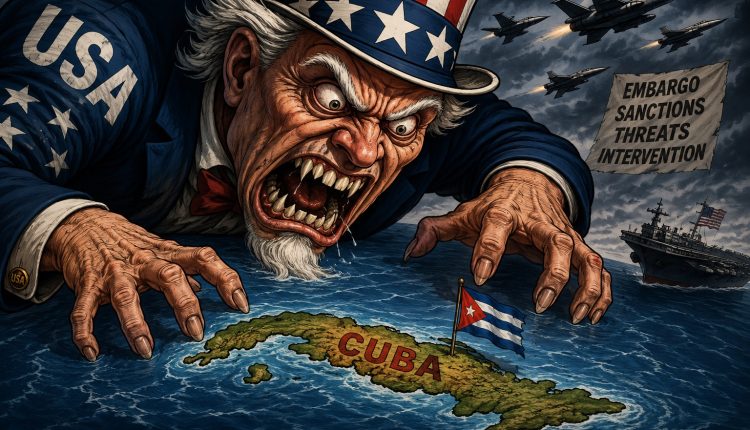
The foolishness of U.S. policy toward Cuba
For over sixty years, Washington has stuck to a policy that has failed by almost every measure. Even with different leaders, ideologies, and global changes, the main strategy has stayed largely the same.
History often repeats itself—not because lessons are missing, but because policymakers frequently choose to ignore them. In The March of Folly, historian Barbara Tuchman detailed how governments across centuries pursued policies that were not just misguided but self-defeating. From Troy to Vietnam, the pattern remained the same: leaders pushed forward even when evidence advised them to stop.
That pattern did not end in 1984 when Tuchman published her book. It persists today, and few examples show this more clearly than the United States’ decades-long policy toward Cuba.
For over sixty years, Washington has stuck to a policy that has failed by almost every measure. What started under President Dwight Eisenhower in 1960 as an economic embargo has become one of the most lasting—and ineffective—foreign policy choices in modern American history. Even with different leaders, ideologies, and global changes, the main strategy has stayed largely the same.
The results speak for themselves. The embargo has not achieved regime change. It has not weakened the Cuban government significantly. And it certainly has not brought US-style democracy to the island. What it has done, however, is impose deep and lasting hardship on ordinary Cubans—restricting access to goods, limiting economic growth, and making daily life more difficult in ways that are both real and deeply human.
To frame these conditions solely as the result of Cuba’s internal system, while ignoring the external pressure exerted by the United States, is to overlook a key part of the story. Sanctions at this scale are not neutral—they influence outcomes. And in this case, they have led to shortages while also providing the Cuban government with a convenient and lasting external enemy to rally against.
For Americans, the costs have been significant but no less real. The embargo has meant missing out on economic ties with a nearby country rich in culture, resources, and potential. It has restricted opportunities for trade, investment, and collaboration that could have benefited both nations. At a time when global competitors are eager to expand their presence in the Caribbean, the United States has effectively pushed itself to the side.
Yet the policy remains in place, driven more by domestic political inertia than strategic reasoning. The problem is that for nearly 70 years, foreign policy toward Cuba has been controlled not by the State Department but by “Little Havana” — home of wealthy Cuban supporters of dictator Fulgencio Batista, who fled to Miami after he was overthrown by Fidel Castro in 1959. The fact is, though, that when national policy becomes rooted in historical grievances rather than current realities, it risks losing effectiveness.
This dynamic is especially evident today, as calls for more aggressive action toward Cuba reemerge in Washington. Escalatory rhetoric—whether through increased sanctions, legal measures against Cuban officials, or even proposals of military intervention—mirrors the same flawed thinking that Tuchman warned about: increasing efforts to fix failure rather than reevaluating it.
The idea of engaging in military confrontation with Cuba is not just dangerous—it is unreasonable. Cuba does not pose a significant national security threat to the United States. It lacks both the capacity and the desire to challenge American power in any traditional way. To portray it as such is to create a false justification for policies that have already proven to be ineffective.
If the goal is real change in Cuba, then six decades of evidence lead to a simple conclusion: isolation doesn’t work. Engagement might.
Opening channels of trade, travel, and communication would not guarantee change, but it would establish circumstances where Cubans have increased access to ideas, resources, and opportunities. When change occurs, it is much more likely to originate from within society rather than being imposed from outside.
Ending the embargo is not an act of concession; it is an acknowledgment of reality. It signifies replacing a Cold War-era policy with one based on pragmatism and mutual benefit. It also indicates a willingness to treat Cuba not as a perpetual adversary, but as a neighbor.
Tuchman’s main warning was not just that governments make mistakes—it was that they keep them going even after those mistakes are obvious. U.S. policy toward Cuba is a clear example of that persistence.
The question now is whether Washington is willing to finally break the pattern—or if this, too, will just be another chapter in the ongoing march of folly.
