
Havana Docks and the long shadow of Cuba’s confiscations
The new reading hands a long-sought victory to American claimants while ensuring that Cuba's economic isolation deepens.
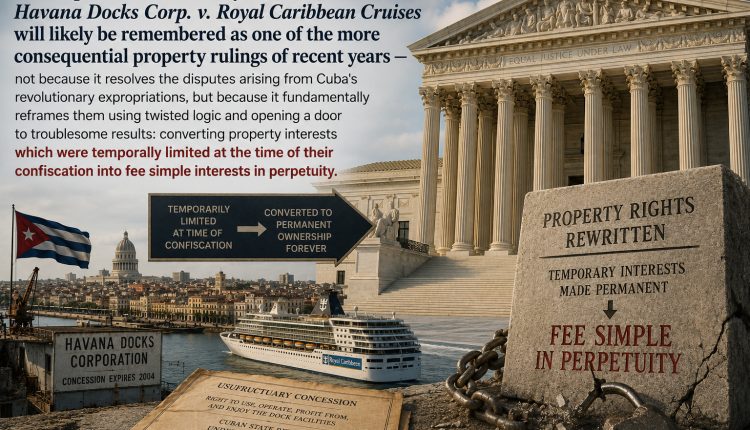
The Supreme Court’s May 21, 2026, decision in Havana Docks Corp. v. Royal Caribbean Cruises will likely be remembered as one of the more consequential property rulings of recent years — not because it resolves the disputes arising from Cuba’s revolutionary expropriations, but because it fundamentally reframes them using twisted logic and opening a door to troublesome results: converting property interests which were temporally limited at the time of their confiscation into fee simple interests in perpetuity.
The case began with a piece of infrastructure and a broken promise.
In the 1920s, Havana Docks Corporation, an American company, obtained rights from the Cuban government to develop and operate dock facilities at the Port of Havana. The arrangement was not permanent and the company held only what lawyers call a “usufructuary concession” — the right to use, operate, profit from, and enjoy the docks, while the Cuban state retained underlying ownership. The concession was scheduled to expire in 2004.
Fidel Castro’s government interrupted those plans. After the Cuban Revolution, it moved to nationalize American-owned businesses and assets. Havana Docks lost its concessionary rights.
A bit of context matters here. Some companies were compensated in other countries after nationalizations because their governments negotiated settlements. The United States reached lump-sum claims agreements, for example, with countries such as Poland, Hungary, and Yugoslavia following the rise of communist governments in those countries after World War II. Cuba never entered a comprehensive settlement with the United States over claims against it.
Cuba offered compensation formulas in some early nationalization laws, often tied to long-term Cuban bonds funded by sugar exports. The United States and affected companies generally regarded those mechanisms as unrealistic or inadequate. This held especially after relations collapsed and the U.S. embargo began. Once diplomatic relations deteriorated, compensation negotiations effectively froze.
Here’s an irony: destroying Cuba’s economy, the aim of U.S. policy for more than 60 years, only makes it more difficult to have the resources needed to compensate anyone.
Thus, large corporations such as ITT, Texaco, Exxon predecessors, Freeport Sulphur, and others were not paid either, despite having certified claims. Havana Docks was therefore not singled out for unfavorable treatment. It shared the fate of many U.S. claimants.
“Certified claims” are claims that the U.S. Foreign Claims Settlement Commission has formally reviewed and validated as losses suffered by U.S. nationals because of property confiscated by a foreign government. In the Cuban claims program, the FCSC certified about 5,900 claims with a principal value of roughly $1.9 billion (not including decades of accrued interest).
What distinguishes Havana Docks is timing and legal opportunity. For decades it had only a certified claim with no practical enforcement mechanism.
Title III of the Cuban Liberty and Democratic Solidarity Act of 1996 (the Helms-Burton Act), created a private right of action allowing U.S. nationals to sue persons or companies that “traffic” in property confiscated by the Cuban government after January 1, 1959.
However, Congress built into the statute a presidential suspension mechanism in 22 U.S.C. § 6085(c). The President could suspend the right to bring these lawsuits for six-month periods if doing so was considered in the national interest and likely to help Cuba’s democratic transition.
Presidents Clinton, George W. Bush, and Obama continuously renewed those suspensions from 1996 onward. As the Havana Docks opinion notes, the right of action “lay dormant for more than two decades” because of those suspensions.
On April 17, 2019, Secretary of State Mike Pompeo announced that the United States would allow Title III to take effect on May 2, 2019. The administration argued that Cuba was supporting the Maduro government in Venezuela, backing authoritarian regimes in the region, and continuing repression at home. The view was that economic pressure on Cuba would weaken the Cuban state and reduce resources available to allied governments, especially Venezuela.
The justifications were flimsy and doubled down on a failed policy, but it gave claimants the enforcement mechanism they lacked.
Under that provision, Havana Docks sued several cruise lines that had brought passengers to Cuba and used those same docks between 2016 and 2019. The cruise operators’ defense was straightforward: the company’s rights would have expired in 2004 anyway, so cruises occurring years after that date could not have caused any cognizable legal injury.
The Supreme Court rejected that argument — but its reasoning deserves more scrutiny than the outcome alone suggests.
Writing for the majority, Justice Clarence Thomas reasoned that the relevant question was not whether Havana Docks still possessed a surviving legal interest. What mattered instead was whether the cruise lines used property that had once been confiscated. The docks themselves, the Court said, remained “tainted” by the original seizure, such that anyone commercially benefiting from them could potentially face liability.
That conclusion shifts the focus of these cases in a significant way. Earlier arguments revolved around the claimant’s rights: Did the owner still have an interest? Had it expired? Would the right have ended naturally regardless of confiscation? The Court moved away from that analysis and redirected attention to the property itself — and that move carries implications the opinion does not fully work out.
The Court’s language edges toward what property lawyers call in rem action, where the claim follows the asset rather than the parties. Usually, disputes like this are in personam: obligations run against a specific person or company based on identifiable rights. The majority never announces it is creating an in rem framework, and technically it isn’t. But describing property as carrying a “taint” that persists decades after the original confiscation — regardless of whether the claimant’s rights have since expired — works like one. The Court should have been more direct about this tension rather than leaving it to fester in future litigation.
The “tainted property” metaphor is rhetorically effective. But legally, it implies an abstract entity and is unpersuasive. If the original owner’s rights disappeared long ago, what exactly survives? The ownership interest itself? The historical injury? A kind of continuing legal stigma attached to the asset? The opinion moves rather quickly from historical confiscation to present liability without answering these questions — and they will matter enormously once courts move beyond ports and cruise terminals to hotels built on confiscated land, refineries rebuilt multiple times over, agricultural estates divided into smaller parcels, or infrastructure projects modified beyond recognition.
As Justice Sonia Sotomayor argued in her concurrence, Havana Docks’ reading of Title III could expose virtually anyone connected to the docks to massive and repeated liability. The company could recover not only from multiple cruise lines, but potentially for each docking event and even from retailers, contractors, or passengers who benefited from activities involving the docks. In effect, liability could be multiplied indefinitely, producing repeated recoveries worth millions or even billions of dollars and imposing penalties so excessive as to be grossly disproportionate to the conduct involved.
There is an even deeper analytical problem. The majority criticizes the lower court for engaging in counterfactual reasoning — asking what would have happened had Cuba never seized the property. Yet that kind of hypothetical is unavoidable. The entire statute depends on historical events and lost rights. One cannot determine whether a valid claim exists without reenacting what existed before confiscation. The Court rejects the counterfactual when it becomes inconvenient but relies on history when it supports the conclusion it wants to reach. That selective use of time is a significant flaw, and it deserved a more direct response from the majority rather than a quiet sidestep.
The decision’s practical reach extends well beyond the cruise industry. There are roughly 5,900 certified claims arising from property confiscated in Cuba — many involving surviving physical assets like hotels, sugar mills, and utilities — and claimants had long worried that expired leases or temporary operating rights would doom their cases. After Havana Docks, those obstacles disappear. Direct suits against Cuba itself remain constrained by sovereign immunity, but private actors doing business on the island — hotel chains, logistics firms, tourism operators, foreign investors — now face a materially different risk calculus that will deter further engagement in the island.
Another irony worth noting: the case concerned docks built nearly a century ago and seized more than sixty years in the past, yet the decision is oriented entirely toward the future. It converts historical confiscation into a rolling source of present liability. Whether that is the right outcome depends entirely on what one thinks the Helms-Burton Act was designed to do — provide symbolic recognition of old wrongs, or actively deter current commerce with Cuba. The Court reads it as the latter, aligning with the stated aims of Trump and his secretary of state, Cuba hawk Marco Rubio, who is of Cuban descent and partly for that reason has tried to engineer regime change for decades.
The “tainted property” idea may well become the opinion’s lasting contribution to property law. It is memorable and perhaps morally intuitive. It is also, for now, a doctrine without defined edges — and in international business and property law, undefined edges have a way of feeding exactly the litigation and conflicts that clearer rules would have prevented.
Moreover, the new reading hands a long-sought victory to American claimants while ensuring that Cuba’s economic isolation deepens — an outcome that fits neatly into decades of failed policy and will shape –– no, deform–– legal and commercial decisions for years to come.
