
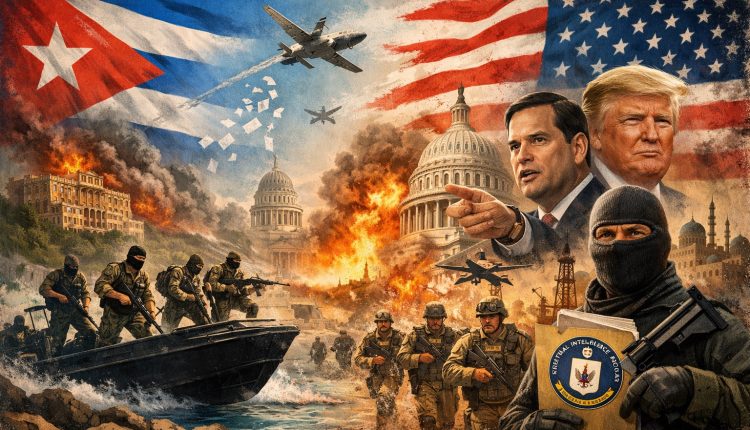
Who is the real terrorist nation?
For decades, individuals operating out of Miami, sometimes through front groups, have sought to destabilize Cuba through violence, sabotage, and intimidation.
We’ve seen this movie before. Planes violate Cuban airspace, dropping leaflets over Havana. Speedboats approach the coast loaded with men, arms, and ammunition — like the recent incident near Cayo Falcones in Villa Clara. The script never changes, yet its authors always expect a different ending.
For decades, individuals operating out of Miami — sometimes openly, sometimes through front groups the Central Intelligence Agency prefers not to claim — have sought to destabilize Cuba through violence, sabotage, and intimidation. The goal is simple: terrorize a population in hopes of toppling its government.
Then the propaganda machine roars to life. Cable news panels, radio talk shows, and newspaper editorials — suddenly, Cuba dominates the headlines for days on end. Much of it radiates from Miami, with the Miami Herald often playing a leading role. Recently, the paper revived the tragedy of Feb. 24, 1996, when two men died during missions by Brothers to the Rescue over Havana, attempting to tie that episode to the latest events. The narrative quickly hardens: Cuba is cast as aggressor; “communism” becomes a slur; “terrorism” is casually affixed to the island as if it invented political violence in places like Vietnam, Iraq, Venezuela, or Iran. The portrait is clear: Cuba menaces the world.
Soon enough, CNN features a “former CIA operative” who questions Cuba’s account and flips the script, branding the island a failed “terrorist nation.” It’s a remarkable inversion. The pot calls the kettle black — and few challenge the premise.
The essential question goes unasked: Who is the real terrorist?
A Circus
At times, it feels like a circus — a carnival of rancor and grievance. Some cling to the belief that Donald Trump will accomplish what no U.S. president has achieved since the triumph of the Cuban Revolution in 1959. They overlook his contempt for nations he has derided as “shithole countries,” many populated by people of darker skin, different faiths, and cultures across Latin America, Africa, the Middle East, and Asia. Yet many Cuban Americans in Miami still rallied to him.
There are those bold enough — or reckless enough — to approach Cuba by fast boat, armed and expecting to spark a counterrevolution. The recent outcome was predictable: deaths and prison cells. What did they expect — flowers?
And then there are the armchair warriors, long gathered at places like Versailles Restaurant, waging rhetorical war over café con leche and croquetas, shouting “Abajo Fidel” years after Fidel Castro’s death. They call for US Marines, for intervention, for salvation imposed from abroad — even invoking institutions like the United States Marine Corps as if invasion were liberation. They demand that Washington “save” Cuba, even if it means subordinating themselves to political forces that treat them as expendable.
Leading this chorus is Secretary of State Marco Rubio, who brands himself a defender of Cuban freedom while advocating policies that intensify hardship on the island. It is a curious patriotism — one that claims kinship yet embraces measures that punish the very people invoked.
Terrorism
Terrorism, stripped of rhetoric, is the deliberate use — or threat — of violence against civilians to intimidate or coerce for political ends. It is defined not by ideology but by method and intent. When armed men depart from the United States to land on Cuban shores, when bombs target hotels, when civilian aircraft become pawns in geopolitical games, the definition grows uncomfortably clear.
For decades, exile groups, sympathetic media, and US intelligence agencies have operated within a broader strategy of pressure and destabilization. Beyond Cuba, US interventions from Vietnam to Iraq, and covert or overt actions in Venezuela and threats toward Iran, have left civilian populations living under the shadow of force and sanctions. These policies are framed as defenses of freedom. Others have long described them as imperial overreach. The labels differ; the fear they generate does not.
If terrorism is the weaponization of fear to achieve political submission, history suggests it is not confined to small states or clandestine cells. It can also be practiced by powerful nations projecting force across continents.
So again: Who is the real terrorist nation?
