
“We cannot allow this evil to continue”
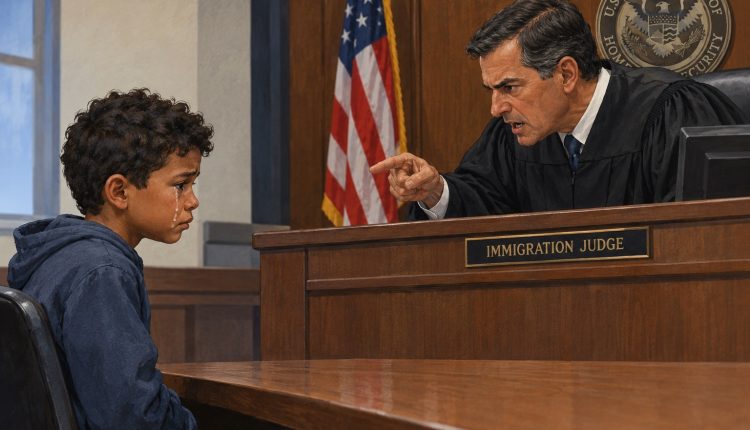
“We cannot allow this evil to continue,” said one commentator after reading a CNN reporter’s account of an immigration court hearing in Harlingen, Texas, on Monday, where children as young as 3 appeared without legal representation and were asked by a judge whether they wanted a “voluntary” departure from the US or a deportation order.
The hearing, attended by Priscilla Alvarez of CNN, was one of many taking place in the US as President Donald Trump pushes to fast-track deportations through abruptly scheduled asylum interviews and court appearances, while the administration also sharply curtails the legal representation available to children.
There is no requirement for children, such as the 1,883 who were being held by the US Health and Human Services (HHS) Department last month, to have an attorney throughout the asylum process, during which they are expected to present evidence that they have a credible fear of returning to their home country and should be granted asylum in the US.
But Shaina Aber, executive director of the Acacia Center for Justice, told CNN that before the group lost a $200 million contract in July, when the administration allowed it to lapse, it was practically unheard of for children to appear in court without legal representation.
“Before, under our contract, it was mandatory to enter into representation if a child was moving forward to the pleading stage while in detention. You’d never have a child in detention being ordered removed without representation,” said Aber, whose group subcontracted with 100 legal service providers to advocate for more than 20,000 unaccompanied migrant children, including those detained while trying to cross the US-Mexico border without their parents and others sent to detention when their family members were arrested by US Immigration and Customs Enforcement (ICE).
As family members and guardians face new vetting requirements to have their children released from the Office of Refugee Resettlement (ORR) at HHS, children are increasingly being pushed into immigration court hearings without anyone to help them advocate for themselves.
A 13-year-old Honduran boy identified as Angel appeared in court Monday without a lawyer and was asked by a judge whether there was a reason he couldn’t return to his home country, which faces a displacement crisis caused by violence, poverty, and climate disasters.
“My mom and almost my entire family are here. It’s too dangerous to go back,” said Angel.
The judge told him he did not qualify for asylum and asked the 13-year-old to choose between a promise of a $3,000 stipend from the Department of Homeland Security to return to Honduras without his mother and family, and a deportation order.
“I don’t know,” Angel said before beginning to cry. “I have no one. I have nothing.”
The judge gave Angel a deportation order and said he had 30 days to appeal it.
The proceedings were observed virtually by an attorney from the US Committee for Refugees and Immigrants (USCRI), which was awarded a $20 million contract last month by ORR, ostensibly to provide legal services to children facing immigration hearings and asylum interviews.
The lawyer did not speak on behalf of Angel or any of the other children who were facing the judge. Attorneys and advocates have said in court filings that USCRI lawyers have either not shown up to hearings or have not spoken in defense of children facing deportation. USCRI did not respond to a request for comment from CNN regarding that claim.
One advocate told CNN that the expedited deportation proceedings are “a complete violation of due process for a child.”
“The kids who are unrepresented, they can’t read the form, much less figure out how to file it. And if they don’t put an asylum claim in, the judges are ordering their removal,” they said. “No one is asking a single question—who will you go to? Will you be safe?”
The hearing took place as Margaret Wurth, senior adviser at the children’s rights division at Human Rights Watch (HRW), warned of the “anguish” the Trump administration is causing for families and children across the US, as the number of people deported by Trump reached 540,000.
HRW spoke to one Haitian man named Pierre, who had been living in Florida with his wife and son, who was born in the US. Pierre had Temporary Protected Status, but Trump ended the program for Haitians, and the US Supreme Court upheld that decision in June.
Pierre was detained during a routine ICE check-in, during which ICE informed him that his work permit had expired. He said he had a pending asylum case and had applied to renew his work permit on time, but he was taken to two different detention centers before being sent back to Haiti.
“I worked so that he could grow up without the fear, violence, and uncertainty that I had known in Haiti,” Pierre told HRW. “I did not get to hug my son. My wife is now alone with the rent, the bills, and our child. She tells me that he still waits for me and asks whether I will be there when he comes home from school.”
Dylan Williams, executive vice president of the Center for International Policy, called the immigration hearing described on Monday as “monstrous.”
“A society that allows this is deeply sick,” he said.
Another observer wondered how proceedings like those described by CNN are proceeding in courtrooms across the country without judges “rage-quitting.” Labor advocate Charles Idelson called on Americans not to “normalize” the treatment of immigrant children by Trump and his top officials, including Homeland Security Adviser Stephen Miller.
“Don’t ever get immune to the inhumanity and dehumanization of what the Trump/Miller project is doing to children and families,” he said.
