
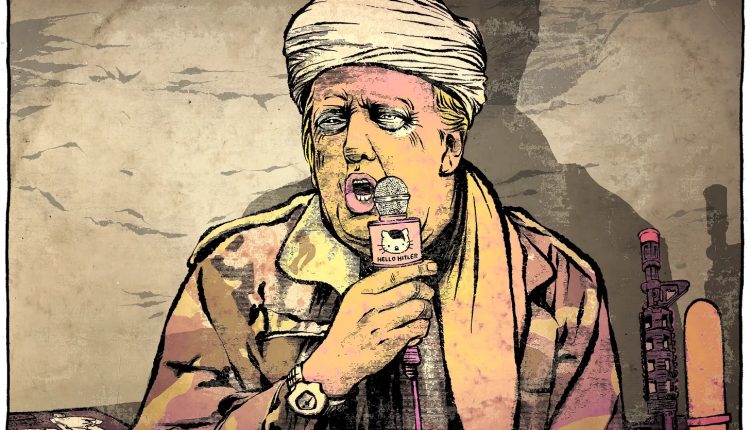
Osama Bin Trump
Did America defeat its enemies—or did it defeat itself?
What if Osama bin Laden got what he wanted—not because al-Qaeda defeated the United States, but because America helped defeat itself?
That provocative argument lies at the heart of Pulitzer Prize-winning journalist Chris Hedges’ latest essay, “Osama Bin Trump.” Hedges argues that Donald Trump did not cause the decline of the American empire. Rather, Trump represents the culmination of decades of military intervention, political dysfunction, economic inequality, and a growing willingness to sacrifice democratic principles in the name of national security.
His conclusion is blunt: “This is the end.”
Hedges places the war with Iran at the center of his argument. He views the conflict not merely as another foreign-policy disaster but as the latest—and potentially most dangerous—chapter in a 25-year cycle of American military interventions that began after the September 11 attacks.
The argument is hard to dismiss by looking only at the numbers.
According to Brown University’s Costs of War Project, the United States has spent or obligated roughly $8 trillion on the post-9/11 wars, including military operations, homeland security, and long-term obligations to veterans. Brown estimates that 4.5 to 4.7 million people have died in the post-9/11 war zones, including millions of indirect deaths resulting from the destruction of health systems, infrastructure, economies, and the environment. More than 38 million people have been displaced.
These are staggering numbers for wars that were supposed to make Americans safer. Instead, Hedges argues, the United States repeatedly turned military victories into strategic defeats.
Afghanistan became America’s longest war. Iraq was invaded based on intelligence claims about weapons of mass destruction that proved false. The broader War on Terror expanded American military operations across much of the Middle East and beyond.
And the consequences did not stop at those borders.
Hedges argues that America’s wars created new generations of people with reasons to hate the United States. He contends that the very military campaigns intended to destroy terrorism helped create the political conditions in which terrorism could flourish.
That is the central paradox of his essay.
Osama bin Laden wanted the United States drawn into costly wars in the Muslim world. America obliged. The United States spent trillions of dollars, lost thousands of its own service members, and participated in wars that killed hundreds of thousands directly and millions more through their long-term consequences. Brown’s research estimates that more than 940,000 people died directly from post-9/11 war violence, while the overwhelming majority of the estimated 4.5–4.7 million total deaths were indirect.
The financial bill continues to grow
As Brown’s researchers describe them, these were essentially “credit card wars.” Much of the spending was financed through borrowing, leaving Americans with not only the original military bill but also enormous interest and long-term veterans’ costs.
And this is where Hedges’ criticism of Trump extends beyond a critique of a single president. He argues that Trump is the product of a country already deeply weakened by the consequences of its own choices.
The working class has been battered by economic insecurity. Public institutions have lost credibility. Political polarization has become an organizing principle. Instead of confronting the structural causes of America’s problems, politicians increasingly point to convenient enemies: immigrants, Muslims, intellectuals, journalists, minorities, and political opponents.
Hedges sees a dangerous historical pattern here. When an empire begins to decline, he argues, it often looks inward to find someone to blame.
The Patriot Act and the post-9/11 expansion of government surveillance demonstrated how quickly extraordinary powers adopted in response to an external enemy could become permanent features of domestic life. Hedges argues that methods developed overseas—from surveillance to militarized tactics—have increasingly been brought home.
In his view, the distinction between America’s foreign wars and domestic politics is beginning to blur. The same government that once sent heavily armed forces into Baghdad, Kabul, and other foreign battlefields is increasingly comfortable using militarized tactics against civilians in American cities.
That is why Hedges believes Trump’s significance extends far beyond Trump. George W. Bush, he argues, helped establish the precedent of expanded executive power and military intervention. Trump inherited that political environment and pushed it further.
The result is a country that Hedges portrays as increasingly accepting of political intimidation, surveillance, nationalism, and the demonization of domestic opponents.
But perhaps the most important part of his argument concerns September 11. Hedges reminds us that the attacks did not occur in a political vacuum. America’s relationship with the Middle East had been shaped by decades of intervention, alliances, sanctions, and support for governments many in the region viewed as oppressive.
After September 11, he argues, the United States had another option. It could have attempted to isolate the terrorists politically and diplomatically while working with the millions of Muslims who had condemned the attacks.
Instead, Washington chose war.
The result was a quarter-century of military intervention, the human consequences of which are still being counted. Brown University estimates that more than 7,000 U.S. service members died in the post-9/11 wars and that at least four times as many service members and veterans died by suicide as died in combat.
Hedges’ conclusion, therefore, is not that America was defeated on a battlefield. It is that America misunderstood the battlefield.
Terrorism cannot ultimately be defeated by bombing alone. Military force can destroy buildings, armies, and infrastructure. It cannot eliminate the political grievances, desperation, and hatred that fuel violent movements.
When military force creates more enemies than it destroys, the strategy becomes self-defeating. That is Hedges’ warning about the United States.
The danger is not merely that America might lose a particular war with Iran. The greater danger, he argues, is that another war could accelerate a much larger process already underway: the exhaustion of American economic resources, the erosion of international credibility, and the weakening of democratic institutions at home.
Whether one accepts Hedges’ sweeping description of the United States as a declining empire, his broader question still deserves attention: After 25 years of war, trillions of dollars spent and millions of lives lost, what exactly did America win?
Washington has rarely been willing to answer that question honestly.
Perhaps the most disturbing possibility raised by Hedges is that Osama bin Laden did not need to destroy America. He only needed America to keep repeating the same mistakes.
Twenty-five years later, Hedges argues, that may be exactly what happened.
We did not defeat terrorism. We helped build a permanent war against it. In the process, we may have weakened ourselves more effectively than any foreign enemy ever could.
