
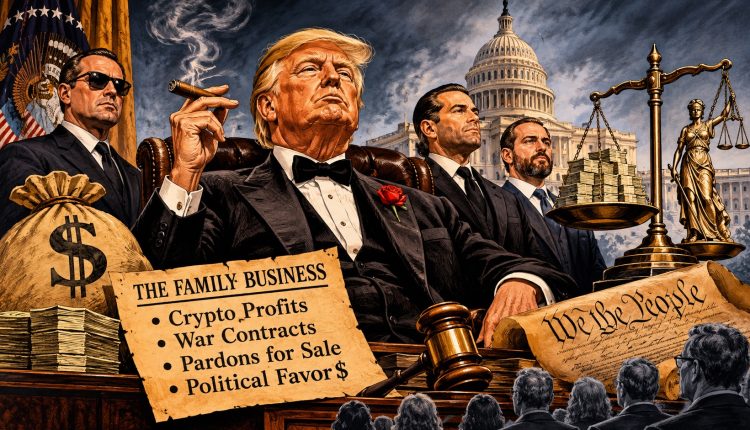
Imagine a Washington where the president makes you an offer you can’t refuse
(Editor’s Note: This story was entirely written by Artificial Intelligence. AI was asked to create an allegory about the current administration in Washington, comparing it to The Godfather while focusing on how Don Corleone handled matters within and beyond the family.)
***
Imagine, for a moment, that Francis Ford Coppola had decided to make another installment of The Godfather. This time, however, the setting would not be Little Italy in New York, Las Vegas, or Havana. It would be Washington, D.C. The Corleone family would have moved into the White House, the consigliere would occupy an office in the West Wing, and the family business would no longer be gambling, unions, or protection rackets. It would be the United States government.
Welcome to Washington, where the old Godfather philosophy seems to have found a new home: loyalty above all, obedience as a measure of character, and enemies who must eventually pay for their transgressions. In this version, the president is Don Corleone, the ultimate authority whose word is law. Cabinet members are the family’s lieutenants, political advisers are the consiglieri, and those who question the boss quickly learn that disagreement can carry a very high price.
The administration’s operating philosophy could easily be summarized by one of cinema’s most memorable lines: “I’m gonna make him an offer he can’t refuse.”
Only in Washington may the offer take the form of a threat to withdraw federal funding, launch an investigation, humiliate someone publicly, withhold a political endorsement, or promise retaliation against anyone who dares to challenge the boss.
In the Corleone universe, loyalty was never an abstract virtue. It was the price of admission. The same principle seems to govern this new political environment. Experience, independence, qualifications, and even personal convictions become secondary to a single question: Are you with the boss? And heaven help those who change their minds.
Remember that in The Godfather, Don Corleone did not have to personally carry out every act of intimidation. He had people for that. His lieutenants understood their assignments, his advisers calculated the consequences, and his enforcers ensured the message was delivered.
Washington has its own cast of characters. There are the loyalists who defend nearly every presidential decision, the political operatives who attack critics, and the officials whose primary qualification seems to be their willingness to demonstrate absolute allegiance. The distinction between serving the public and serving one individual becomes increasingly difficult to discern.
The Family Business: Follow the Money
But another dimension of the Godfather comparison deserves considerably more attention: money. After all, the Corleone family was not in the business of accumulating power simply for the pleasure of having it. Power was a means to an end. It protected the business, opened doors, eliminated competition, and generated wealth. And what is a family business without profits?
Consider the cryptocurrency empire surrounding the president and his family. According to Reuters, Trump’s June 2026 financial disclosures showed more than $1.4 billion in income from family cryptocurrency ventures in 2025. These included World Liberty Financial, co-founded with his sons, and the $TRUMP meme coin. Reuters also documented how the family’s crypto interests benefited from investors and from an administration pursuing policies favorable to the industry.
Think about that for a moment. The president of the United States is both a political decision-maker and the beneficiary of a family business in an industry his administration helps regulate. In the Godfather’s universe, this would hardly be considered unusual. It would simply be another way of doing business.
Then there is the business of war.
For the average American, war means casualties, anxiety, higher prices, and the possibility of sending sons and daughters into harm’s way. For the defense industry, it can mean billions of dollars in contracts and new business opportunities. When members of the president’s family have financial interests in defense technology companies that stand to benefit from Pentagon contracts, the questions practically ask themselves. ProPublica has documented financial ties between senior defense officials and companies competing for lucrative military contracts. Other investigations have examined the president’s sons’ investments in defense-related businesses.
Nobody should have to wonder whether decisions about war, military spending, and national security are being swayed by private financial interests. Yet that is precisely the question these arrangements raise.
In the Corleone family, business opportunities were never allowed to go to waste. Apparently, neither are opportunities in Washington.
And then there are presidential pardons.
In the Godfather’s world, favors created obligations. Nothing was truly free. A person seeking protection or forgiveness understood that access to Don Corleone was valuable and that the family kept track of its debts.
Reuters has reported on the growing network of political influencers, wealthy intermediaries, donors, and presidential associates seeking clemency. Some pardon recipients and their advocates had contributed millions of dollars to Trump-related political interests. Reuters could not determine the total amount of money involved in obtaining pardons, and donations alone do not prove that a pardon was purchased. But the circumstances raise an uncomfortable question: Has presidential clemency become another commodity in Washington’s marketplace of influence?
Imagine explaining to an ordinary citizen that the scales of justice are supposed to be blind, while wealthy and well-connected individuals can cultivate access to the highest office in the country in pursuit of forgiveness. In the Corleone family, that would simply be called taking care of business. The problem is that presidential pardons are not supposed to be family favors. They are an extraordinary constitutional power entrusted to the president, not a private currency to be traded for political loyalty, donations, or personal enrichment.
In this arrangement, the public is left wondering where the business ends and the government begins. Perhaps that is the most disturbing part of the entire production. The issue is not simply whether individual transactions violate the law. It is whether the presidency itself is being turned into an extraordinarily profitable enterprise for those closest to power.
The Family Has Enemies
Of course, every Godfather needs rival families. In Washington, they are the opposition party, independent journalists, judges, prosecutors, bureaucrats, and anyone else who dares to exercise authority beyond the president’s personal orbit.
The problem with this arrangement is that the United States is not supposed to be a family business. The Constitution does not establish a hierarchy of godfathers and underbosses. Instead, it establishes three branches of government, each with its own responsibilities and powers, because the founders understood the dangers of concentrating authority in one person’s hands.
The president is not a king, Congress is not a family council, and the Justice Department is not meant to serve as a private attorney’s office. Yet the Godfather comparison becomes especially troubling when political loyalty is prioritized over institutional independence. In a democracy, public officials are supposed to answer to the law and the Constitution. In a family operation, they answer to the boss.
There is, of course, a difference between Hollywood and Washington. The Corleones never pretended their business was a democracy. They knew exactly what they were doing. American presidents, on the other hand, take an oath to defend a Constitution designed to prevent precisely this kind of personal rule.
And that brings us to the most important character in this production: the American public.
In The Godfather, ordinary people often found themselves caught between powerful families, with little say in the decisions that affected their lives. In a democracy, citizens are supposed to have the final word. They are not supposed to be spectators as a political family divides the spoils.
Perhaps the greatest danger is not that Washington has become a Hollywood gangster movie. Rather, it is that Americans might gradually become accustomed to the idea that intimidation is leadership, personal loyalty is patriotism, and presidential power is something to be feared rather than held accountable.
Don Corleone once explained that he wanted people to come to him with respect, not fear. That distinction matters. A democracy cannot survive when fear replaces respect or when citizens and public officials alike begin calculating the personal consequences of speaking their minds.
The Godfather was a brilliant cinematic portrait of the corruption of power. It was never meant as a blueprint for governing a nation. Washington should remember that. Because in America, the government belongs to the people. And no matter how powerful the Don believes himself to be, the American people are not supposed to be his family.
