
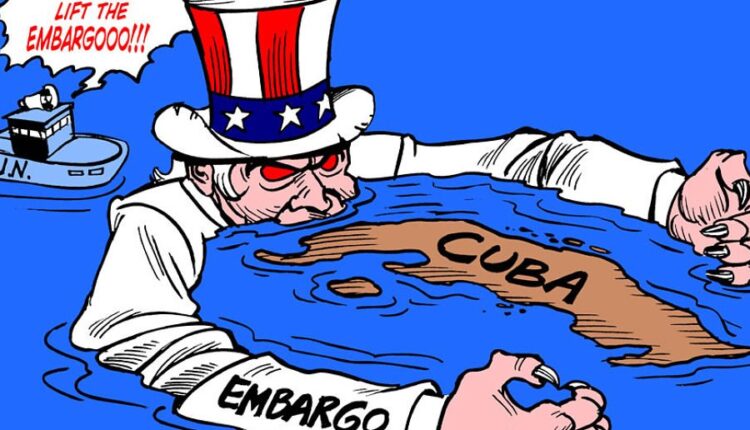
It is time for the U.S. to listen
For more than three decades, the international community has sent Washington a clear and unmistakable message: The United States should end its economic embargo against Cuba.
Since the 1990s, the United Nations General Assembly has voted overwhelmingly in favor of resolutions calling for the embargo’s lifting. Year after year, country after country has opposed a policy that has remained in place since 1962. Yet Washington continues to ignore the overwhelming majority of the world’s nations.
As another United Nations vote approaches, Cuba’s Foreign Minister, Bruno Rodríguez Parrilla, has accused U.S. Secretary of State Marco Rubio of pressuring and blackmailing foreign leaders to weaken international opposition to the embargo.
In a post on his official X account, Rodríguez accused Rubio of pressuring heads of state and government to change their votes, describing Washington as nervous about facing yet another diplomatic defeat.
These allegations raise an important question: Why would the United States need to persuade other nations to abandon their opposition to a policy if that policy were as defensible as Washington claims?
The United Nations voting record speaks for itself. In 1992, the General Assembly adopted its first resolution calling for an end to the embargo, with 59 countries voting in favor and only three opposed (71 nations abstained). Since then, international opposition has grown dramatically. For decades, the United States has become increasingly isolated on an issue that much of the world considers an unjustifiable obstacle to Cuba’s economic development and the well-being of its people. The overwhelming majority of the international community continues to oppose the embargo.
And even though these resolutions are not legally binding, they reflect an important measure of international opinion, and that opinion has been remarkably consistent for more than 30 years.
Why, then, does Washington persist?
U.S. officials have argued that economic pressure is necessary to bring about political and economic reforms in Cuba. And critics of the Cuban government often point to restrictions on political freedoms, limits on dissent, and Cuba’s economic failures. All are legitimate subjects for debate. But acknowledging Cuba’s problems does not require accepting the embargo as a solution.
And who suffers the consequences of this embargo? The Cuban people must put up with limited access to fuel, medicines, financing, and many other necessities. The consequences extend into everyday life, contributing to electricity shortages, transportation disruptions, and difficulties for hospitals, businesses, and families already struggling to make ends meet.
The Cuban government also bears responsibility for its policy decisions and economic shortcomings. No honest assessment should ignore them. But it is equally dishonest to discuss Cuba’s economic crisis without considering the effects of more than six decades of American sanctions and the additional restrictions imposed over the years.
An embargo intended to pressure a government can, in practice, impose substantial costs on the population that government claims to represent. After all these years, Washington must answer a difficult question: Where is the evidence that this policy has achieved its stated objectives?
The U.S. State Department confirmed that Marco Rubio spoke with Salvadoran President Nayib Bukele on October 13 to discuss mutual goals at the UN, specifically Cuba. While this call doesn’t prove Bruno Rodríguez’s claims of threats or blackmail, it highlights the intense diplomatic maneuvering behind a UN vote that Washington has historically struggled to win.
It is deeply troubling that a powerful nation is trying to rally governments behind a policy the international community has consistently rejected. The United States has every right to express its views on Cuba’s political system. That does not mean it should expect other sovereign nations to endorse its policy, let alone pressure them to do so.
The United Nations was established, in part, to provide nations with a forum to express their views, regardless of their economic or military power. When an overwhelming majority repeatedly reaches the same conclusion, that judgment deserves more than another round of diplomatic lobbying.
The embargo debate should not be reduced to a contest between Washington and Havana or to a question of whether one supports or opposes Cuba’s government. It is also a question of whether economic coercion that affects millions of ordinary people is a sensible, humane, or effective instrument of foreign policy.
For more than three decades, the world’s nations have repeatedly answered that question at the United Nations General Assembly’s ballot box. Washington may choose to disregard those votes because they are not binding. But it cannot reasonably claim that the international community has been silent.
The message has been clear, consistent, and overwhelming: End the embargo against Cuba.
It is time for the United States to listen.
