
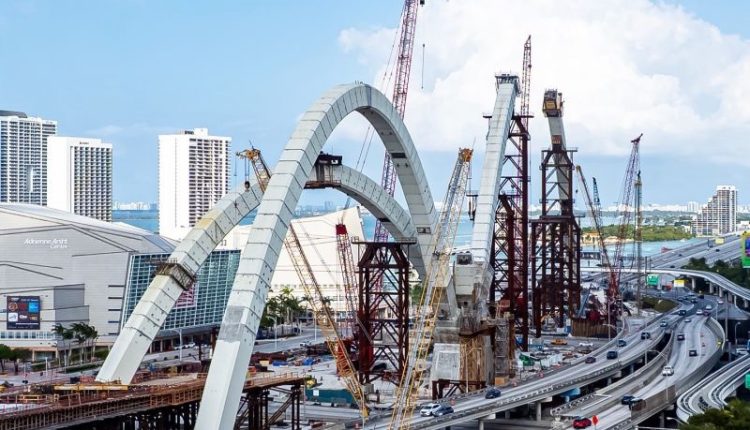
Miami’s ‘Tarantula’ has become a monument to government excess
Six arches. Nearly a billion dollars. Six years behind schedule and counting.
Six arches. Nearly a billion dollars. Six years behind schedule and counting. Somewhere in Tallahassee, a bureaucrat is still calling this thing “iconic.” Miamians have a better word for it: the Tarantula — and it’s time to ask why the state and county are still pouring money into its legs while basic services go begging.
Think of politicians, elected leaders, and community stalwarts who are supposed to look out for what’s best for our community. Then ask who’s making money off this. It’s not the taxpayers, who continue to fund it and stand to gain nothing from it when finished, if it ever gets completed.
Also, unless you’re crazy about this serpentine tarantula that sits atop a busy roadway in Miami and supposedly will bring tourists to our area, what role does this ugly mess on Biscayne Boulevard play?
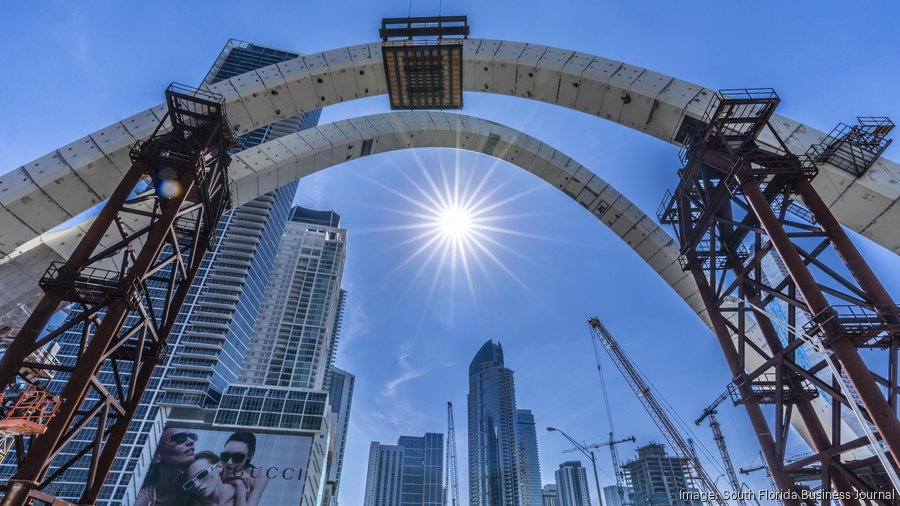 Let’s be honest about what this project actually is. FDOT didn’t need six sweeping precast arches to move traffic between I-95, SR 836, and the MacArthur Causeway. A functional interchange — the kind engineers have been building competently for a century — would have done the job for a fraction of the cost. What Miami got instead is a 1,025-foot sculpture masquerading as infrastructure, sold to the public as a “signature” moment for the skyline. The original pitch in 2013 was a $673 million bridge. Now it’s $866 million and climbing, with the contractor separately alleging $400 million in cost overruns from design errors and defective concrete. Nobody in Tallahassee or at the Miami-Dade Expressway Authority (MDX) is being held accountable for that math.
Meanwhile, Florida is staring down real budget pressure — insurance markets in crisis, public schools underfunded, affordable housing evaporating by the month in Miami-Dade, and a county government warning residents about tightening budgets. Toll dollars collected from working commuters on SR 836 are being funneled, in part, into arches nobody asked for so they can look good in drone footage. This is the definition of misplaced priorities: chasing a skyline photo op while the people paying the tolls can’t afford rent three exits away.
Defenders will say the bridge unlocks a park underneath it, or that “signature” infrastructure pays for itself in tourism and civic pride. Nonsense! Civic pride doesn’t fix a roof, and tourists don’t pay property insurance premiums for the people who live here year-round. When a public agency asks taxpayers to trust it with hundreds of millions in discretionary “beautification” projects and then blows through the timeline by half a decade and the budget by nine figures, that trust should be gone.
What could that money have actually done for Miami-Dade? Even a fraction of the $400+ million in disputed overruns — set aside the full $866 million — could have meaningfully moved the needle:
- Affordable housing: This alone could have built or subsidized many thousands of units in a county with one of the worst affordability crises in the country.
- Flood mitigation and sea-level infrastructure: Miami Beach’s stormwater pump program has cost roughly $500–600 million total for citywide upgrades. Money spent on arches is money not spent hardening the region against the flooding that actually threatens its long-term viability.
- Transit: Miami-Dade’s transit system has been starved for capital funding for decades. A few hundred million could meaningfully expand bus rapid transit or fund long-promised rail extensions that would cut congestion more effectively than any interchange redesign.
- Public schools and teacher pay: Miami-Dade County Public Schools has faced recurring shortfalls; this kind of money could underwrite raises or facility repairs across dozens of schools.
-
Miami-Dade budget: Miami-Dade County Mayor Daniella Levine Cava presented a budget facing a nearly $100 million deficit for the 2026–2027 fiscal year.
None of these fixes come with a ribbon-cutting photo as flattering as six glowing arches over Biscayne Boulevard. But they’re the kind of spending that actually serves the people footing the bill — rather than the skyline.
