
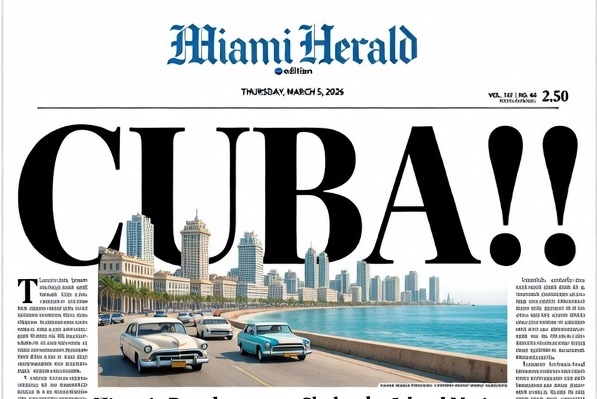
Is the Miami Herald practicing information warfare disguised as journalism?
In polarized environments — whether in Miami exile politics or Washington power struggles — media outlets can become arenas where policy battles are fought indirectly.
Recently, a series of front-page stories in the Miami Herald by Nora Gámez Torres — the paper’s Cuba and U.S.–Latin America policy reporter — have depicted a dramatic scene of secret negotiations, upcoming leadership changes in Havana, and broad geopolitical moves just 90 miles from Florida’s coast. The stories are detailed and urgent, mostly built on a single recurring element: unnamed sources.
That, in itself, is not unusual. Anonymous sourcing has long been a part of investigative journalism. But when anonymity becomes the rule rather than the exception — and when the claims are explosive yet consistently unverifiable — readers have good reason to ask tougher questions.
Take the recent report suggesting that Cuban President Miguel Díaz-Canel may be sidelined as part of back-channel talks between advisers to Secretary of State Marco Rubio and figures close to Raúl Castro. The article relies heavily on “a source with knowledge of the matter” and “multiple sources” who requested anonymity due to the sensitivity of negotiations. The claims are broad: that Washington sees Díaz-Canel as an obstacle, that sanctions could be gradually eased, and that a leadership sacrifice might prevent US military action.
These are not just small policy adjustments. They suggest a possible reorganization of the Cuban government.
Yet no documents are produced. No officials speak on the record. No corroborating evidence emerges beyond layered anonymity. After publication, the story spreads widely. Other outlets cite the Herald. Social media amplifies the claims. The narrative begins to take shape — not because it has been independently verified, but because it has been repeated.
This is how perception turns into reality.
The pattern is familiar. A dramatic claim about Havana often emerges, suggesting internal divisions, secret negotiations, or an impending collapse. It is credited to anonymous insiders. It carries political weight. Then, weeks later, it disappears. No deal is reached. No leadership shift happens. No subsequent inquiry confirms or dismisses the initial allegations. The cycle simply begins anew with the next anonymous leak.
Journalistic ethics do permit anonymity when sources face real danger. However, best practices also call for restraint. Newsrooms generally require editors to know the sources’ identities, verify their credibility, and provide readers with enough background to judge reliability. The Society of Professional Journalists’ code advises reporters to “identify sources whenever feasible” and to explain why anonymity is granted.
When anonymity becomes habitual — especially in geopolitically charged stories — skepticism is healthy.
The real question is whether readers are being given verified reporting or political messaging disguised as journalism.
The question isn’t whether Cuba is in crisis. It is. The island’s economic collapse, mass migration, and political developments are well documented. Nor is it whether US officials engage in covert diplomacy; they often do. The real question is whether readers are being given verified reporting or political messaging disguised as journalism.
Consider the political context. Rubio, a longtime supporter of tough Cuba policies, has publicly called for “dramatic reforms.” President Donald Trump has described Cuba as a “failing nation” and even mentioned the phrase “friendly takeover.” These are not neutral players in the Cuba debate. They have strategic incentives — both domestic and international — to show leverage, gain momentum, and create a sense of inevitability.
If unnamed “sources” describing imminent Cuban concessions or leadership sacrifices come from individuals aligned with that policy agenda, the line between reporting and information warfare becomes blurry. Governments often plant narratives to test reactions, put pressure on opponents, or influence public opinion. Reporters, knowingly or not, can serve as conduits.
This isn’t an accusation; it’s a concern.
The Miami Herald wields significant influence in South Florida and beyond. Stories published there are quickly picked up by national outlets and international media. In the Cuban coverage ecosystem, the Herald often acts as a primary source. That increases its responsibility. When it publishes claims about secret negotiations or military conglomerates “stealing billions” — again citing anonymous insiders — those claims spread outward.
And when the stories “die down,” as critics note, the initial headline stays in the public mind.
The effect is cumulative. A steady flow of anonymous allegations builds a narrative of dysfunction, corruption, and looming collapse. Some of that narrative may be accurate. But journalism’s strength lies not only in what it reports but also in how thoroughly it verifies.
One must also ask: where are the follow-ups? If talks were “well advanced,” what happened? If Díaz-Canel was viewed as expendable, did Havana respond? If sanctions relief was discussed, did policy change? Journalism isn’t just about breaking news; it’s about closing loops.
None of this implies that Cuba’s government does not warrant scrutiny. In fact, scrutiny is crucial. However, it must be reciprocal. When unnamed sources influence stories with significant diplomatic consequences, readers deserve clarity about the sourcing process: How many sources are involved? Which governments do they represent? What is their credibility? Were the documents examined? Were officials from the opposing side allowed to respond?
In polarized environments — whether in Miami exile politics or Washington power struggles — media outlets can become arenas where policy battles are fought indirectly. Narratives leak. Headlines signal. Public pressure mounts.
Responsible journalism requires resisting that gravitational pull.
Readers recognize that sensitive diplomacy requires secrecy. But they also see that repetition isn’t proof. When dramatic claims repeatedly don’t yield observable results, trust declines.
Ultimately, the problem isn’t Nora Gámez Torres as an individual reporter. It’s a broader issue regarding sourcing standards in high-stakes geopolitical reporting. Anonymous sources are sometimes necessary, but they shouldn’t be used routinely to support every important claim.
If the negotiations are genuine, evidence will eventually emerge. If a leadership change is near, it will become obvious. Until then, headlines based on unseen sources should be viewed as provisional stories rather than confirmed facts.
In the complex history between Washington and Havana, misinformation has often played a role as significant as policy. The Miami Herald appears to be adding to that legacy.
