
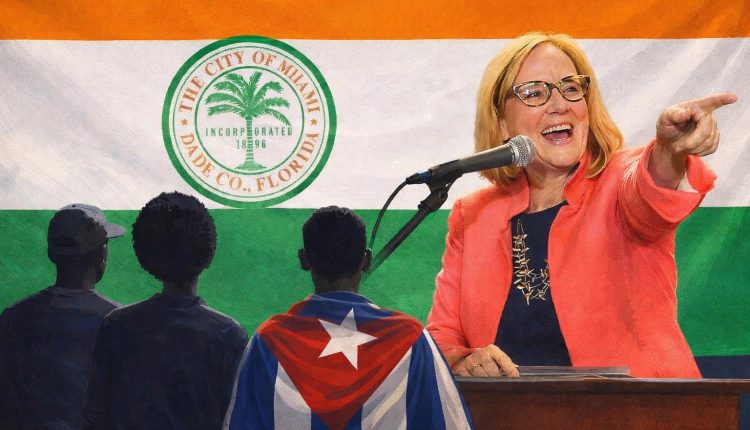
Are there fundamental changes occurring within Miami’s Cuban electorate?
In 2025, anti-communist rhetoric alone failed to win Miami’s mayoral office — even with heavy national Republican backing and nonstop warnings about socialism.
For more than half a century, Cuban American politics in Miami has centered on a single word: communism.
It has shaped elections, defined loyalties, and turned local races over potholes and zoning into referenda on Fidel Castro. Candidates didn’t need plans — only slogans. Invoke socialism, wave the flag of exile, and victory was often assured.
But the 2025 Miami mayoral election suggests that era may finally be ending.
Eileen Higgins’s victory — Miami’s first Democratic mayor in nearly 30 years — was not a fluke. It was the result of shifting voting behavior among whites, Blacks, independents, and, most notably, Cuban Americans.
Something fundamental is unfolding within Miami’s Cuban electorate.
The Old Formula Is Losing Power
For decades, Cuban Americans were treated as a monolithic voting bloc. Republicans didn’t just win Cuban votes — they inherited them.
The logic was emotional, historical, and understandable. Many first-generation exiles had fled communism. Politics was not theoretical; it was about survival. Anti-communism was not ideology — it was identity.
But identity politics has a limited shelf life.
In 2025, anti-communist rhetoric alone failed to win Miami’s mayoral office — even with heavy national Republican backing and nonstop warnings about socialism.
That should have been impossible under the old political rules. It wasn’t.
What the Numbers Reveal
In the runoff election, Black voters did what they have done for generations: they voted overwhelmingly Democratic, often giving Higgins 85 to 90 percent of the vote.
That wasn’t new.
White voters, particularly in urban neighborhoods such as Brickell, Edgewater, and Downtown, also moved strongly in her direction, with margins exceeding 60 percent in many precincts. These voters weren’t motivated by ideology. They were voting on cost of living, insurance rates, flooding, traffic, and city dysfunction.
But the most politically significant development occurred in Cuban-heavy precincts.
Neighborhoods that supported Republicans in the 2024 presidential election shifted noticeably in the 2025 mayoral runoff. In parts of Little Havana, Flagami, and West Brickell, Democratic margins improved sharply — enough to tip the election.
This was not a Cuban landslide. But it was something far more dangerous to political orthodoxy: movement.
From Exile Politics to Resident Politics
A quiet transformation is underway. Younger Cuban Americans — and even many older ones — are beginning to distinguish between symbolic battles abroad and practical problems at home.
They are asking questions that sound suspiciously normal:
- Why can’t teachers afford to live here?
- Why is insurance bankrupting homeowners?
- Why does rent rise while wages stall?
- Why does City Hall feel like a private club?
These are not socialist questions. They are homeowner questions. They are American questions.
And they are increasingly shaping how Cuban voters behave — especially in local elections, where Havana has no vote and Miami does.
The Myth of the “Communist Threat” at City Hall
The old narrative claims that any Democrat in Miami represents a slippery slope toward Venezuela, Cuba, or Nicaragua.
Yet Miami has been governed almost entirely by Republicans for three decades — and housing is unaffordable, traffic is paralyzing, and corruption scandals are routine.
At some point, fear stops working.
You can only blame Havana for Miami’s flooding for so long. You can only scream “communism” while approving luxury towers that displace families, before voters start asking who exactly benefits from the panic.
The 2025 election suggests that many Cuban Americans are now asking that question.
Not Liberal — Just Local
This shift does not mean Cuban Americans are becoming liberal. Most are not.
Many voted Republican for president in 2024 — but voted differently the following year for mayor. That split-ticket behavior is the clearest sign of political maturity.
It means Cuban voters are no longer voting emotionally — they are voting situationally.
National election? Ideology matters. Local election? Results matter.
That’s not betrayal. That’s citizenship.
A Warning to Both Parties
Republicans should be alarmed.
When Cuban voters stop responding automatically to Cold War messaging, elections must be won the hard way — with policy, competence, and trust.
Democrats should not celebrate prematurely. Cuban voters did not embrace a party. They rejected dysfunction. If Democratic leadership fails to deliver affordability, transparency, and basic governance, these same voters will walk away just as quickly.
The Cuban vote is not realigning — it is liberating itself.
Miami Is Growing Up
What happened in 2025 was not an ideological revolution. It was normalization.
Miami’s electorate — including Cuban Americans — is increasingly resembling the rest of the country: diverse, complex, pragmatic, and unpredictable.
That unpredictability is healthy.
It means no community votes automatically. No party owns anyone. And no historical trauma can be endlessly recycled to excuse present-day failures.
Cuban Americans are not abandoning their history. They are expanding it. They are no longer voting only as exiles dreaming of yesterday — but as residents shaping tomorrow.
And that may be the most American political transformation Miami has witnessed in a generation.
