
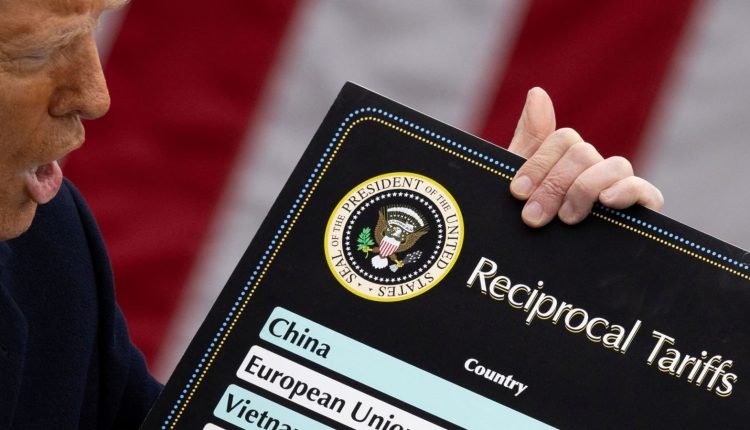
Trump tariff refunds: Corporate execs get the bonuses, consumers get screwed
Lawsuits have been filed against major retailers and manufacturers, including Walmart, Target, Nike, and Lululemon.
There is something particularly offensive about watching corporate executives collect bonuses made possible by a government mistake while ordinary Americans are left holding the bill. That is precisely what is happening as the federal government prepares to return billions of dollars to companies following the Supreme Court’s decision striking down President Donald Trump’s sweeping tariffs.
Remember those tariffs? Trump sold them to the American public as a way to protect American industries, punish foreign competitors, and bring manufacturing jobs back home. What he didn’t emphasize was that American consumers and businesses would end up paying a substantial share of the cost through higher prices.
Now comes the second act of this economic experiment, arguably even more revealing than the first.
According to an investigation by ProPublica reporters Robert Faturechi and Nick McMillan, at least nine publicly traded companies have disclosed plans to use some of their tariff refunds to fund bonuses for executives and employees rather than reimburse the customers who absorbed the higher prices.
Among the companies identified are Stanley Black & Decker, the manufacturer of household and professional tools; TJX, the parent company of TJ Maxx and Marshalls; and Acushnet, which owns the Titleist golf brand.
In other words, consumers paid more when the tariffs were imposed, but corporate executives may now be rewarded when the government returns the money. If that sounds like an extraordinary arrangement, it is.
Consider Stanley Black & Decker. When Trump’s tariffs increased the cost of imported goods, the company repeatedly raised prices, publicly explaining that the increases were necessary to offset the additional expenses. The company is now receiving at least $298 million in tariff refunds. Yet instead of committing to refund money to customers who paid those higher prices, it disclosed that part of the financial benefit was offset by costs associated with variable incentive compensation — corporate language for bonuses.
The company has not explained how much executives will receive, who qualifies for the payments, or whether consumers can expect any reimbursement.
The situation is not unique. TJX, the company behind TJ Maxx and Marshalls, reported receiving $331 million in tariff refunds. It also accrued $112 million in additional expenses for year-end incentive compensation and discretionary bonuses for eligible employees worldwide. The company has declined to explain how much of that money might reach senior management or whether customers will benefit from lower prices. Its only assurance is that the remaining funds will support future growth.
Acushnet, the owner of Titleist, disclosed approximately $12 million in incentive compensation expenses related to its tariff refund.
Apparently, when the government makes a mistake, there is still an opportunity for somebody in the corporate world to celebrate.
The underlying problem is not complicated. The companies importing the merchandise are legally entitled to apply for the refunds. But the people who ultimately paid for the tariffs were often not the importers. They were the consumers who paid inflated prices.
The distinction is crucial. The New York Federal Reserve estimated that American customers absorbed approximately 26% of tariff costs. A Harvard Business School study placed the figure considerably higher, at 43%. Another study estimated that Trump’s tariffs cost the typical American household approximately $1,000 last year.
Yet the federal refund system allows only the direct importers, known as importers of record, to apply for the money. The families who paid higher prices at the checkout counter have no comparable mechanism to recover their losses. And the potential refunds are enormous. The government is facing the task of returning approximately $170 billion in duties collected on more than 53 million imported shipments.
There are no meaningful restrictions requiring companies to share those refunds with the consumers who helped finance the original tariff payments.
That has prompted Democratic senators Elizabeth Warren, Cory Booker and Peter Welch to demand that the administration establish a system requiring companies to pass some of the money back to consumers and small businesses.
Their argument is hard to dismiss: allowing corporations to retain money collected indirectly from customers while also receiving government refunds amounts to a giveaway to some of the largest companies in the country.
Even Treasury Secretary Scott Bessent has acknowledged the problem. In February, discussing whether Americans would actually see any of the refunded money, he offered a rather revealing assessment: “I got a feeling the American people won’t see it.”
That is quite an admission from a member of the administration responsible for defending the policy. To be fair, not every company is treating the refunds as an opportunity to increase executive compensation.
Burlington Stores, for example, received approximately $55 million in tariff refunds. Its CEO, Michael O’Sullivan, announced that the company would use the money to offer better prices to shoppers rather than record a one-time earnings increase. A company spokesperson confirmed to ProPublica that none of the refund would go toward bonuses.
That demonstrates that companies do have choices. Shipping companies UPS and FedEx have also established online systems to reimburse customers for tariffs paid on shipments. In their case, they can identify the charges because they often itemize the tariff costs when providing shipping services.
Meanwhile, consumers are increasingly turning to the courts. Lawsuits have been filed against major retailers and manufacturers, including Walmart, Target, Nike, and Lululemon, seeking to force them to share their tariff refunds with customers.
Stanley Black & Decker is among the companies facing legal action. One lawsuit argues that the company could effectively recover the same tariff payments twice: first through higher prices charged to consumers and again through refunds from the federal government.
Whether those lawsuits succeed remains uncertain. But the questions they raise deserve public attention. There is also a larger issue here that goes beyond corporate accounting and executive compensation.
Companies routinely tell consumers that prices must rise because of higher costs. When those costs increase, customers are expected to accept the explanation and pay more. But when those costs subsequently disappear, there is no comparable urgency to lower prices or return the money.
The argument that executives deserve bonuses because tariffs previously hurt company earnings does not entirely hold up either. As accounting professor Nick Guest of Cornell University told ProPublica, executives might reasonably argue that they should be compensated for financial damage caused by circumstances beyond their control. But customers suffered those same circumstances, he pointed out. Why should they be excluded from the benefits of the recovery?
That is the question corporate America has yet to answer convincingly.
The problem is not simply that companies are exploiting a legal loophole. It is that a system designed without adequate safeguards allows the financial consequences of government decisions to fall disproportionately on ordinary people, while the benefits of correcting those decisions flow to corporations.
Trump’s tariffs were ultimately struck down because the Supreme Court determined that he had exceeded his authority by imposing them without congressional approval. But a court ruling does not automatically reverse the economic damage already done to millions of American households. And it certainly does not guarantee that the money collected will find its way back to the people who paid it.
The ProPublica investigation exposes an uncomfortable reality: when government policy goes wrong, ordinary Americans are frequently expected to absorb the consequences. When the government finally corrects its mistake, corporations may be first in line to collect the benefits.
It is difficult to call that economic fairness. It looks much more like corporate welfare, financed by consumers who were never given a choice.
