
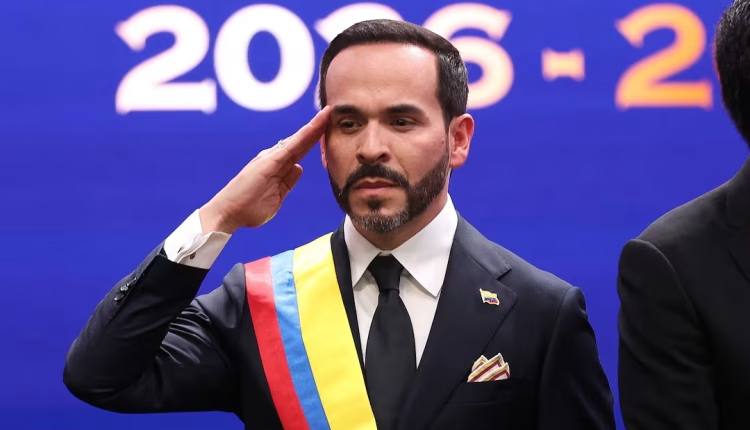
 President Abelardo de la Espriella
Colombians defy decree ‘criminalizing protest’ in rallies against government
Protesters voiced opposition to funding cuts affecting public institutions, including the National Learning Service.
Colombians took to the streets Wednesday to protest the right-wing government of President Abelardo de la Espriella, denouncing austerity measures, renewed ties with Israel amid its genocidal assault on Gaza, and policies protesters fear will roll back hard-won social and worker rights.
The nationwide mobilizations—which are backed by trade unions, Indigenousorganizations, students, and political opposition groups—came one day after de la Espriella signed a controversial decree expanding police power to violently quash demonstrations.
Leftist former President Gustavo Petro joined demonstrators in Bogotá, where protesters carried Colombian and Palestinian flags and condemned the government’s rapprochement with the United States and Israel.
In a message addressed to Interior Minister Rodrigo Lara, Petro said: “A decree without prior public notice is not valid. Mr. Lara, stop wasting time and study law again.”
De la Espriella’s foreign policy has marked a sharp break with Petro’s government, which severed diplomatic relations with Israel in 2024 over its assault on Gaza and suspended Israeli arms imports. De la Espriella has restored relations, reopened trade ties, and moved to recognize Israeli sovereignty over the illegally occupied Syrian Golan Heights. On Wednesday, Colombia also opened an embassy in Jerusalem, a deeply controversial move given the city’s disputed status, with Palestinians also claiming it as their capital.
The de la Espriella administration’s economic policies have also fueled the new demonstrations. Protesters voiced opposition to funding cuts affecting public institutions, including the National Learning Service, the agency responsible for reintegrating former combatants, and electricity subsidies—particularly in the Caribbean region. Labor organizations and student groups are also demanding protections for workers, public education, and university autonomy.
In stark contrast, under Petro—Colombia’s first left-wing president—the government expanded access to public universities, increased the minimum wage, and improved labor protections.
The protests are taking place amid growing alarm over de la Espriella’s Decree 1525, signed Tuesday, which revises police protocols for responding to demonstrations.
Ana Erazo, a Colombian lawmaker from the leftist Historical Pact party, slammed the decree for “criminalizing protest.”
The president’s order establishes a five-stage protest intervention framework, which starts with “preventive engagement” and dialogue and escalates toward use of force. However, it specifies that, under certain circumstances involving violence, officers can skip the dialogue phase before responding with force.
While insisting that the right to peaceful protest is guaranteed by Colombia’s Constitution, de la Espriella said Tuesday: “Never again a permanent blockade of a highway. Never again an urban bus lane turned into a trench. Attacking a person, throwing objects to injure someone, detaining someone, or using a child in a protest is not protest; it is a crime and will be treated as such.”
In the streets of Colombia’s cities, demonstrators decried what they described as an erosion of rights under de la Espriella.
“I feel like we have no guarantees,” teacher Ester Guerra told Agence France-Presse in the capital Bogotá, “and that the little we did obtain… we’re about to lose.”
Jimena Rodriguez, a 20-year-old student protester, said she believes that de la Espriella “just wants to hand the country over to the United States, to Israel.”
“I feel dark times are coming,” she added.
