
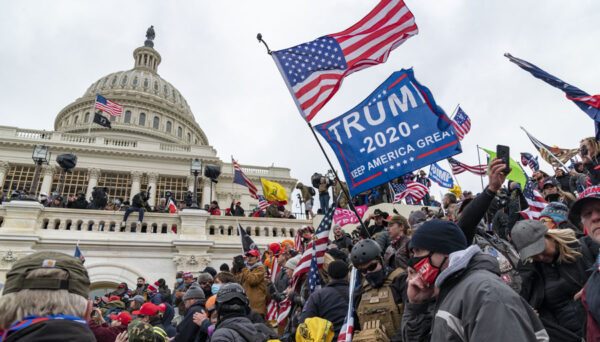
Who’s more violent: The political right or the political left?
Comparative academic research indicates that far-right actors have been more commonly responsible for lethal attacks in the U.S. than far-left actors.
When scholars, law enforcement agencies, and non-profit trackers analyze politically motivated violence in the United States, a clear pattern emerges in recent decades: actors on the far-right have been responsible for a larger share of lethal attacks, plotted violence, and organized extremist groups than the far-left. This finding is consistent across multiple datasets and government and independent reports.
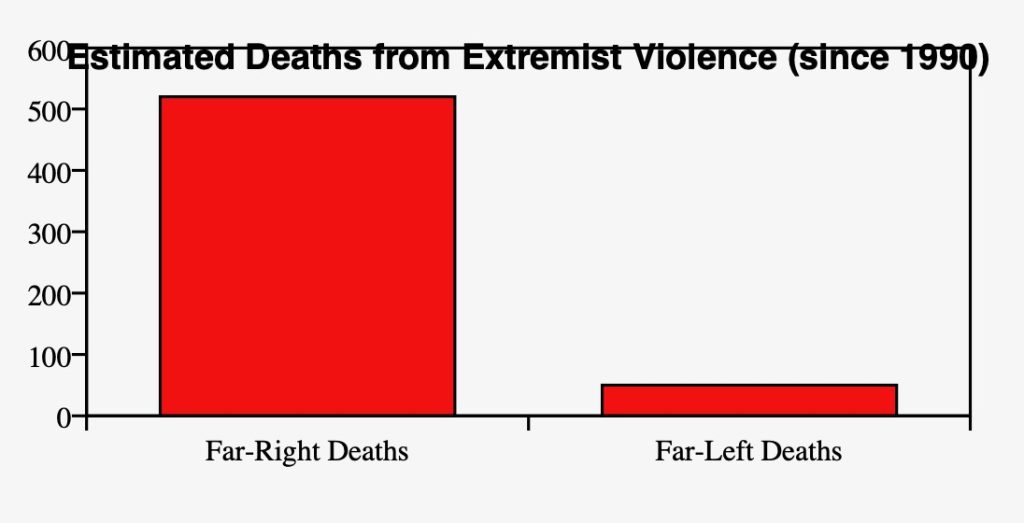
Here’s a summary of the data: a recent synthesis of National Institute of Justice (NIJ) research reports indicates that, since around 1990, far-right extremists have been responsible for significantly more ideologically motivated homicides than far-left or radical Islamist extremists. The NIJ authors cite approximately 227 deadly far-right incidents that resulted in over 520 deaths, compared to far-left extremists’ much lower number of lethal events and fatalities. This NIJ synthesis, based on reviews of decades of studies, has been widely used by analysts to illustrate the asymmetric lethality of far-right attacks.
Independent civil-society trackers and academic data confirm that pattern. The Southern Poverty Law Center (SPLC), which catalogs hate and antigovernment groups, counted roughly 1,371 hate and antigovernment extremist groups in the U.S. in 2024 — most being organizations or networks linked to white-supremacist, nativist, or antigovernment (often right-wing) ideologies. The SPLC warns these organizations form an infrastructure that can lead to violent action.
Academic and conflict-monitoring projects have also documented the upward trend in right-wing violence and lethal options. The Armed Conflict Location & Event Data Project (ACLED) pilot for the U.S. cataloged thousands of political-violence and protest events and highlighted a growing role for right-wing militias, recruitment, and training activities that increase the risk of violent incidents around elections and polarized political moments. ACLED’s analysis has shown peaks of right-wing militia activity correlated with election cycles and political mobilization.
Federal agencies have acknowledged the change. The Government Accountability Office (GAO) and congressional reports highlight that domestic terrorism investigations and interest from federal law enforcement surged significantly in the 2010s and early 2020s, with the GAO documenting a multi-hundred percent increase in domestic terrorism-related investigations over a ten-year period — a sign of growing concern about homegrown violent extremism. Recent FBI public statements and threat assessments identify racially or ethnically motivated violent extremists (categories overlapping with many far-right groups) and anti-government violent extremists as the main domestic threats.
Comparative academic research indicates that far-right actors have been more commonly responsible for lethal attacks in the U.S. than far-left actors. Researchers analyzing global terrorism and domestic databases consistently find that, in the U.S. context, right-wing extremist incidents (including white supremacist and antigovernment violence) account for a larger share of fatalities and plots compared to left-wing extremist incidents. However, the exact numbers vary depending on the methodology and the period examined.
What this means for policy and public discussion: the majority of evidence over recent decades indicates a larger and more deadly threat from far-right violent extremism in the United States than from far-left groups. That does not mean left-wing political violence is nonexistent — there are documented incidents and dangerous actors — but policy, prevention, and enforcement efforts have increasingly concentrated on racially motivated and antigovernment violent extremists because of their frequency, organization, and lethality. Experts stress prevention (community intervention, counter-radicalization, and targeted law enforcement) alongside protecting civil liberties.
Bottom line: Based on data from multiple reputable government, academic, and NGO sources, the majority of recorded lethal attacks, plotted extremist violence, and the organizational footprint of violent groups in the U.S. indicate that the far-right poses the most significant violent political threat in recent decades.
