
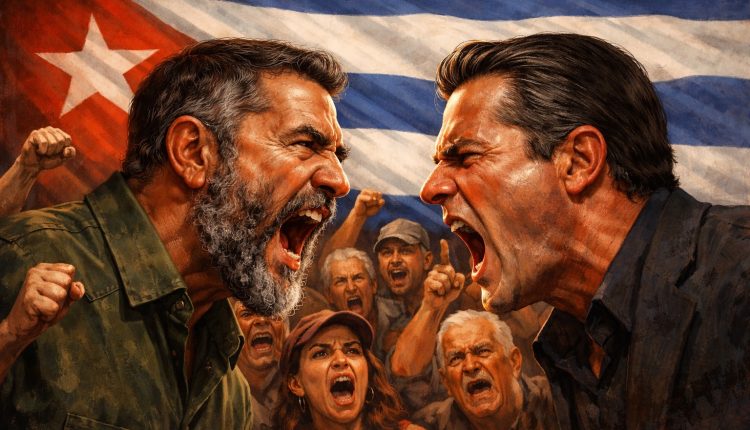
When dialogue was a crime
The very idea once treated as treason is quietly returning to the center of U.S.–Cuba policy.
For decades in Miami’s Cuban exile community, one word carried the weight of betrayal: dialogue.
To suggest that the United States should talk to the Cuban government was not merely controversial. It could be socially ruinous, politically toxic, and at times physically dangerous. Those who dared advocate engagement were branded dialogueros — collaborators with the enemy.
Now, in an irony that deserves careful reflection, the very idea once treated as treason is quietly returning to the center of U.S.–Cuba policy. Reports that the Trump administration has opened negotiations with the Cuban government have produced surprisingly muted outrage in parts of Miami’s exile establishment.
The silence is revealing.
For much of the Cold War and well into the post–Soviet era, the political culture of Cuban Miami defined itself around an uncompromising principle: no recognition, no negotiation, no dialogue with the Cuban government. The premise was simple. Talking to Havana would legitimize the revolution led by Fidel Castro and prolong its survival.
That doctrine became almost sacred in exile politics.
Yet history tells a more complicated — and darker — story about what that absolutism produced. In the late 1970s, when exile figures and community leaders explored conversations with Havana about family reunification and prisoner releases, they were vilified and threatened. Some paid an even higher price.

The killing of Carlos Muñiz Varela in 1979 remains one of the most chilling reminders of that era. Muñiz, a young activist involved in promoting dialogue and travel between the island and the exile community, was gunned down in Puerto Rico. To this day, the case remains unresolved, even though the authorities are aware of who was involved in the murder.
And Muñiz Varela was not alone. Bombings, intimidation, and blacklists were used against those who dared question the hardline orthodoxy. Businesses were boycotted. Community leaders were ostracized. Dialogue was portrayed not as diplomacy, but as betrayal.
The political climate in Miami was shaped by this rigid code for decades.
That is why the current moment feels so striking.
If Washington today is indeed exploring talks with Havana — as acknowledged by Cuban President Miguel Díaz-Canel — the reaction from many of the same circles that once condemned engagement has been far more cautious than outraged. The word that once triggered fury now circulates quietly in policy discussions.
What changed?
The Cuban government has not fundamentally changed its system. The Communist Party still governs the island.
What has changed is political convenience.
When dialogue came from moderates, academics, or reform-minded exiles, it was treated as surrender. When it emerges from a conservative administration in Washington, it suddenly becomes strategic realism.
This contradiction exposes an uncomfortable truth about exile politics: for many years, the taboo around dialogue was never purely about principle. It was also about power — who had the authority to define the community’s position and who did not.
The result was a climate that discouraged open debate and punished dissent.
To be clear, diplomacy with Havana is not inherently virtuous or misguided. Governments talk to adversaries all the time. The United States negotiated with the Soviet Union during the Cold War. Engagement can serve practical purposes: migration agreements, security cooperation, humanitarian concerns, or even gradual political change.
But if dialogue is acceptable today, then honesty requires acknowledging something else as well: it should never have been treated as a crime yesterday.
The exile leaders, activists, and intellectuals who argued decades ago that communication was necessary were not traitors. In many cases, they were simply right and ahead of their time.
Some paid for that stance with their reputations. A few, tragically, paid with their lives.
If dialogue is now acceptable when conducted by Washington, then the exile community owes a long-overdue apology to the people who were previously condemned for advocating it.
History has a way of exposing hypocrisy.
And sometimes the most revealing question is the simplest one:
If dialogue is legitimate now, why was it once treated as betrayal?
