
Washington’s contradictory Cuba strategy
Washington appears to be simultaneously strangling the Cuban economy while courting the insiders who control it.
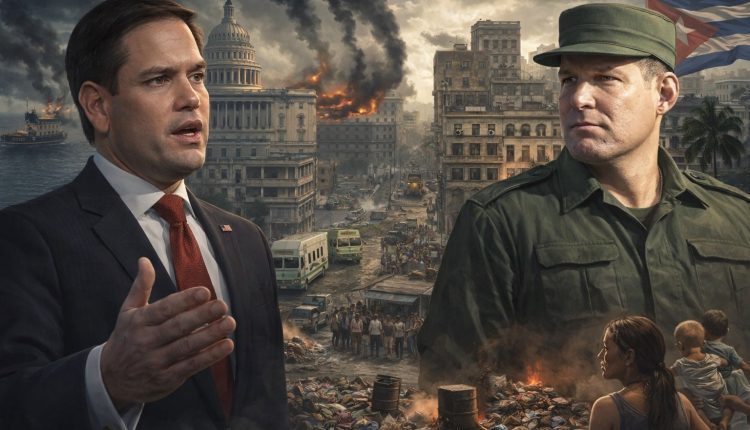
In diplomacy, who you choose to talk to often matters as much as what you say. Recent reporting by the Miami Herald and comments by U.S. Secretary of State Marco Rubio suggest that Washington may be attempting something unusual — pressuring Cuba to the breaking point while quietly exploring back-channel contacts with the very power structure it publicly condemns.
According to the Herald, Rubio has been holding discussions with Col. Raúl Guillermo Rodríguez Castro, grandson of Raúl Castro and a key figure inside Cuba’s opaque military-business nexus. Rodríguez Castro reportedly oversees GAESA’s economic interests, the armed forces conglomerate that dominates tourism, retail, finance, and foreign exchange on the island. In other words, and according to the Miami Herald, Washington is speaking not to Cuba’s formal government but to the family network widely believed to hold ultimate authority.
If true, this alone reveals a fundamental truth long denied in public discourse: real power in Cuba does not necessarily flow through the office of President Miguel Díaz-Canel. It flows through the military, the Communist Party hierarchy, and above all the Castro family. If the United States is now engaging a Castro grandson as an interlocutor, it tacitly acknowledges that reality.
At the same time, the Trump administration has intensified pressure on Havana by choking off external lifelines, particularly oil shipments once supplied by Venezuela. The reported capture of Venezuelan leader Nicolás Maduro by U.S. forces, and speculation about a Cuban equivalent to Venezuelan figure Delcy Rodríguez, underscores how deeply the administration views regional politics through a regime-change lens.
Yet this strategy produces a glaring contradiction: Washington appears to be simultaneously strangling the Cuban economy while courting the insiders who control it.
Pressure Without a Plan
In a Bloomberg News interview with editor-in-chief John Micklethwait, Rubio argued that Cuba’s core problem is not U.S. sanctions but a failed economic model. He described the island as having “no real economy” and surviving historically on subsidies — first from the Soviet Union, then from Venezuelan oil under Hugo Chávez.
There is truth in that assessment. Cuba’s centralized system has struggled to generate productivity, investment, or sufficient exports. Chronic shortages, crumbling infrastructure, and mass emigration attest to deep structural dysfunction.
But Rubio’s framing omits an equally important reality: external pressure magnifies internal weaknesses. Cutting fuel supplies to an energy-dependent island doesn’t merely expose economic inefficiency — it paralyzes transportation, food distribution, hospitals, and electricity generation. The Herald describes conditions that verge on societal collapse: days-long blackouts, suspended surgeries, garbage piling up in the streets, canceled flights, shuttered hotels, and looming unemployment.
These are not abstract policy outcomes. They are humanitarian consequences.
Rubio insists the United States is offering humanitarian aid through the Catholic Church, a channel meant to bypass the Cuban state. While commendable, such assistance cannot substitute for an economy. Food parcels and medicine shipments may temporarily alleviate suffering, but they do nothing to rebuild power plants or restart industry.
Talking to Power
The decision to engage Rodríguez Castro is particularly revealing because he represents continuity rather than reform. As part of the GAESA network, he is tied to the very system Washington criticizes — a military-controlled economy that channels profits into state coffers while ordinary Cubans struggle to survive.
If the goal were democratic transformation, one might expect outreach to civil society, independent entrepreneurs, or opposition figures. Instead, the outreach is to the gatekeepers of the status quo.
Why? Because U.S. policymakers likely recognize that no meaningful change in Cuba can occur without the consent of those who control the security apparatus and the economy. Negotiating with the Cuban president alone would be symbolic; negotiating with the Castro inner circle could be decisive.
But that also means any deal would almost certainly preserve the core power structure, trading economic concessions for the government’s survival.
Domestic Politics in Miami
Pressure on Havana is also driven by U.S. domestic politics, particularly in South Florida. Cuban-American hardliners have long advocated a “maximum pressure” approach, including cutting travel, remittances, and trade.
Such demands resonate politically but risk closing off diplomatic off-ramps. History suggests that regimes under existential threat tend to harden, not liberalize.
Allies Urge Negotiation — Not Collapse
Meanwhile, Cuba’s traditional partners appear unwilling to rescue the island economically. Foreign Minister Bruno Rodríguez has been touring friendly capitals, including Moscow, seeking support. Russian Foreign Minister Sergey Lavrov publicly urged negotiations with Washington rather than escalation.
This reflects a broader international consensus: stability is preferable to collapse. A failed state 90 miles from Florida would trigger mass migration, regional instability, and humanitarian crises far more costly than any current policy dispute.
The Human Dimension
Lost in geopolitical maneuvering is the Cuban population itself. Ordinary citizens did not design the island’s economic system, nor do they control foreign policy decisions. Yet they bear the brunt of shortages, inflation, and deteriorating living conditions. For the majority, options are stark: endure hardship or emigrate.
Toward a Realistic Policy
The current moment presents both danger and opportunity. Cuba is weaker economically than at any time since the collapse of the Soviet Union. That vulnerability could push leaders toward pragmatic reforms — or toward repression and insularity.
A sustainable U.S. strategy would recognize three realities:
- Economic collapse does not automatically produce democracy. It can produce chaos, authoritarian retrenchment, or mass migration.
- Engagement with power brokers is unavoidable. Any transition will involve those who control the military and economy.
- Humanitarian considerations must be central. Policies perceived as collective punishment undermine moral authority and international support.
Back-channel discussions with Rodríguez Castro suggest Washington understands the first two points. Whether it embraces the third remains unclear.
The Stakes Ahead
U.S.–Cuba relations have oscillated for six decades between hostility and cautious engagement. The Obama-era opening showed that normalization is possible; subsequent reversals demonstrated how fragile it is.
Today’s approach — squeeze hard while whispering privately — may yield concessions, but it also risks miscalculation. If pressure tips the island into uncontrolled collapse, the consequences will not remain confined to Cuba.
Ultimately, diplomacy is not about punishing adversaries; it is about shaping outcomes. If Washington truly seeks a freer, more prosperous Cuba, it must decide whether its objective is reform, regime change, or simply leverage.
Talking to the gatekeepers suggests one answer. Crushing the population suggests another.
History will judge which direction is taken.
