
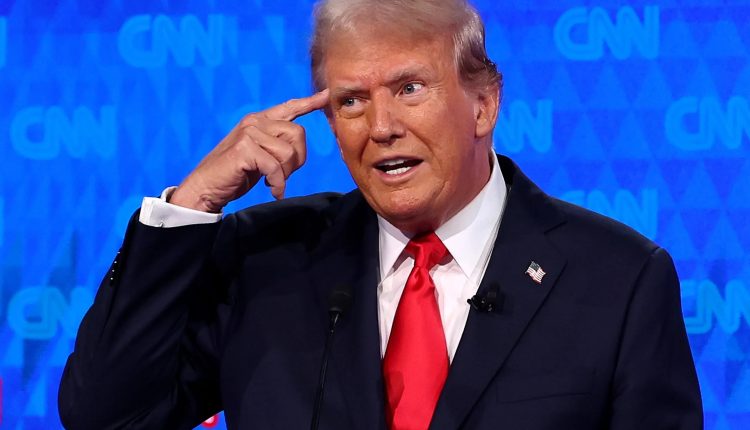
Trump’s mental sharpness being questioned
Trump is 79 years old. His public statements increasingly suggest confusion, disorientation, and a tenuous relationship with reality.
For years, Donald Trump has projected an image of supreme confidence—boasting about his intelligence, touting his memory, and mocking political opponents as feeble-minded or senile. But as his public appearances grow more erratic and disjointed, we should stop pretending this behavior is just “Trump being Trump.” The truth is more troubling: there are serious and growing questions about the president’s mental acuity, and we ignore them at our peril.
Earlier this summer, Trump met with European Commission President Ursula von der Leyen. In the middle of a conversation on immigration, he suddenly veered into a bizarre rant about wind turbines. Without prompting, he declared that the United States “will not allow a windmill to be built,” claiming they “kill birds” and drive whales “loco.” These statements were not only unsubstantiated—they were completely disconnected from the topic at hand.
This wasn’t a one-off. At a recent cabinet meeting, Trump spent 15 minutes talking about interior decorating. He claimed the U.S. had just donated $60 million to Gaza—a figure no official source could verify—then insisted no other country had contributed anything, even though both the United Kingdom and European Union have committed tens of millions in aid. When asked about campaign promises, he launched into a tangent about water pressure in household faucets and his hair care routine.
These moments would be puzzling from anyone. But from the president of the United States, they’re alarming.
To be clear, Trump has always had a freewheeling, improvisational speaking style. What’s changed is the growing incoherence, the fabricated anecdotes, the factual confusion. Consider his story last month claiming that his late uncle, a former MIT professor, had once taught the Unabomber. Not only did Ted Kaczynski never attend MIT—Trump’s uncle died a full decade before Kaczynski was even identified. The story is provably false, yet Trump told it with warmth and confidence, as if recalling a fond memory.
Mental health professionals have a term for this: confabulation—when someone blends real events with imagined ones. “This level of thinking really has been deteriorating,” said Dr. Harry Segal, a psychologist at Cornell.
Yet despite all this, the media and political class have largely tiptoed around the subject. Contrast that with the scrutiny directed at Joe Biden, who after a single poor debate performance in June 2024 was all but pushed out of the race. There was no hesitation in questioning Biden’s mental sharpness, often with a tone of derision. Trump, on the other hand, has been allowed to wave away legitimate concerns with his usual bluster about being a “stable genius.”
This double standard is indefensible. If we believe that cognitive clarity is a basic qualification for the presidency—as we should—then it must apply to everyone. The stakes are simply too high to pretend that Trump’s conduct is just harmless eccentricity or colorful rhetoric.
In a healthy democracy, we should be able to ask hard questions about our leaders’ fitness for office—especially when those leaders seek to hold the most powerful position in the country. This isn’t about partisanship. It’s about honesty, transparency, and responsibility.
Trump is 79 years old. His public statements increasingly suggest confusion, disorientation, and a tenuous relationship with reality. At times, it seems less like political theater and more like cognitive unraveling in real time.
The American people deserve better than a media culture that treats these warning signs as punchlines or internet memes. We deserve a national conversation about leadership and capacity—one that includes all candidates, not just the ones it’s convenient to criticize.
The presidency demands more than bravado and memory-tested slogans. It requires coherence, command of facts, and the ability to lead with clarity. If Donald Trump cannot meet that standard, then it’s time we said so—plainly, and out loud.
