
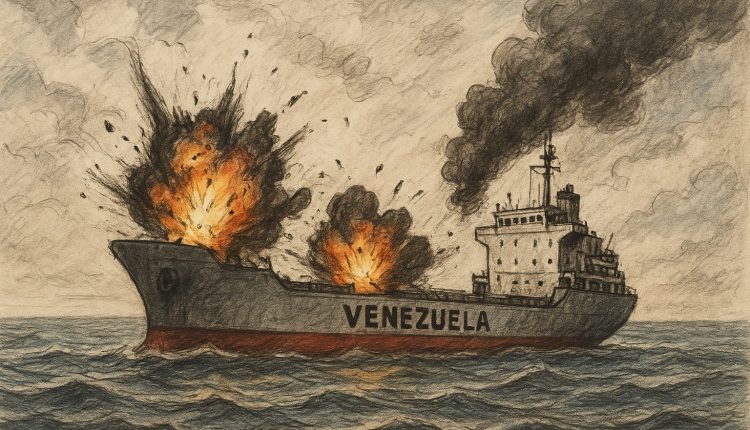
Trump’s Caribbean lawlessness
The recent maritime strikes that killed people off the Venezuelan coast have prompted grave questions about whether American policymakers are treating international law as optional.
There is a difference between boldness and lawlessness. What the Trump administration calls a campaign to choke cocaine flows and punish “narco-terrorists” in the Caribbean increasingly looks less like targeted law enforcement and more like a dangerous, unlawful escalation — one that international lawyers, UN experts, and human-rights organizations say may amount to extrajudicial killings, even murder. The recent maritime strikes that killed people aboard small vessels off the Venezuelan coast have not only inflamed a hemisphere already rattled by U.S. brinkmanship; they have prompted grave questions about whether American policymakers are treating international law as optional.
Start with the facts that matter. U.S. forces struck boats in the Caribbean and eastern Pacific this year, actions the administration defends as necessary to stop drugs and protect American lives. Those strikes have, according to reputable reporting, killed dozens of people and involved cases in which survivors were later struck or left to die — circumstances that human-rights groups and UN experts characterize as unlawful extrajudicial killings. Human Rights Watch, after fact-finding, concluded that some strikes “amount to extrajudicial killings” under international law. The U.N. human-rights office and special rapporteurs have likewise warned that a “war on narco-terrorists” cannot be used as a cover for summary executions.
Legal frameworks are not just academic formalities. The laws of armed conflict, the UN Charter, and human rights treaties all set clear restrictions on using lethal force: it must be necessary, proportional, and aimed at lawful military targets. Intentionally attacking people who are hors de combat (out of the fight) or pose no immediate threat — such as survivors clinging to wreckage — is clearly forbidden and can be considered a war crime. That’s why top international lawyers and human rights groups have called for independent investigations: the pattern of strikes, the reported failure to intervene and rescue, and the Pentagon’s own hesitations about orders and accountability all raise the possibility of criminal liability at the highest levels.
Nor are these legal concerns abstract when set against recent policy moves. By designating the so-called “Cartel de los Soles” as a foreign terrorist organization and publicly promising to leverage “new options,” the administration has expanded the rhetorical and legal space for kinetic responses short of declared war. The State Department’s terrorist designation and Pentagon statements about “new options” are being interpreted, not unreasonably, as a green light for more aggressive measures in and around Venezuelan waters. The danger is predictable: when political leaders blur the line between criminal suspects and terrorists, and when operational commanders are given wide discretion without transparent rules of engagement, the result can be an erosion of basic legal safeguards.
Worse still, accountability is evaporating at precisely the moment it is most needed. Reports that a senior defense official may have ordered follow-up strikes that hit survivors — allegations that prompted bipartisan alarm and calls for inquiry — ought to trigger immediate, independent investigation rather than partisan spin and executive obfuscation. If verified, such orders would not be merely policy errors but criminal acts. The precedent this sets is catastrophic: normalize impunity for unlawful killings, and you normalize the idea that American power can be wielded outside the law. That is a long-term strategic disaster; it corrodes America’s moral standing and fuels the very instability policymakers claim to be combating.
There is also a regional political cost. Latin American governments — including many traditionally wary of Caracas — are aghast at a U.S. willingness to carry out lethal strikes with limited transparency. The U.N. human rights office and independent experts have urged the United States to halt these operations and to respect international norms. This isn’t about being soft on crime; it is about ensuring that the rule of law governs even the toughest security challenges. Responding to transnational criminality demands cooperation, intelligence, and law-enforcement partnerships — not the spectacle of missiles against small boats that risk killing innocents and inflaming anti-American sentiment across the hemisphere.
The essential choice is clear. The administration can reframe its approach around lawful interdiction, multilateral cooperation, and robust independent oversight — or it can double down on a militarized posture that courts illegality and meritless acclaim. If the aim is to save lives, then sticking to the law is not a hindrance; it is the only realistic path to durable security. If the aim is regime change dressed up as counter-narcotics, then the United States risks exporting a violence that will return to haunt American streets and reputations alike.
Americans who care about security, justice, and the country’s standing in the world should demand two things now: transparent, independent investigations into the strikes, and a public articulation of clear legal rules that constrain the use of lethal force. Anything less is not toughness — it is lawlessness. And lawless power in the name of safety is the surest route to injustice.
