
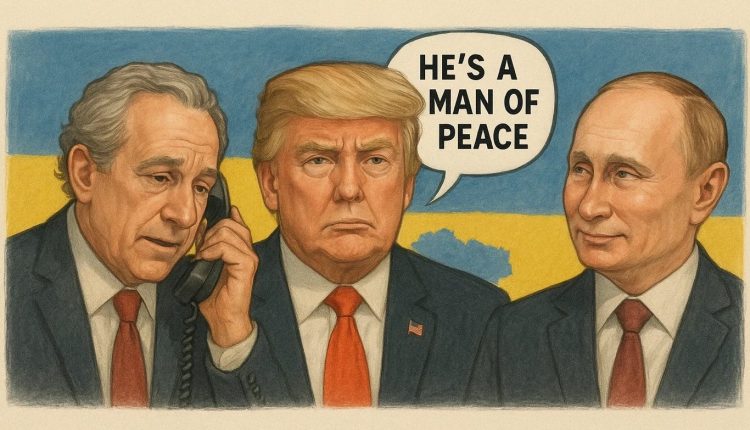
The Witkoff peace process, or, How to laugh along the back-channel
In this tragicomedy, Steve Witkoff plays the role of a coach on how Russia can get its way in the Ukraine war negotiations.
In a recent episode of the tragicomedy that is the Trump administration, Steve Witkoff plays the role of a coach on how Russia can get its way in the Ukraine war negotiations. His first lines: pitch to Trump in a conciliatory, praise-based tone. Specifically, recommend that Putin call Trump to congratulate him for the Gaza ceasefire and frame Russia as having supported that outcome. “Say Russia supported it … say you respect him as a man of peace.”
He also advises that instead of brusquely demanding territorial concessions, the Russians should emphasize optimism and peace (“talk more hopefully”) to make the deal more appetizing. According to Witkoff:
“Now, me to you, I know what it’s going to take to get a peace deal done: Donetsk and maybe a land swap somewhere,” he said. “But I’m saying instead of talking like that, let’s talk more hopefully because I think we’re going to get to a deal here.”
He proposes a “20-point Trump plan for peace” as a framework, essentially advising Moscow to stop being greedy and endorse a plan modeled on prior ceasefire diplomacy that reads like it was authored by Vladimir Putin anyway.
Witkoff also urges scheduling a direct call between Putin and Trump before the visit to Washington by Ukrainian President Volodymyr Zelenskyy, a smart tactical move to frame the narrative in Russia’s favor ahead of U.S.–Ukraine discussions.
Steve Witkoff, real-estate developer, amateur diplomat, and full-time sycophant, finally found his calling: advising a nuclear superpower on the finer points of flattery. Historians will argue for decades whether he was motivated by idealism, naïveté, or the unshakable conviction that world peace could be achieved through the power of a good sales pitch. They will agree, however, that none of it was to uphold the ideals of democracy or American interests.
“Yuri, baby,” you can imagine him saying into the phone with the confidence of someone who has never read a single page of the Constitution or the Geneva Conventions, “start with the Gaza ceasefire. Tell him he’s a man of peace. Lay it on thick. You know how he loves that.”
On the other end, Yuri Ushakov, career diplomat, seasoned negotiator, and survivor of at least seven internal Kremlin purges, would have taken notes with the pained patience of someone being instructed on how to operate a toaster by a toddler.
“And remember,” Witkoff went on, “talk hopefully. Not ‘give us Donetsk or else.’ More like, ‘I believe in a brighter future where you, Donald J. Trump, single-handedly end a European land war.’ Remind him this would be the ninth war he can claim to have ended, forever owning a Guinness Book of World records entry. You’ve got to feed the man’s ego.”
Ushakov, whose job normally involves parsing nuclear messaging and the movement of armored divisions, found himself drafting a script that resembles a Valentine’s Day card written by a hostage.
Meanwhile, in Washington, the official national-security apparatus was trying to figure out why the Russian Foreign Ministry had suddenly begun sending love letters like Kim Jong Un’s. Within hours, Moscow was preparing the most obsequious diplomatic memo in modern history, one so gushing that even Lavrov reportedly asked, “Are we still a country, or have we become a fan club?” “He is a man of peace, a visionary, a giver of hope,” read one communiqué. The analysts assumed it was a glitch. Or a hack. Or performance art.
But no. It was the Witkoff Strategy.
To make matters simpler, Witkoff recommended the infamous “20-Point Peace Plan,” a phrase that sounded both authoritative and vaguely nonexistent, like the dress code for a cult. The plan, he explained, would allow Trump to appear both tough and magnanimous, while Russia got to keep what it had already taken in addition to what it couldn’t take in four years after the invasion. True art, he believed, was creating the illusion of compromise while changing absolutely nothing except screwing the other side.
The timing was crucial. Witkoff urged the Kremlin to reach Trump before Zelenskyy arrived in Washington. “You’ve got to pre-sell the deal,” he said, slipping into the familiar argot of a condo developer. “If he talks to Zelenskyy first, you lose the emotional high ground. But if you get in early with praise and positive vibes—boom! Peace.”
Meanwhile, Trump—flattered, buoyant, and entirely unburdened by reality—told aides he was “very close” to ending the war, despite not having spoken to either combatant.
Thus was born the Witkoff Peace Process: geopolitics reimagined as motivational speaking, territorial disputes settled with real-estate optimism, and diplomacy performed by people who shouldn’t be allowed near a printer, let alone a peace process.
