
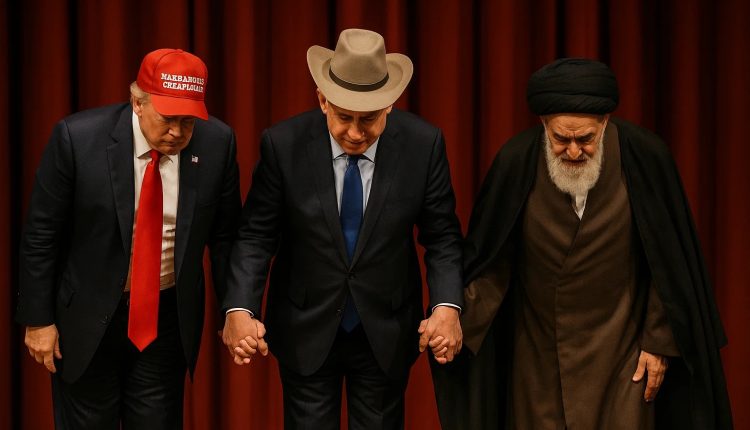
MAGA, MIGA, BIBI: Not a hat trick
In this article, the writer is channeling a worried hallucination of democracy.
There are few things more pitiful than a desperate magician repeating a failed trick. The crowd has seen the rabbit, the dove, the disappearing subpoena. They’ve clapped politely. Some have stormed the stage. And yet, here we are again—three men, three illusions, and one fraying top hat from which they hope to pull not rabbits, but regimes.
The first man is American and orange-hued, though it is not polite to mention it. He once sold steaks, casinos, and stakes in a democracy. Now, he sells slogans. His first was MAGA—Make America Great Again—a four-word incantation designed to conjure a mythic past that involved neither Reconstruction nor Roe v. Wade. MAGA not as a policy but a cologne, a pungent blend of leaded gasoline and frontier cosplay.
It has failed to stop him from being impeached twice, indicted more times than a Chicago alderman, and criminally charged to the tune of a symphonic 88. Still, he presses on, magician’s wand in one hand, golf club in the other, promising to make things great again by making someone else—now Iran—great, after bombing that country.
Hence, MIGA: Make Iran Great Again.
It is not clear if this is satire, prophecy, or just a typo. One suspects he saw the acronym in a dream and mistook the Ayatollah for a real estate developer with strong family values. There is no Persian Gulf strategy, no theological pivot—only a vague instinct that “greatness” can be franchised like an Arby’s, even to countries whose citizens chant “Death to America.” But never mind. Trump now believes he can bring Iran to heel—or to Trump Tower Tehran, where the elevators are always under Sharia-compliant renovation.
Meanwhile, Netanyahu treats war like seasonal allergies—inevitable, recurring, and best handled with a prepared statement and a photo op. As the Gaza conflict metastasizes and a northern front simmers, he insists it is “not political,” much like a man eating a lobster dinner during Lent might insist it is “not indulgent.” Every bomb dropped is a campaign ad. Every hostage negotiation, a brief polling bump. And in between, he lectures the world on morality, flanked by ministers who make Avigdor Lieberman look like a Unitarian.
Bibi, unlike Trump, is fluent in actual politics. He speaks in security briefings, not catchphrases. But his methods rhyme: surround yourself with loyalists, hollow out the judiciary, call your indictment a leftist coup, and if things get dicey, launch a war. It worked in Gaza. It may work in Lebanon again. And when all else fails, invoke the existential threat and call in the diaspora checkbooks.
Here, the hat trick begins to unravel. We have MAGA, MIGA, and BIBI. But these are not three hats; they are the same hat worn in different climates, adapted for different audiences. One has fringe. One has a brim. One is fireproof and partially funded by U.S. military aid. All three conceal not ideas, but the absence of them. They are political toupees—obvious, undignified, but curiously resilient.
The third man in this conjurer’s triangle is not always seen, but his silhouette looms large: the Supreme Leader of Iran, a figure who, in this unfolding farce, plays both foil and phantom. He is simultaneously the enemy of the West and the beneficiary of its theater. For every Trumpian blunder, there is an Iranian reaction. For every Israeli escalation, a defiant sermon from Qom. These three men need each other the way professional wrestlers need villains—without the other, they are merely strange men in spandex shouting into mirrors.
And so, we arrive at the punchline—or the prophecy. The world is not being governed; it is being entertained to death. The hat trick, we discover, is not the pulling of democracy from the jaws of despair, but the reverse: the slow, televised stuffing of democracy into a magician’s hat, while the audience claps, boos, or simply checks their phones.
What unites MAGA, MIGA, and BIBI is not ideology, but velocity—the pace at which spectacle replaces substance. Each leader lives in a permanent campaign, each campaign a perpetual crisis, each crisis a convenient reason to delay judgment, cancel elections, or bomb something just offscreen. If you squint, you can almost see the shared playbook: accuse the press, blame the deep state, hug a flag, fire a missile.
It’s not a hat trick. It’s a trick played on the hat, on the very idea of leadership. And the hat—threadbare, overused, and now slick with the sweat of three demagogues—is not magic anymore. It’s just a hat. An ugly one. Red, perhaps, or blue and white, or black with gold embroidery and a line of Qur’anic text that reads, if you tilt your head just right, “Made in Mar-a-Lago.”
In the end, it is inevitable that the three would meet—not in reality, of course, but in a neutral dreamscape constructed jointly by the Hungarian Ministry of Propaganda and a think tank that specializes in weaponizing nostalgia. The summit is held in Budapest, or possibly Baku, or somewhere else with chandeliers, no extradition treaty, and excellent foie gras.
They gather in a subterranean ballroom with no clocks and no exits. Trump arrives first, wearing a gold tie and a red hat with a new slogan: “MIGABIBIGA”—Make It Great Again, But In Bibi’s Image, God Assenting. He says it polled well among evangelicals. Netanyahu enters next, flanked by a security detail and a constitutional lawyer dressed as King David. The Ayatollah does not appear in person but sends a hologram of himself chanting revolutionary poetry from 1979, which Trump applauds, mistaking it for a Rolling Stones lyric.
The three sit around a polished marble table, behind name placards that read Martyr, Messiah, and CEO. They are handed invisible pens and a shared legal pad. Their task: draft a universal charter for leadership in the age of permanent exception.
Article I: All leaders are innocent until accused, and even then, only if the polls say so. Article II: Any war that boosts approval ratings shall be deemed defensive in nature, regardless of geography, law, or common sense. Article III: Hats shall not be removed under any circumstances.
But they cannot agree on the preamble. Trump wants it to start with “We, the winners …” Bibi insists on “In the name of eternal vigilance …” The holographic Ayatollah loops endlessly, reciting, “Death to the imperialists,” which everyone interprets as a general blessing.
Finally, the legal pad bursts into flames—not metaphorically, but literally, as it is printed in disappearing ink on combustible parchment. The summit concludes with a group selfie, which no one dares to post, and a joint statement declaring victory over reality itself.
Back home, the headlines read like riddles:
— “Trump Revives Iran to Save America.”
— “Netanyahu Declares Ceasefire, Immediately Breaks It.”
— “Khamenei Unavailable for Comment, Possibly Ascended.”
And still, the audience watches.
They watch the trials, the wars, the press conferences, the hats. They watch the illusions flicker and fade, then return, brighter than before, now in HD. And somewhere, far from the cameras, a child asks a question no leader is prepared to answer: “Was it ever real?”
The answer, of course, is yes. And then, tragically, no. And then, most terrifying of all: Only when it was useful.
