
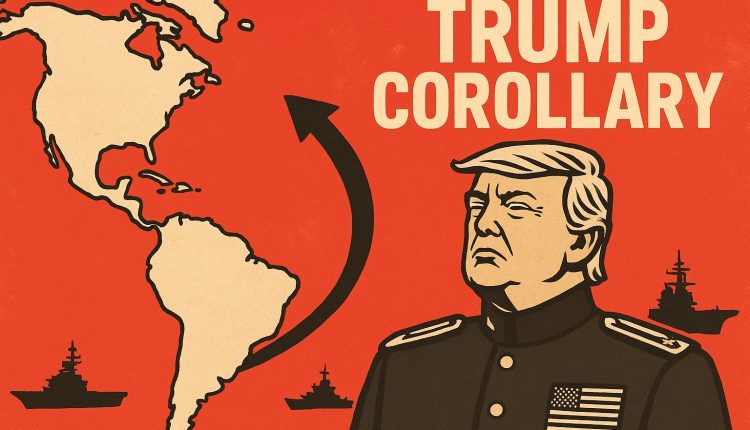
The Trump Corollary is not foreign policy — it’s imperialism in broad daylight
The U.S. seems convinced that Latin America’s destiny is to be Washington’s backyard.
Let’s stop pretending we don’t know what we’re looking at. The so-called “Trump Corollary” — Washington’s newly declared right to reshape Latin America by force, covert ops, or economic strangulation — isn’t a doctrine, a strategy, or a “regional priority.” It’s imperialism. Old-school, boots-on-the-neck imperialism, just wrapped in 2025 language and sold as “security.”
And the Biden, Obama, Bush, and Clinton people should spare us the outrage. The only thing Trump did was say the quiet part out loud.
A Doctrine Built on Arrogance
The Monroe Doctrine was born as a bluff by a weak, young America in 1823 — a symbolic line against European recolonization. But it quickly mutated into something uglier: a unilateral claim to the entire hemisphere. By 1904, Theodore Roosevelt dropped the mask altogether, declaring the U.S. the self-appointed “policeman” of Latin America.
“Policeman” is a polite word. What Washington actually became was an arsonist who kept returning to the scene with a can of gasoline.
Cuba. Nicaragua. Guatemala. Chile. Haiti. Panama. Honduras. The Dominican Republic. The list is so long it becomes numbing. Coups, invasions, blockades, stolen elections, IMF chokeholds, CIA “advice,” death squads dressed up as “security cooperation.” And for what?
Bananas. Copper. Sugar. Oil.
And the undying U.S. conviction that Latin America’s destiny is to be Washington’s backyard.
Enter the Trump Corollary: The Empire Says the Quiet Part Out Loud
Eric Ross, in a Tom Dispatch opinion piece, recently spelled it out: the U.S. is now asserting the right to intervene to stop any “non-hemispheric power” from gaining influence in Latin America. Translation: if a Latin American government dares to make deals with anyone other than Washington or U.S. corporations, the Marines might be on the next boat.
And we’re already seeing the consequences. A massive U.S. military buildup in the Caribbean. CIA operations green-lit inside Venezuela. Extrajudicial killings at sea. A naval base reopened in Puerto Rico so the Pentagon can “project power.” And, unbelievably, a president openly flirting with a ground invasion of Venezuela in 2025.
This isn’t policy. It’s a protection racket.
“Narco-State,” “Terrorism,” “Stability” — The Same Excuses, Every Time
You could make a Bingo card out of the justifications:
- “Narcoterrorism”
- “Democracy promotion”
- “Failed state”
- “Foreign influence”
- “Migration control”
It’s the same script used to justify the 1954 coup in Guatemala, the murder of Salvador Allende’s democracy in Chile in 1973, and the decades-long suffocation of Cuba under the Platt Amendment. Every time a Latin American nation tries to stand on its own feet — to nationalize oil, assert control over resources, or chart an independent foreign policy — suddenly Washington discovers a crisis.
The Trump Corollary is the latest excuse. Nothing more.
What Washington Really Fears
Let’s be honest: the U.S. does not fear instability in Latin America — it has caused more of it than any foreign power. What it fears is sovereignty.
- It fears a region choosing its own partners.
- It fears governments that don’t bend to U.S. corporate interests.
- It fears resource nationalism.
- It fears the simple idea that Latin America belongs to Latin Americans.
Venezuela’s true “crime” is not drugs, corruption, or even authoritarianism — Washington has happily supported far worse. Its crime is refusing to hand its oil, minerals, and strategic relationships back to Western companies.
The Corollary Is a Warning — And an Opportunity
Latin America has seen every version of this play. And it has survived every empire that believed itself eternal: Spain, Britain, France, and now the United States, which still imagines it can dictate the region’s future.
The Trump Corollary is a danger — but it is also a moment of clarity. No more illusions. No more diplomatic euphemisms. The façade of partnership has collapsed.
The Task Now
Those who care about Latin American sovereignty — in the region and in the U.S. — must call this doctrine what it is and oppose it without compromise. Not moderate it. Not soften it. Not “improve” it. Reject it.
Because a hemisphere built on coercion is not a hemisphere at peace. And a foreign policy that treats nations as vassals is not stability — it’s domination.
What Latin America needs is not another U.S. “Corollary.” It requires the United States to finally mind its own business.
