

The National Assembly of People’s Power meets amid tensions and pressures (Part One)
Forty-eight hours earlier, Minister Marta Elena Feitó Cabrera sparked controversy when she appeared before a parliamentary committee denying the existence of beggars in Cuba.
The fifth regular session of the National Assembly of People’s Power, in its tenth term, met last week at the Convention Center amid a climate of energy shortage, ongoing economic decline, rising poverty and homelessness, increasing internet communication costs, and renewed pressure from the Trump administration aimed at tightening the economic blockade against Cuba.
Minister of Labor Resigns After Strong Criticism
Just 48 hours earlier, the Minister of Labor and Social Security, Marta Elena Feitó Cabrera, sparked controversy when she appeared before a parliamentary committee, denying the existence of beggars in Cuba. “We have seen people who appear to be beggars. When you look at their hands, you look at the clothes these people are wearing. They are disguised as beggars; they are not beggars. There are no beggars in Cuba,” she said.
She even went further, attacking those who clean windshields and ask for money at traffic lights, as well as the so-called garbage collectors on the island, whom she described as “illegible self-employed individuals who are violating the Treasury.”
Her words triggered an immediate backlash both on and off the island, especially on social media, where criticism of the minister, the deputies who did not question her statements, and the Cuban government itself intensified.
The minister, who had held the position since 2019 and was a member of the PCC Central Committee, resigned after a flood of criticism on social media, including a public rebuke by President Miguel Díaz-Canel during the committee meeting itself. According to an official statement, the former minister “acknowledged her mistakes” during a government and party review of the incident, during which her resignation was accepted due to the “lack of objectivity and sensitivity” of her highly questioned statements.
“What Marta Elena Feitó Cabrera said was not only a personal outburst, but the stark expression of a bureaucratic logic that has long been disconnected from the people,” Tere Felipe wrote in her post. She recalled the article, “Begging is not compatible with the Cuban social project,” published in Granma last March. Its author, Isabel Acosta Sánchez, a Justice of the Supreme People’s Tribunal, noted: “Begging, which at first glance may seem like a tolerated activity, is a practice that can be classified as a different type of crime, depending on the purpose of the perpetrator.”
The newspaper Granma published 30 comments on the article, all negative, with phrases like “What a lack of empathy!” and “Criminalizing poverty and people living in poverty instead of offering alternatives to fight one and protect the other is a favorite tendency of the pro-capitalist right.” They questioned whether state institutions are doing everything necessary to ease the desperate economic situation currently faced by a large part of the population; they highlighted the extreme fragility of the Family Care System (SAF), the closure or neglect of many nursing homes; the fact that pensions and social assistance are insufficient to meet basic needs such as food and hygiene; and the alcoholism, drug addiction, and mental illness among many homeless people, along with the lack of medication and shelter for them.
The Economy in Decline
In his appearance before the Economic Commission first, and in his speech before the Assembly later, Economy Minister Joaquín Alonso painted a grim picture of a country in crisis, as Progreso Weekly reported in an article this week.
Cuba’s economic spiral deepens: 5 years of decline and no relief in sight
According to official Cuban media, the island’s economy shrank by 1.1% in 2023, deepening the nearly 10% decline it has faced since 2019. For a country already dealing with shortages and worsening infrastructure, the announcement confirmed what most Cubans experience daily: the crisis not only persists but is getting worse,” the Minister reported. Last year, agriculture fell by 17.9% and manufacturing by 3%.
And there is no recovery in sight. So far this year, Alonso stated, Cuba’s foreign currency earnings are already 9% lower than in the same period in 2023, while imports have increased by 7%, a worrying imbalance that exacerbates the country’s growing debt. Alonso Vázquez reported that, at the end of the first half of the year, foreign currency earnings from exports and the planned export of goods decreased compared to 2024, as did visitor arrivals, tourism revenues, and imports of goods and services.
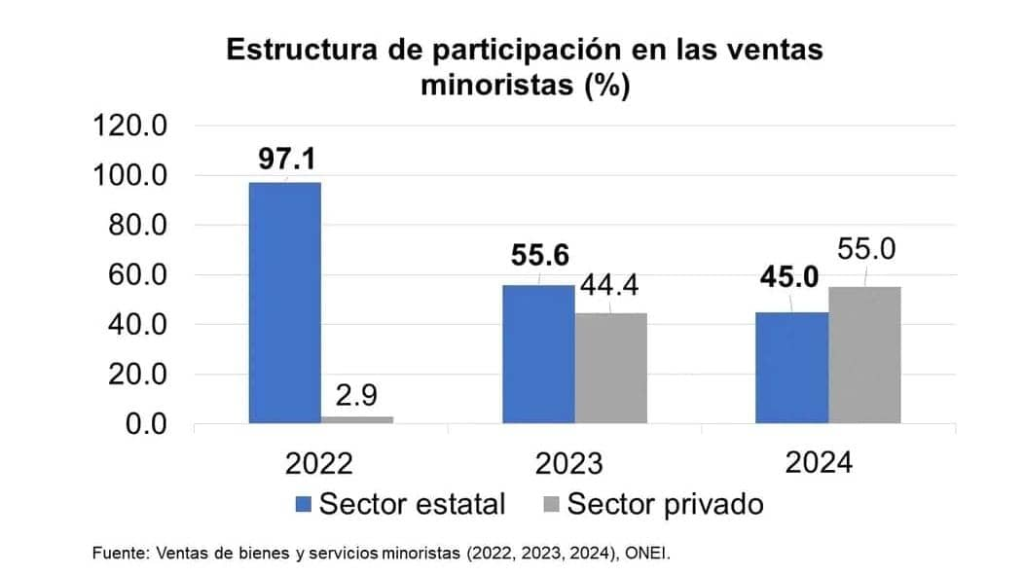
However, during the first half of the year, private sector imports exceeded $1 billion, a 34% increase from the same period in 2024. Even in 2024, this sector surpassed the state sector in retail sales for the first time.
 In this complex situation, the minister said, “work is ongoing continuously on the study, design, implementation, and execution of a set of transformations that are part of the government program to correct distortions and boost the economy by 2025.”
The main goals of the 2025 Economic Plan, outlined in the government program, have concentrated on continuing macroeconomic stabilization, increasing the country’s external revenue, boosting domestic production—especially in food—and securing resources for defense and internal security.
Furthermore, the goal is to gradually restore the national electricity system (SEN) by modifying the energy matrix; address social policy priorities, paying special attention to individuals, families, households, and communities in vulnerable situations; and prioritize and promptly incorporate the contributions of science, technology, and innovation into economic recovery.
