
The cost of invading Cuba: A ‘War of the Entire People’
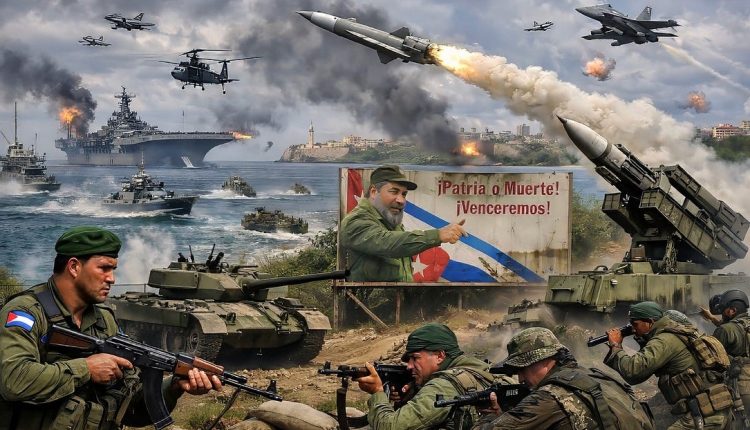
The idea of “War of the Entire People” is straightforward and audacious. If the island is invaded, the war does not end with the defeat of conventional forces. It begins there.
The U.S. military is not rehearsing for an invasion of Cuba or actively preparing to militarily take over the island, Francis Donovan, head of the U.S. Southern Command, told lawmakers recently. Meanwhile, Cuba’s Deputy Foreign Minister Carlos Fernández de Cossio responded to Trump’s threats to “take Cuba in some form,” insisting that it had “been ready historically to mobilize as a nation [to face] military aggression.” “We don’t believe it is something that is probable, but we would be naive if we do not prepare,” de Cossio told NBC’s Meet the Press.
The recent history of the United States attacking Iran unexpectedly not once, but twice, in June 2025 and February 2026 while negotiations were ongoing reinforces De Cossio’s wisdom.
Cuba, in fact, has spent more than half a century strategically oriented toward a confrontation with the United States. From the outset, Cuban planners have worked under no illusions. They know they cannot win a conventional war. The goal, then, has not been victory in the traditional sense. It has been survival—and, more importantly, how to make the cost of attacking Cuba so high that the attack never comes, or, if it does, becomes a prolonged and politically untenable undertaking for the United States. De Cossio’s declaration alludes to a concept developed after the Bay of Pigs invasion and refined over decades: the “War of the Entire People.”
This perspective shapes everything. It is a doctrine built on asymmetry and exhaustion.
Contrary to what one might imagine, the backbone of Cuba’s defensive posture is not its navy or air force. Neither would be effective. The air force, equipped largely with aging airplanes—MiG-21s, MiG-23s, and a handful of MiG-29s—would be outclassed almost immediately in any direct engagement with modern American aircraft. Cuban planners understand their limitations, and it is unlikely they would commit those assets early, if at all. Preserving them, dispersing them, or simply avoiding their destruction may be more valuable.
The navy also has mostly aging Soviet-era vessels (e.g., Osa- and Komar-class missile boats), patrol craft, and small support ships. Chronic resource limitations have reduced readiness and operational capacity. The fleet cannot contest open sea lanes or survive prolonged engagement with a modern navy. But small, fast attack craft can operate in coastal waters, exploiting geography to cause disruption with hit-and-run missile or torpedo attacks, mine deployment in approach routes, harassment of amphibious forces, and integration with shore defenses.
Cuba historically has invested more heavily in air defense. During the Cold War, it assembled one of the most robust air defense networks in the Western Hemisphere. Much of that system is now dated—surface-to-air missiles designed decades ago—but “obsolete” is a misleading term in this context. These systems may not reliably counter stealth aircraft, but they can still threaten helicopters, drones, transport planes, and even non-stealth fighters under certain conditions. More importantly, they complicate planning. They would force an attacker to slow down, to allocate resources, to take risks that make it more vulnerable.
On the ground, the picture is similar: large inventories of older Soviet equipment—tanks, armored vehicles, artillery. In open terrain against modern American forces, they would fare poorly. But Cuba is not open desert. It is a mix of cities, dense vegetation, and uneven terrain. In those environments, technological superiority diminishes. Defensive warfare, especially when combined with local knowledge and prepared positions, can still be effective even with aging equipment. Recent conflicts, including the war in Ukraine, have shown that older systems remain dangerous when used intelligently and in the right context.
Cuba has also devoted attention to coastal defense, for obvious reasons. Any invasion would likely involve amphibious operations. Anti-ship missiles, coastal artillery, mines, and small fast-attack vessels cannot defeat a navy as powerful as that of the United States, but they do not need to. Their role is to disrupt, inflict losses, and force caution—pushing attacking forces farther offshore, slowing tempo, increasing complexity.
Yet none of these elements—air defense, ground forces, coastal systems—captures the core of Cuba’s strategy.
The idea of “War of the Entire People” is straightforward and audacious. If the island is invaded, the war does not end with the defeat of conventional forces. It begins there. The country is divided into defense zones. Civilians are organized into militias. Weapons and supplies are dispersed. Command structures are designed to function even if central authority is disrupted, resembling Iran’s decentralization and militia structure. The assumption is that resistance will be continuous, decentralized, and embedded in the population.
At that point, the conflict ceases to be conventional. It becomes something closer to what the United States faced in Vietnam, and later in Afghanistan and Iraq: guerrilla warfare, ambushes, sabotage, urban resistance, and the slow erosion of political will. Cuban military thinking has long emphasized that would be the decisive phase of such a war.
Seen in strictly conventional terms, the imbalance is overwhelming. The “Colossus to the North” would control the air and sea and could handily defeat Cuban regular forces. But wars are not decided only by hardware. Geography matters. So does time. So does the willingness of a population—or a government—to endure prolonged hardship. The near-term objective is just to survive a war of attrition, and the Cuban population has ample experience enduring prolonged hardship.
Estimates that a full occupation might require several hundred thousand troops are inexact, but they point to an inescapable problem. An operation of that magnitude would carry not only military costs, but political ones, both domestically and internationally. Whether those costs would be acceptable is an open question, and one that cannot be answered in purely military terms.
Cuba’s strategy, then, rests on a calculation that has remained remarkably consistent: it cannot defeat the United States outright, but it may be able to force it to bite off more than it can chew. Whether that calculation would hold in practice is unknowable. But there is no doubt that any such conflict would be catastrophic for the Cuban population and deeply uncertain in its outcomes. Plus, the United States will surely suffer casualties and material losses. American planners may continue to delude themselves with the notion that the Cuban people will topple the government, but this is again contradicted by the experience in Iran and elsewhere. Usually, people who are having their homeland destroyed by a foreign hegemon tend to turn against that hegemon, not their government.
History offers very few examples of wars of this kind producing clean or satisfying results for the stronger party. It does offer ample examples of smaller and weaker forces defeating a colossus through asymmetric warfare.
