
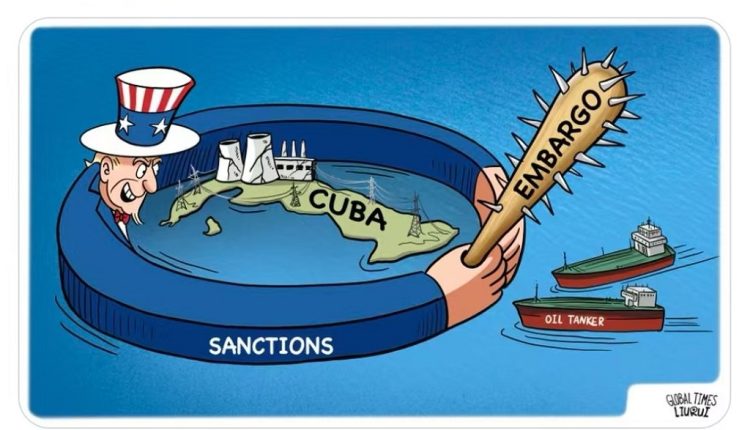
Sovereign immunity exposes the bankruptcy of the Cuba embargo
More than 60 years after the revolution, the embargo has produced a thicket of sanctions, lawsuits, and humanitarian consequences that isolate the United States as much as Cuba.
When the U.S. Supreme Court takes up the long-running property disputes tied to the Cuban Revolution, many will frame the moment as a quest for justice for Americans whose assets were seized in 1959. In reality, the cases now before the Court expose something far less noble: the legal and moral exhaustion of a six-decade campaign to economically strangle Cuba.
At issue is Title III of the Helms-Burton Act, the most aggressive component of the U.S. embargo regime. It allows U.S. nationals to sue companies — including foreign firms — for “trafficking” in property nationalized after Fidel Castro came to power. For more than twenty years, presidents of both parties quietly shelved this provision because they understood its explosive diplomatic consequences. That changed in 2019, when Donald Trump activated it as part of a broader effort to tighten economic pressure on Havana.
The result was not justice. It was legal chaos.
Now, ironically, the most important development in these cases may be a 2024 lower-court ruling that Cuban state entities can invoke foreign sovereign immunity — the longstanding principle that one nation’s courts generally cannot sit in judgment over another sovereign state. Far from being a technicality, this ruling exposes the fundamental contradiction at the heart of Helms-Burton: the United States is trying to use domestic courts to punish a foreign government for actions taken on its own territory more than sixty years ago.
A law designed to punish, not resolve
Helms-Burton was never simply about compensation. It was designed to deter foreign investment in Cuba and tighten the embargo by weaponizing U.S. courts against third countries. In effect, Washington sought to internationalize its unilateral sanctions policy by threatening lawsuits against companies from Europe, Canada, and elsewhere.
That is why earlier administrations — from Bill Clinton to Barack Obama — repeatedly suspended Title III. Allies warned that allowing lawsuits over decades-old nationalizations would violate international norms and trigger retaliatory measures. They were not wrong.
The 2024 immunity ruling simply acknowledges a reality that policymakers long understood: you cannot credibly claim respect for international law while simultaneously demanding that U.S. courts override another nation’s sovereignty.
Consider the case brought by ExxonMobil against the Cuban state enterprise CIMEX. Exxon seeks more than $1 billion for oil assets nationalized in 1960. But if CIMEX is an arm of the Cuban state, as both sides acknowledge, allowing the suit to proceed would effectively put Cuba itself on trial in a U.S. courtroom.
That is precisely what sovereign immunity is meant to prevent.
The selective memory of expropriation
Lost in much of the public discussion is a basic historical fact: nationalization of foreign property was not unique to Cuba. It occurred across the developing world in the mid-20th century as newly independent nations sought control over their economies. In many cases — including Cuba’s — compensation was offered but rejected because of political conditions attached by Washington.
To portray these disputes as simple theft ignores the Cold War context in which they occurred. It also ignores the far greater economic damage inflicted by the embargo itself, which has cost Cuba hundreds of billions of dollars in lost trade, investment, and development.
If justice is the goal, the ledger runs both ways.
The cruise line absurdity
The companion case involving Carnival Corporation, Royal Caribbean, Norwegian Cruise Line, and MSC Cruises reveals an even deeper incoherence. These companies are being sued for using port facilities in Havana, even though the U.S. government itself encouraged travel to the island during the Obama years.
A federal judge initially imposed $440 million in damages, only for an appeals court to overturn the ruling. The spectacle of companies being punished for following U.S. policy underscores how Helms-Burton turns ordinary commerce into legal peril.
If foreign businesses must choose between engaging with Cuba and risking ruinous U.S. litigation, the message is clear: the embargo is not merely a bilateral dispute but an attempt to control the economic decisions of the entire world.
Sovereign immunity as reality check
Critics argue that granting immunity will deprive Americans of their right to compensation. But the uncomfortable truth is that these claims were never likely to be resolved through litigation alone. They were always bargaining chips in a broader political conflict that Washington has refused to settle through negotiation.
In fact, comprehensive claims settlements are a routine feature of diplomatic normalization. The United States has resolved similar disputes with countries ranging from Vietnam to Eastern European states after the Cold War. The refusal to pursue such a settlement with Cuba reflects political choice, not legal necessity.
The immunity ruling, therefore, does not deny justice; it highlights the failure of a policy that substitutes punishment for diplomacy.
Time to end the legal siege
More than 60 years after the revolution, the embargo has not brought about regime change, democratization, or reconciliation. What it has produced is a thicket of sanctions, lawsuits, and humanitarian consequences that isolate the United States as much as Cuba.
The Supreme Court now has an opportunity — perhaps unintentionally — to force a reckoning. By affirming that sovereign nations cannot be hauled into U.S. courts at will, it could expose Helms-Burton as the overreach it has always been.
True justice for confiscated property will not come from billion-dollar verdicts that can never be collected. It will come from negotiation, normalization, and an honest accounting of history on both sides.
Until then, these lawsuits serve less as instruments of redress than as relics of a failed policy — one that continues to punish ordinary Cubans while offering little tangible benefit to Americans.
If the Court’s decision makes Title III harder to use, it may do more than reshape legal doctrine. It may finally signal that the era of trying to litigate Cuba into submission is coming to an end.
