
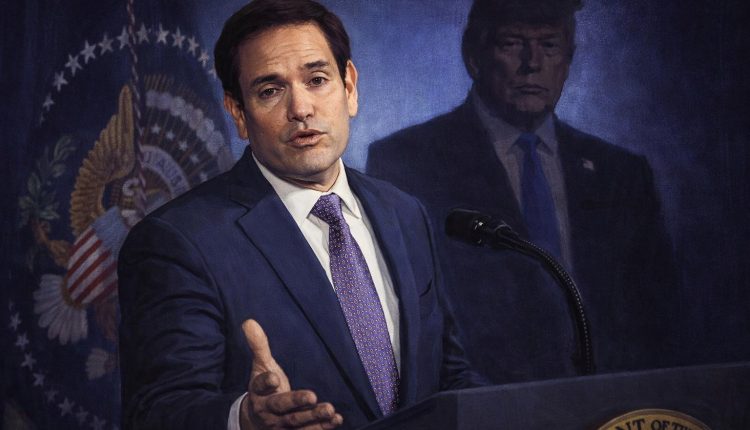
Marco Rubio and the narco-terrorist elite
By the time Rubio entered politics in Miami, he was surrounded by donors, fixers, and mentors drawn from the same exile networks that had long blurred the line between anticommunism, organized crime, and U.S. intelligence.
(Editor’s Note: This article summarizes an article first published in The American Prospect and written by Maureen Tkacik. To see the original article, click here.)
***
Marco Rubio has spent his political career presenting himself as a paragon of moral rectitude—an earnest son of immigrants, a devout Catholic, a football-loving teenager who rose through discipline and faith. But as Maureen Tkacik documents in The American Prospect, Rubio’s biography intersects repeatedly with one of the most notorious drug trafficking networks in modern U.S. history, a network deeply enmeshed with American intelligence, Cold War terror campaigns, and Miami’s Cuban exile underworld.
That intersection begins not with Rubio himself, but with his late brother-in-law, Orlando Cicilia.
As Tkacik recounts, Cicilia ran an exotic animal import business that doubled as a front for a massive narcotics operation tied to Mario and Guillermo Tabraue—figures long known to federal law enforcement as major traffickers and CIA-linked informants. The enterprise moved “nearly a half million pounds of cocaine and marijuana” between the late 1970s and 1980s. Rubio, then a teenager, worked for Cicilia, building cages and cleaning animals.
Rubio has insisted he knew nothing about the drugs. “He was only 16,” Tkacik notes, adding dryly that one of Cicilia’s co-defendants was also 16 when, according to testimony, Mario Tabraue ordered him to murder his estranged wife. The point is not legal culpability. As Tkacik writes, “What politician doesn’t have a felon relative?” The issue is political mythology.
When Univision reported Rubio’s connection to Cicilia’s business in 2011, Rubio’s allies went on the offensive, accusing the network of blackmail and organizing a Republican boycott of its debate. Rubio’s own memoir later portrayed Cicilia not as a trafficker but as a loving family patriarch. The house where Cicilia stored cocaine, Tkacik writes, was recast as “a sanctuary that held his far-flung family together.”
Cicilia’s arrest in 1987—during Operation Cobra, which dismantled the Tabraue network—was described in Rubio’s memoir as a shock that stunned the family. Yet law enforcement records, court testimony, and intelligence files show the Tabraue organization had operated for years in plain sight, protected in part by its role as a CIA asset under the DEA’s covert DEACON program.
Guillermo Tabraue, the patriarch of the operation, was revealed during his 1989 trial to have been a paid CIA informant operating under the alias “Abraham Diaz.” His handler testified in open court. The result was anticlimactic: Tabraue served only a few months in a minimum-security prison camp.
This pattern—drug traffickers shielded when politically useful and discarded when expendable—is the central theme of Tkacik’s essay. Rubio’s personal proximity to that world, she argues, mirrors his later political career, in which he has become what she calls “the Trump administration’s most formidable liar,” lending credibility to policies that openly embrace narco-linked strongmen under the banner of fighting narcotics.
Rubio has repeatedly praised foreign leaders whose families or inner circles were implicated in major trafficking schemes. In 2018, he commended Honduran president Juan Orlando Hernández for combating drug traffickers—“just seven months before his brother was indicted for trafficking 158 tons of cocaine.” He hailed Ecuador’s Daniel Noboa as an “incredibly willing partner,” despite revelations that Noboa’s family business trafficked hundreds of kilos of cocaine in banana crates.
Rubio has likewise championed El Salvador’s Nayib Bukele, despite documented negotiations between Bukele’s government and MS-13, and Argentina’s Javier Milei, whose political circle was engulfed in Miami cocaine trafficking scandals. He has been a vocal defender of Colombia’s Álvaro Uribe, whom a 1991 Pentagon analysis identified as “one of the 100 most important Colombian narco-terrorists” and “a close personal friend of Pablo Escobar.”
The through-line, Tkacik suggests, is not hypocrisy but continuity.
Rubio’s crusade against Venezuela—framed around the alleged “Cartel of the Suns”—fits neatly into this tradition. The term itself, Tkacik notes, originated not with Nicolás Maduro but with a CIA-backed trafficking operation uncovered in 1990, in which U.S. Customs agents found American intelligence collaborating with Venezuelan generals to smuggle cocaine as a counterinsurgency tactic.
As Berkeley professor emeritus Peter Dale Scott wrote in a letter cited by Tkacik, the contradiction between the U.S. waging a “war on drugs” while pardoning major traffickers is only apparent. “The ill-conceived and deliberately misnamed ‘War on Drugs’ has been a cover for contradictory CIA involvement with drug traffickers for decades.”
Rubio’s rhetoric about militarizing drug enforcement echoes Cold War operations like Operation Condor, in which U.S.-backed regimes used cocaine revenues to fund death squads and suppress leftist movements across Latin America. “They’re bringing back Operation Condor,” one investor told Tkacik bluntly.
By the time Rubio entered politics in Miami, he was surrounded by donors, fixers, and mentors drawn from the same exile networks that had long blurred the line between anticommunism, organized crime, and U.S. intelligence. Others around him fell—most notably his close ally David Rivera—but Rubio, as one consultant put it, “was the anointed golden child.”
Tkacik’s article does not accuse Rubio of criminal conduct. Instead, it dismantles the fiction that his political worldview is divorced from his personal history. Rubio grew up adjacent to a narco-terrorist ecosystem that prospered not despite U.S. power, but because of it.
“Few Americans learned this lesson the hard way at so tender an age as Marco Rubio,” Tkacik concludes. The tragedy, she implies, is not that Rubio escaped that world—but that he has spent his career reproducing it, now armed with the authority of the U.S. state.
