
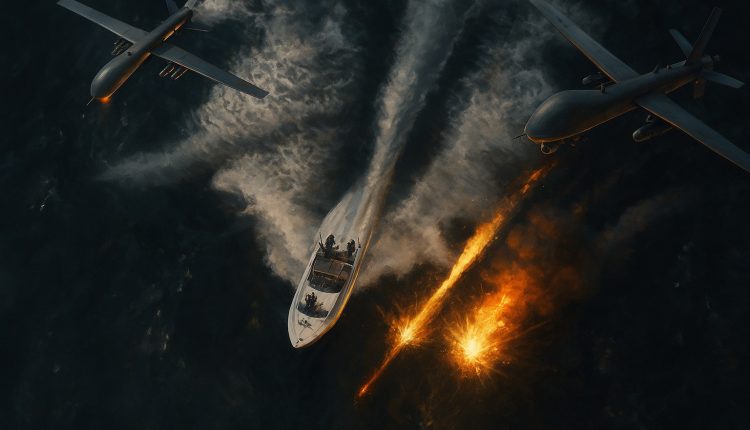
Is the U.S. provoking a war with Venezuela under the guise of anti-drug operations?
This alleged drug war narrative is not new. For decades, Washington has used narcotics as a justification to militarize Latin America.
In an era when U.S. foreign policy continues to exert its power through military operations masked as “security efforts,” a disturbing pattern is emerging yet again—this time involving Venezuela. The recent reports of U.S. airstrikes on ships allegedly linked to Venezuelan drug cartels demand closer scrutiny, not just for their legality, but for what they may truly represent: the early stages of an engineered conflict.
The U.S. military claims it is targeting drug trafficking vessels in international waters, citing intelligence that ties them to Venezuelan cartels. These strikes, while not yet officially recognized as acts of war, are alarmingly close. The targeted ships are often destroyed without trial, due process, or confirmation from independent observers. There’s no transparency—only the word of a government apparatus with a long, controversial history of foreign intervention under flimsy pretexts.
Let’s not forget the precedents. From Iraq to Libya, the U.S. has repeatedly justified military aggression with narratives of “weapons of mass destruction,” “humanitarian intervention,” or in this case, “combating narcotics.” However, once the dust settles, it often becomes clear that economic, geopolitical, or ideological motives were the true driving forces. Venezuela, with the largest proven oil reserves in the world and a government defiant of U.S. hegemony, fits the profile perfectly.
This alleged drug war narrative is not new. For decades, Washington has used narcotics as a justification to militarize Latin America. Under Plan Colombia, billions of dollars flowed into military operations that were supposed to curb drug production but largely failed in that mission. What it did succeed in was bolstering right-wing governments and expanding U.S. influence in the region. Could we be seeing a similar pattern with Venezuela?
In recent years, the U.S. has relentlessly pressured the Venezuelan government, led by Nicolás Maduro, through sanctions, economic isolation, and overt support for opposition figures such as Juan Guaidó. The country’s oil exports have been choked, its assets seized, and its people driven into a humanitarian crisis. Now, by targeting Venezuelan-linked vessels, the U.S. may be crossing a dangerous line—one that turns covert destabilization into overt military aggression.
What makes this escalation more concerning is the absence of international consensus or oversight. If these ships really pose a threat as narcotics carriers, why not involve the United Nations or regional partners in the Organization of American States? Why not present transparent evidence before launching missiles? The unilateral actions speak volumes. This isn’t global cooperation—it’s gunboat diplomacy in the 21st century.
There are also serious legal questions. International law imposes a significantly higher threshold for the use of force, particularly when it involves targeting entities associated with sovereign nations. Even if the vessels are in international waters, attacking them without Venezuela’s consent or U.N. authorization could constitute an act of war. More disturbingly, if any civilians or noncombatants are harmed, the U.S. could be setting itself up for accusations of war crimes.
Then there’s the issue of public manipulation. By framing these operations as part of the “War on Drugs,” the U.S. government taps into decades of ingrained rhetoric that has often been used to justify the unjustifiable. Americans are told to picture shadowy drug lords flooding their communities with poison, while in reality, these operations are usually far more about controlling territory and toppling unfriendly regimes than protecting citizens at home.
Make no mistake: the consequences of this path are enormous. Venezuela is not Afghanistan or Iraq. It has regional alliances, a modern military, and deep resentment toward U.S. interference. A military conflict in Venezuela could spiral into a proxy war involving countries like Russia, China, and Iran—all of whom have economic and diplomatic ties with Caracas. It could destabilize the entire region, send millions more refugees northward, and cost American lives—not to mention billions of taxpayer dollars.
The American public deserves an honest debate about this. Congress has not authorized any conflict with Venezuela. Most Americans would probably oppose another foreign military intervention, especially one based on weak evidence and neocolonial motives. It’s time for the media, lawmakers, and citizens to push for transparency and restraint before the situation spirals out of control.
In the name of national security, the U.S. may be inching toward war. But the question we must ask is: whose security are we really protecting? Because for the Venezuelan people, and quite possibly for ordinary Americans too, this reckless path promises only more suffering.
