
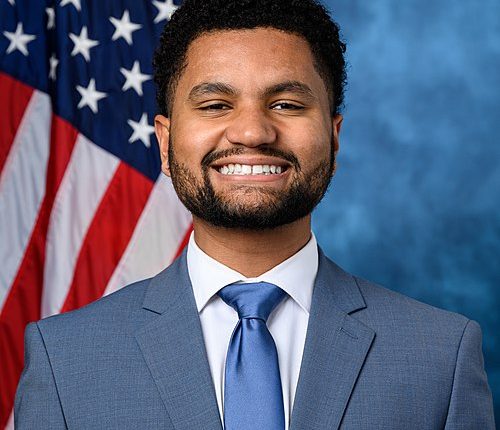
 Rep. Maxwell Frost
GOP trying to paint Maxwell Frost as a political liability
Republicans are targeting Dem House members adjacent to Frost's district and hoping his progressive bonafides hurts his colleagues.
The youngest member of Congress, Rep. Maxwell Frost, has become a rising star on the progressive left. But as the 2026 midterms approach, some Republicans believe his bold stances could become a political liability—for his Florida colleagues.
While Frost himself represents Florida’s deep-blue 10th Congressional District, where Democrats dominate, the National Republican Congressional Committee (NRCC) has zeroed in on two other Democrats in more vulnerable seats: Reps. Darren Soto and Jared Moskowitz.
Their apparent crime? Standing too close to Frost.
Guilt by Association
In a series of press releases and digital attacks, the NRCC has repeatedly tied Soto and Moskowitz to Frost’s unabashedly progressive platform. After Soto and Frost appeared together at a UnidosUS roundtable in July, the NRCC pounced, blasting Soto for aligning with what it called “radical lunatics.”
“Out of touch Darren Soto continues to show Floridians that his allegiance lies with radicals like Maxwell Frost,” said NRCC spokesperson Maureen O’Toole in a recent statement. “Voters will remember that.”
The criticism comes despite Frost’s comments at the roundtable, where he emphasized support for working families and criticized a GOP budget deal that slashed social programs. “We’re fighting back to reverse these reckless policies and help hardworking families breathe easier,” Frost posted at the time.
But Republicans are betting that just being on stage with Frost may be enough to damage Soto’s standing in his swing district.
Soto, Moskowitz Walk a Fine Line
Both Soto and Moskowitz have worked closely with Frost on issues important to their constituents. The trio joined forces to tour the controversial “Alligator Alcatraz” immigration facility earlier this summer and frequently co-sign joint statements with Florida’s Democratic delegation on topics such as education and Medicaid.
Still, there are noticeable ideological differences among the three. According to the progressive advocacy group ProgressivePunch, Frost holds one of the most liberal voting records in Congress—ranked 8th overall, with an ‘A’ grade and a 98.92% lifetime score. Soto scores a ‘B’ (136th), and Moskowitz sits further to the center with a ‘D’ (198th).
Republicans aren’t buying those distinctions. Shortly after former President Trump signed an executive order targeting cashless bail, the NRCC labeled Frost a “poster child” for progressive justice reform—and tagged Moskowitz as his “BFF.”
“Dangerous Democrat Jared Moskowitz is more interested in protecting criminals than Floridians,” said O’Toole. “His pro-crime, anti-law enforcement agenda is wildly out of touch.”
Moskowitz, who flipped a Republican-leaning district in 2022 and is seeking a third term, declined to comment on the NRCC attacks. However, his record shows key breaks from Frost—most notably on foreign policy and Israel.
Israel, Immigration, and the Dividing Line
Frost has taken some politically risky stances—particularly in Florida. He voted against military aid to Israel, citing the humanitarian toll in Gaza and criticizing Prime Minister Benjamin Netanyahu. Both Soto and Moskowitz supported the aid package, with Moskowitz emerging as one of Israel’s most vocal defenders in the Democratic caucus.
Still, the NRCC has worked to tie all three lawmakers together, accusing Moskowitz and Soto of aligning with what they call Frost’s “anti-Israel, pro-Hamas” agenda.
The same pattern has played out on immigration. When Frost visited El Salvador to protest the deportation of a Maryland man accused of MS-13 ties, Republicans mocked the move—and even offered Soto and Moskowitz plane tickets to join him.
But Soto’s campaign pushed back hard, emphasizing his record of standing up for Central Florida’s immigrant communities. “Rep. Soto will continue to conduct rigorous oversight over ICE,” said a campaign spokesperson. “His constituents demand it.”
A High-Stakes Midterm Ahead
Make no mistake—Republicans aren’t expecting to unseat Frost. His district remains a progressive stronghold, with more than 60% of voters backing Vice President Kamala Harris in the 2024 presidential race.
But it’s a different story in the neighboring districts.
Soto’s district only narrowly supported Harris in 2024, while Moskowitz’s district was even more divided. And with Republicans hoping to continue to control the House in 2026, these Central Florida battlegrounds are high on their list.
What remains unclear is whether voters will truly punish moderate Democrats for working alongside a colleague who is further to the left. While Frost may be popular in Orlando, his progressive agenda is still untested in more centrist parts of the state.
The Frost Factor
Frost himself isn’t worried.
“This is the same group working to elect politicians who cut Medicaid and kicked two million Floridians off their healthcare,” he said in an interview. “I’m focused on tackling the affordability crisis, while Republicans are focused on tax breaks for billionaires and mega corporations.”
Yet even as he shrugs off the attacks, Frost’s high-profile presence continues to cast a long shadow—especially in districts where Democrats can’t afford to make unforced errors.
For now, Soto and Moskowitz are betting that shared values and district-focused work matter more than ideological purity. But as 2026 approaches, they’ll need to convince voters that friendship with Frost doesn’t equal political liability.
Whether they succeed may help decide control of the House.
