
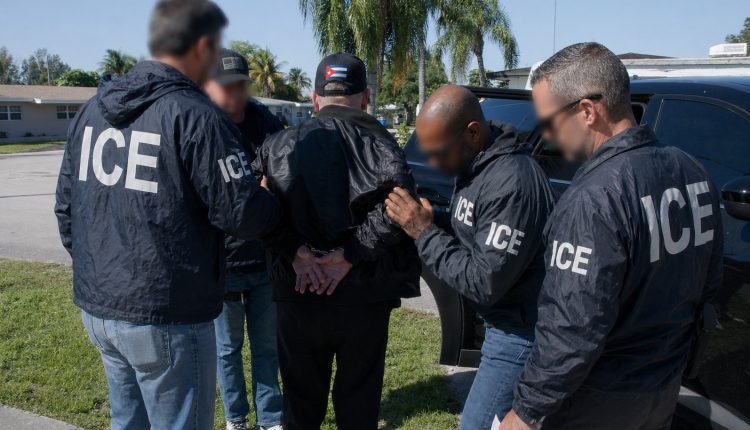
Cubans in the US: From political pawns to targets of repression
For over sixty years, U.S. policy toward Cuba—including the economic embargo—has fueled the hardships that push people to migrate.
For decades, Cuban migration to the United States was not just about humanitarian concern — it was a political tool influenced by Washington’s hostility toward Cuba. Today, with the new hardline policies of Donald Trump, that tool is being abandoned, leaving tens of thousands of Cubans in legal limbo and revealing the deeply cynical nature of U.S. immigration policy.
A recent report by the Cato Institute—hardly an advocate for Cuba—exposes a harsh reality: green card approvals for Cubans have nearly disappeared, while arrests by Immigration and Customs Enforcement (ICE) have risen sharply. The study states that green card approvals have plummeted by 99.8% since December 2024, and ICE arrests of Cubans have increased by 463%. Even more remarkable, approvals that once reached thousands each month have now dwindled to just dozens.
This is not an accident. It is policy.
The End of “Special Treatment”
For years, Cuban migrants received special treatment under the Cuban Adjustment Act, a Cold War-era law created to reward those fleeing a socialist system that the United States aimed to weaken. The law allowed Cubans to gain permanent residency after just one year and one day in the U.S.
Today, that pathway has been completely shut down.
The Trump administration has halted processing for green cards, asylum claims, work permits, and naturalization applications—not only for Cubans but also for migrants from various countries. It additionally dismantled a humanitarian parole program that had allowed vetted Cuban migrants to live and work legally for two years. The outcome is a legal bottleneck impacting nearly one million Cubans, according to the same Cato analysis.
As immigration researcher David Bier told the Miami Herald, “This is a dramatic curtailing of immigration from Cuba.”
Manufactured “Illegality”
What is happening is not just stricter enforcement—it is the intentional manufacture of illegality.
By shutting down legal pathways, U.S. authorities are effectively pushing migrants out of status, making them more vulnerable to detention and deportation. As the Cato report explains, weakening the legal immigration system is a necessary step toward enabling mass deportations. Without legal status, migrants are left with two options: leave or face removal.
This situation exposes a fundamental contradiction. For decades, Cuban migration was promoted and supported as propaganda against Havana. Now, many of those same migrants are being criminalized.
South Florida Feels the Impact
Nowhere is this shift more evident than in South Florida, which hosts the largest Cuban diaspora.
Stories like that of “Rosa,” a Cuban migrant from Matanzas who asked not to be identified, illustrate the human cost, as reported by the Miami Herald. After arriving legally under a parole program, she applied for residency, expecting a straightforward process. Instead, she now faces endless uncertainty.
Her experience illustrates a wider pattern: thousands of applications delayed, families divided, and lives destabilized.
Ironically, even within the Cuban-American community—traditionally supportive of strict policies toward Havana—there is increasing discomfort. Polling indicates strong opposition to deporting Cubans without criminal records and widespread support for legal migration pathways.
Deportation Without Destination
The situation is further complicated by the longstanding tension between Washington and Cuba over deportations. Cuba has historically resisted accepting certain deportees, especially those with criminal convictions, leaving many individuals stranded in the United States in a state of ongoing uncertainty.
Instead of resolving this diplomatically, the Trump administration has gone after controversial agreements with third countries. Reports show that thousands of Cubans have been deported to nations like Mexico—countries that are not their own—raising serious legal and ethical issues.
The Broader Strategy
The targeting of Cubans is part of a broader effort to restrict immigration overall. The Cato report notes that:
- Overall, green card approvals have been cut roughly in half
- Family-based immigration has dropped significantly
- Refugees—already heavily vetted—have seen approval rates collapse by 99%
At the same time, increased coordination between enforcement agencies like ICE and immigration officials has blurred the line between adjudication and policing.
A Policy of Contradictions
Perhaps the most telling aspect of this moment is its hypocrisy.
For over sixty years, U.S. policy toward Cuba—including the economic embargo—has fueled the hardships that push people to migrate. Still, when Cubans reach U.S. borders, they are often met not with protection, but with detention and deportation.
Migrants like Rosa are stuck between two systems: unable to return home because of economic pressures worsened by U.S. sanctions, and unable to move forward in the United States because of restrictive immigration laws.
The sharp increase in arrests and breakdown of legal options reveals a deeper truth: U.S. policy toward Cuban migrants has never been rooted in consistent principles. It has always been driven by politics.
When Cuban migration supported Washington’s geopolitical goals, it was welcomed and even favored. Now that priorities have changed, those same migrants are seen as disposable. In the process, thousands of Cuban families—many in Florida—are suffering because of a policy that keeps prioritizing ideology over humanity.
