
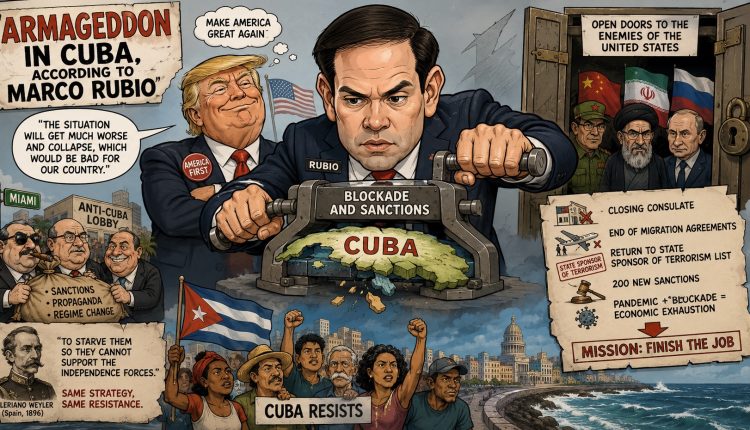
Armageddon in Cuba, according to Marco Rubio
If Donald Trump is the “neighborhood bully,” Rubio is the one responsible for making excuses that justify his actions.
“The situation will worsen significantly and collapse, which would be harmful to our country,” Secretary of State Marco Rubio told Fox, referring to the situation in Cuba and its potential impact on the United States.
“On the other hand, the situation could improve. But for that to happen, significant and deep economic reforms are necessary. These reforms are impossible with those currently in power,” he added, noting that those individuals “have opened the doors to the adversaries of the United States to operate on Cuban territory against our national interests with total impunity.”
More than a prediction of the natural death of the Cuban system, as Rubio would have it, this is an announcement of a murder—spoken by someone who has had his finger on the trigger for years. If Donald Trump is the ‘neighborhood bully,’ Rubio is the one responsible for making excuses that justify his actions.
Like most Cuban American politicians, Marco Rubio has built his career around the issue of Cuba and the goal of overthrowing its government. As a successor to the counterrevolutionary groups that, under CIA protection, shaped Miami’s political landscape, his approach to achieving this goal is through U.S. intervention—an aim now closer than ever as he has become the most powerful politician of Cuban origin in U.S. history.
Although Trump humiliated him in the 2016 primaries, Rubio ultimately subordinated himself to the New York magnate, who gave him Cuba policy to “keep him happy.” Around Rubio, a team of “experts in the art of doing harm” was assembled, reviewing every loophole in the embargo and crafting, with surgical precision, new measures aimed at suffocating Cuba.
Without any factual or scientific basis to support the claim, they were the inventors of the alleged “sonic attacks” on U.S. officials stationed in the country. This served as a pretext to close the U.S. consulate in Havana, halt existing migration agreements, and completely reverse the policies aimed at improving relations carried out by the Barack Obama administration. Cuba was once again placed on the list of “state sponsors of terrorism,” and 200 new sanctions were imposed on the island.
The Trumpist tsunami was worsened by the pandemic’s effects. Due to the U.S. embargo, Cuba had to develop its own vaccines and strain its healthcare system, depleting its economic reserves. As Joe Biden also anticipated a collapse, Marco Rubio took on the role of Secretary of State in Donald Trump’s second term with the goal of “finishing the job.”
What does Marco Rubio contribute to Donald Trump’s administration?
Rubio enjoys backing from some of the largest donors in the Republican Party, including the Zionist lobby and arms manufacturers—an attribute especially valued by the president. He is also a key figure in Florida’s political scene, which now serves as the hub for the MAGA movement and Trumpism’s electoral base.
Additionally, his time on the Senate Intelligence Committee offers knowledge and connections in foreign policy and enhances the sophistication of the country’s international discourse, which is often marked by the ineptitude of its top officials.
Above all, Rubio brings his ties to the Latin American right, a crucial element in shaping the Monroeist outlook that defines current U.S. policy toward the region. Instead of acting as the moderating force some expected within the cabinet, Marco Rubio has become an instigator of an interventionist policy comparable only to that pursued by the United States in the early 20th century in the region.
This stance is now gaining new life amid the decline of U.S. global dominance. The slogan “Make America Great Again” was first used by Ronald Reagan, but Trump made it central to his political identity, linking it to a perception widely shared by the American public. His career’s success has often been rooted in promoting the idea that he alone can turn this situation around.
Marco Rubio has fully understood the president’s instincts and has become an advocate of the slogan “peace through strength,” especially in Latin America and the Caribbean. This is where the significant danger of current U.S. policy toward Cuba lies—and, for different reasons, the precedents of Venezuela and Iran increase that risk.
The success of the Venezuela operation against Maduro emboldened Donald Trump and strengthened Rubio’s position, and may lead them to attempt the same venture in Cuba. In the case of Iran, the opposite applies: for a man who needs recognition of his superiority, failure in Iran could drive Trump to seek a “consolation prize” in Cuba.
Only personal interests would prevent Donald Trump from executing such an operation; strategic, legal, or moral factors do not influence this president. Marco Rubio, however, though he shares the same interventionist mindset, is likely to think differently—and this has so far shaped policy toward Cuba.
Rubio understands that simply stationing an aircraft carrier off Havana’s Malecón, as Trump suggests, would not be enough to intimidate Cubans. Resistance would be intense, and even if defeated, there would be no glory for the United States in such an unbalanced and unjustified war. On the contrary, it would strengthen the myth of the greatness of the Cuban Revolution and increase the impact of its example—an unbearable legacy for the Cuban American far right.
What Marco Rubio aims to do is discredit the Cuban revolutionary process to prevent others from trying to copy it. That’s why he is determined to tighten the embargo until the Cuban economy collapses, while pushing the story that any “collapse” wouldn’t be because of the U.S., but due to the nature of communism and the mistakes of Cuban leaders.
Politicians and analysts strain to interpret the messages of Donald Trump and Marco Rubio about Cuba, but Cubans are familiar with this tactic. It is the same one used by Spanish Captain General Valeriano Weyler when he tried to starve them into submission so they couldn’t support the independence forces in the late 19th century. Then, as now, they had to resist alone—and there were not a few who acted against their own people.
