
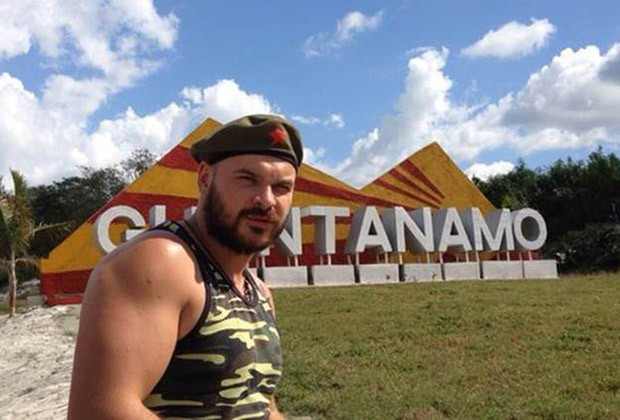
Cuba will expel Russian neo-Nazi
The Cuban government may have to expel a neo-Nazi leader sought by Russia to end a legal dilemma, the man’s lawyer said Thursday (Jan. 23) in Moscow.
The fugitive, Maxim Martsinkevich, was arrested last week in Santiago de Cuba, after the Russian Interior Ministry notified Havana that he was wanted on charges of incitement to violence and gay-bashing and asked that he be extradited to Russia.
[For background, read “Cuba arrests Russian...” (Jan. 18) and “Neo-Nazi’s lawyers claim…” (Jan. 19) in Progreso Weekly.]
Martsinkevich’s attorney, Alexei Mikhalchik, told the RIA-Novosti news agency that if Russia submits a formal request to Havana, the extradition process would take at least two months. To avoid that lengthy process, “the security services of Cuba and Russia could deport Martsinkevich claiming that he is unlawfully present in the territory of Cuba.”
[UPDATE (Jan. 25): The Russian press is reporting that Martsinkevich will be expelled from Cuba on the grounds that he carried no identification papers and had not notified the Russian Consulate in Havana that he lacked such papers. In addition, the Consulate informed Martsinkevich’s lawyer that his client had overstayed his presence in Cuba, which, for tourists, is 30 days. No date was set for the expulsion and no further details were provided by the Consulate or the Cuban government.]
“That is an artificial situation. [Martsinkevich] is there legally, but the allegation would be a pretext to deport him at any moment,” the lawyer explained.
Mikhalchik pointed out that “if no charges are filed, Cuba cannot detain [a suspect] for more than seven days.” Martsinkevich was arrested on Jan. 17, so Cuba would have to release him on his own recognizance on Jan. 24, the lawyer said.
In Havana this week, a Russian Embassy spokesman, Sergei Oboznov, said that Marsinkevich’s extradition “will be decided in the coming days. This further confirms the effectiveness of bilateral cooperation in the field of law enforcement and the high professional level of the relevant Cuban structures,” the diplomat said, according to the newspaper Moskovsky Komsomolets.
The Russian Life News service on Thursday gave some details of Martsinkevich’s arrest, provided by one of two friends who were with him at the time.

“We were with ‘Machete’ in the suburbs of Santiago de Cuba, at a cottage we had rented,” said Sergei Korotkikh, referring to Martsinkevich by his nickname. “The detention took place very correctly.”
“Compared with the Russian police, the Cuban police are the height of civility and good manners. They even asked the manager to bring food so we could eat while we continued to communicate. It was all very polite and civilized.”
The following day, Korotkikh said, he was questioned for almost eight hours by representatives of the Cuban Interior Ministry and the Santiago police, several of whom spoke Russian.
“They were interested in Maxim’s personality, whether he was a public figure, whether he was on TV, whether the case against him was political,” he said. Released by the authorities, Korotkikh flew back to Moscow but was not permitted to re-enter Russia. He is now staying in Minsk, Belarus.
Expulsion for illegal entry to the island might be a swift solution to the diplomatic quandary faced by Cuba.
“Judging from the policemen’s behavior, they were afraid of an international scandal,” Korotkikh told Life News. “But they cannot restrict [Martsinkevich’s] movements beyond Friday (Jan. 24).”
As of noon Thursday (Jan. 23), neither the Cuban Interior Ministry nor its Russian counterpart had issued any statements about the case.
