
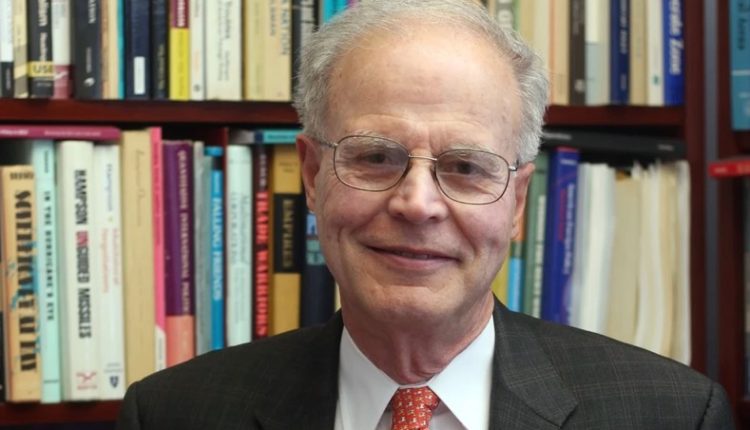
 Jorge I. Domínguez
Domínguez’s warning about Washington’s new Cuba narrative
Domínguez cites its astonishing claim that the Cuban government's "fundamental objective" has always been to "erase the United States from the face of the earth.
A recent U.S. State Department report, Cuba: The Capital of 21st Century Communism, makes a bold claim. According to the report, Cuba is not just an authoritarian Caribbean country facing its worst economic crisis in decades. Instead, it depicts the island as the main architect of a broad ideological conspiracy aimed at ultimately undermining American civilization itself.
To retired Harvard University professor and renowned Latin American scholar Jorge I. Domínguez, this is neither serious scholarship nor sound policy analysis. It’s political theater disguised as intelligence.
Writing for OnCuba, the web magazine, Domínguez thoroughly dissects the report, arguing that it depends on historical exaggeration, selective omissions, and a troubling neglect of context. His conclusion is straightforward: the document “exaggerates historical facts and distorts them to suggest that they remain valid today,” while ignoring decades of U.S. actions against Cuba and turning voluntary international solidarity into an imagined espionage conspiracy.
The tone of the State Department report alone ought to raise eyebrows.
Domínguez cites its astonishing claim that the Cuban government’s “fundamental objective” has always been to “erase the United States from the face of the earth.” It further contends that Cuba is not just a nation-state but “a subversive and intelligence operation” whose main purpose is to wage “an existential revolution” against the United States.
Such language resembles more the rhetoric of an ideological manifesto than the calm assessment expected from government analysts.
Domínguez claims that this exaggerated language plays a key role: compensating for weak evidence.
“The exaggerated tone,” he writes, “seeks to compensate for the weakness of the evidence presented throughout the text.”
That observation strikes at the heart of his critique.
The report frequently references revolutionary movements, intelligence operations, solidarity organizations, and political activists from the Cold War era. Many of these examples are historically accurate. Cuba did support revolutionary movements in Latin America and Africa. Fidel Castro did assist the Sandinistas. Cuban intelligence proved to be remarkably effective at infiltrating U.S. institutions during certain periods.
Domínguez does not deny any of this. What he objects to is presenting events that occurred primarily during the 1960s, 1970s, and 1980s as though they continue to define Cuba’s capabilities in 2026.
History matters. But history cannot simply be frozen in time and repackaged as present reality. Perhaps the most telling example is what the report emphasizes—and what it overlooks.
As Domínguez notes, the report mentions civil rights activist Robert F. Williams 21 times and the Venceremos Brigade 21 times. Yet, it barely acknowledges Cuba’s military interventions in Angola and Ethiopia—operations that genuinely occupied the attention of successive American administrations—and completely ignores the 1962 Cuban Missile Crisis, arguably the most dangerous confrontation of the Cold War. Henry Kissinger was concerned about Soviet nuclear submarines visiting Cuba and tens of thousands of Cuban troops in Africa.
Domínguez notes that this new report barely mentions either. Instead, it depicts small activist groups with limited modern influence as existential threats to American civilization.
That imbalance, he argues, weakens the report’s credibility.
Just as striking is what the document leaves out entirely. Nowhere, Domínguez points out, does the report address the long history of American efforts to overthrow the Cuban government.
- There is no mention of assassination plots against Fidel Castro.
- No discussion of the economic sanctions first imposed in 1960, which are still ongoing.
- No mention of decades of economic pressure.
- No acknowledgment of recent policies aimed at further isolating Cuba during one of the island’s worst humanitarian crises.
A history told from only one side ceases to be history. It becomes advocacy.
One of Domínguez’s strongest arguments is the impressive history of cooperation between Washington and Havana—cooperation that took place under both Republican and Democratic presidents.
- He reminds readers that John F. Kennedy negotiated the release of Bay of Pigs prisoners.
- Lyndon Johnson signed the first migration agreement.
- Richard Nixon reached agreements on combating aircraft hijackings.
- Jimmy Carter opened the Interests Sections, expanded migration, and promoted law enforcement cooperation.
- Ronald Reagan concluded additional migration agreements.
- George H. W. Bush continued diplomatic understandings.
- Bill Clinton negotiated further migration accords, expanded counternarcotics cooperation, facilitated the return of Elián González, and broadened practical bilateral collaboration.
- George W. Bush approved agricultural trade agreements.
For decades, despite significant political differences, both governments also collaborated on anti-drug efforts, maritime rescue missions in the Florida Straits, and other security issues. As Domínguez notes, even the U.S. Drug Enforcement Administration has acknowledged the effectiveness of some aspects of bilateral anti-narcotics cooperation.
This history does not comfortably align with the State Department’s portrayal of Cuba as an irredeemable civilizational enemy.
Perhaps Domínguez’s most unique contribution is his discussion of what political scientist Joseph Nye famously called “soft power.”
The State Department report repeatedly indicates that international support for Cuba mainly stems from recruitment, coordination, or manipulation by Cuban intelligence.
Domínguez disagrees.
Many individuals and organizations, he argues, supported Cuba voluntarily—not because they were recruited by Havana’s intelligence services but because they admired aspects of Cuba’s health care and education systems, opposed U.S. sanctions, or simply felt cultural affinity with the island.
“The document refuses to admit,” Domínguez writes, “that many people and organizations became supportive of Cuba through their own decisions, without having been cultivated, recruited, or coordinated by an omnipresent and omnipotent Ministry of the Interior.”
That distinction matters. People are capable of reaching independent political conclusions. Not every expression of solidarity is evidence of foreign manipulation.
Ironically, Domínguez suggests that Washington’s policies may have actually bolstered the very sympathy that the report largely credits to Cuban intelligence efforts. By treating every critic of U.S.-Cuba policy as either naïve or manipulated, policymakers risk misunderstanding both Cuba and their own society.
Domínguez also notes that the report singles out Democratic Socialists of America while conceding that the organization was not created or directed by Cuban intelligence. The report admits that its support for Cuba reflects decisions made independently by its members.
Yet the report still presents that support as evidence of a growing Cuban threat within the United States.
For Domínguez, this is another example of disproportion replacing analysis.
Reasonable observers may disagree with some of Domínguez’s conclusions. Many historians would acknowledge Cuba’s widespread intelligence operations overseas, while also recognizing the coercive nature of its political system. Others might argue that authoritarian governments still influence through networks formed decades ago.
Those debates are legitimate. But good policy requires honest history. The purpose of intelligence assessments should be to illuminate complexity—not erase it.
As Domínguez shows, historical evidence becomes less convincing when facts are chosen solely to support a predetermined narrative.
If Cuba’s current challenges are genuine—and they definitely are—they merit analysis based on evidence rather than exaggeration.
Democracies are most resilient when they face difficult history honestly, including their own.
That may ultimately be the most important lesson in Jorge Domínguez’s insightful critique: a government confident in its values should never fear historical context.
On the contrary, context is what separates history from propaganda.
