
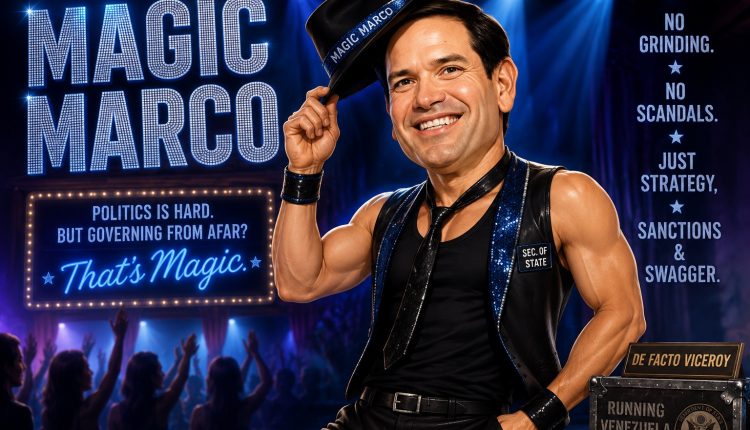
Magic Marco
Marco Rubio seems to have mastered a remarkable political trick: time after time, controversies that might have ended other political careers somehow become mere footnotes in his own.
In the 1980s, Marco Rubio lived temporarily in a Miami home with his older sister, Barbara, and her husband, Orlando Cicilia. At the time, Cicilia was a key figure in a massive, multi-million-dollar South Florida cocaine and marijuana smuggling ring. Federal agents raided the Cicilia home and seized it as part of “Operation Cobra” in 1987. Two years later, Cicilia was convicted of distributing approximately $15 million worth of cocaine and was sentenced to 25 years in federal prison. He served 12 years before being released in 2000.
In his book, “An American Son”, Rubio maintains that he was totally unaware of Cicilia’s drug connections.
I ask you, the reader, to think back to when you were 16. I understand that 16 is young. But, seriously, were you that naïve—or even that oblivious? Because if Little Marco, as President Trump once referred to him, truly had no idea there was something out of the ordinary about the brother-in-law he lived with—a man who played a major role in an international drug ring—then we really have a problem. Not only was Cicilia one of the “Cocaine Cowboys” they now make movies about, but he also stored kilos of cocaine in a spare bedroom inside his West Kendall home, where Rubio was living.
If Rubio truly had no knowledge of any of this, or even the slightest inkling that something was amiss, then Marco Rubio has no business serving as Secretary of State. And that’s for many reasons, including the possibility that he lacks the judgment required to hold what may be the second most powerful political office on the planet. Answering directly to the President of the United States, Rubio has the power to influence the fate of millions.
Then there’s the story of Marco’s relationship with David Rivera, his roommate and close friend when they both served in the Florida House of Representatives during the first decade of the 2000s. For starters, they jointly purchased a house in Tallahassee, where they later faced foreclosure proceedings during Rubio’s 2010 U.S. Senate campaign after failing to pay the mortgage for nearly a year. They eventually settled with the bank and sold the house at a loss.
In my opinion—and this is personal, subjective speculation—Marco and David had no intention of paying the mortgage. Why should they? They had been dodging consequences their entire lives. Rubio, however, was in the middle of his first Senate campaign; miraculously, the money appeared, and the bank issue was settled.
Add to that the fact that David Rivera was recently convicted by a federal jury in Miami on seven counts, including acting as an unregistered foreign agent for Venezuela’s government and conspiracy to commit money laundering. Rivera faces up to 60 years in prison and is being held in federal custody as a flight risk. Testifying under oath in federal court during Rivera’s trial, Rubio stated that he had no knowledge his longtime friend had secured a multi-million-dollar contract to lobby on behalf of the Venezuelan government—even though the two met in 2017 to discuss Venezuela and the work Rivera was doing.
It seems Mr. Rubio has a very bad memory. Or perhaps he simply forgets the things that are inconvenient.
There’s also the controversy surrounding Rubio’s use of a Republican Party of Florida (RPOF) American Express card between 2005 and 2008 while he was Speaker of the Florida House. He came under investigation for charging personal expenses—such as a family vacation, computer supplies, and home repairs—to a card intended for party business. Of course, Rubio had an explanation. In an interview, he said:
“I did not bill personal expenses to the Republican Party of Florida. The Republican Party of Florida never paid my personal expenses. Never. But look, you know, I shouldn’t have done it that way. It was a lesson learned. It was a mistake. If I had to do it over again, I’d do it very differently.”
Strip away the word salad. The question is simple: Did he or didn’t he?
The fact is, he may have made “a mistake.” We all do. But the RPOF American Express card was charged, and those charges included:
- Home improvements: $3,756 paid to Iberia Tiles.
- Auto expenses: $599 at Braman Honda for vehicle repairs.
- Vacation and travel: $1,745 in Las Vegas hotel and rental car costs; $10,000 for a family vacation at a Georgia plantation resort (which Rubio later claimed was a travel agent’s mistake); and $1,625 at the St. Regis Hotel in New York.
- Personal services and retail: A $134 haircut at Churchill’s barbershop in Miami, $765 at the Apple online store, and $180 at a children’s sports activity center.
- Everyday expenses: Groceries, gas station fill-ups, and even tabs at Happy Wine in Miami.
Then came perhaps the most extraordinary profile of Rubio’s career, published by The New York Times under the headline “How Marco Rubio Is Running Venezuela From Afar.” The article describes a breathtaking concentration of power in the hands of one American official, portraying Rubio not simply as Secretary of State but as the man effectively directing the affairs of another sovereign nation.
According to The New York Times, Rubio has become Venezuela’s “de facto viceroy,” exercising a level of influence that “no American official has [held] since L. Paul Bremer III arrived in Baghdad in 2003 to run U.S.-occupied Iraq.” The newspaper reports that Rubio effectively controls Venezuela’s finances, oversees the distribution of oil revenues through the U.S. Treasury, decides who may conduct business in the country under American sanctions, influences cabinet appointments, and even reviews major political decisions made by Venezuela’s interim government.
Perhaps the most striking passage compares the financial relationship to “parents handing out allowances to children,” with Rubio and his staff determining how Venezuelan money can be spent. The article also reports that Venezuela’s acting leader, Delcy Rodríguez, routinely consults Rubio on major decisions, exchanges WhatsApp messages with him, and even sought his approval before publicly responding to praise from President Trump.
The Times makes clear that this arrangement reflects what it calls “Trump-era American power, in which the winner takes all regardless of sovereignty and international law.” It also notes that critics accuse Washington of exploiting Venezuela’s resources while propping up an unelected government and postponing a genuine democratic transition.
Whether one supports or opposes U.S. policy toward Venezuela, the article raises an obvious question: How does a politician whose career has repeatedly been shadowed by questionable judgment, convenient lapses of memory, financial controversies, and controversial personal associations end up wielding this extraordinary authority over another nation?
Marco Rubio seems to have mastered a remarkable political trick: time after time, controversies that might have ended other political careers somehow become mere footnotes in his own.
He keeps falling upward.
Perhaps that, more than anything else, explains why things always seem to turn out well for Marco Rubio—even when he keeps taking the wrong turns.
