
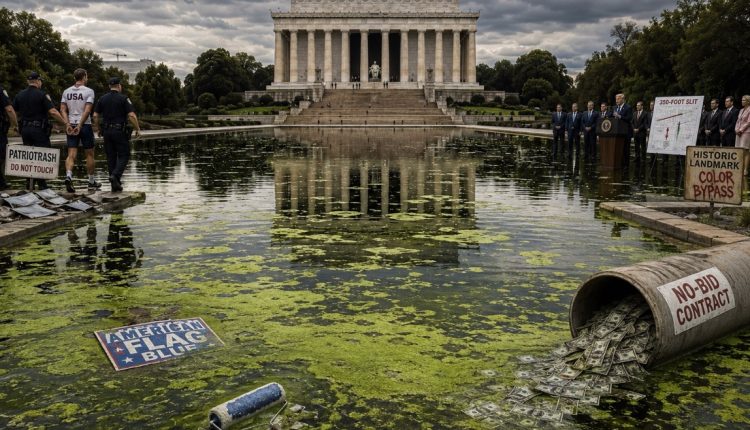
The mysterious conspiracies of the algae
How corruption turned a reflecting pool into a crime scene
By now the entire world knows about the recent “remodeling” of the famous Lincoln Memorial Reflecting Pool in Washington, D.C., which President Trump wants to remake in his own image — as with everything else in the nation’s capital. Like Narcissus, he wanted to see himself reflected in the pool, but the goddess Nemesis decided to punish him for his cruelty and pride.
Trump set out to fix an imaginary problem and threw an astronomical amount of money at it, but an organism responded to all that green with a green of its own. Is it algae? Is it cyanobacteria? Is it sabotage? Is it patriotism? Washington responded to this uncertainty in the traditional manner by producing several competing explanations and believing all of them simultaneously. Before long, the Reflecting Pool became less a body of water than a national aquarium for conspiracy theories, each one swimming lazily around the others and feeding on federal appropriations.
The basic scientific fact at the center of it all is that “cyanobacteria” and “blue-green algae” are two names for the same life form. Blue-green algae is the older, common name. Cyanobacteria is the modern scientific name.
The names are the same, but they are not the same thing. Cyanobacteria are called algae in much the same way that a no-bid contract is called competitive bidding or a coat of paint is called infrastructure. The terminology survives mainly because reality has been shellacked.
But who cares? Scientific distinctions have become unfashionable. We live in an age in which names routinely signify their opposite in an Orwellian dictionary. Oversight means to look the other way. Routine matters are urgent. Cronyism becomes procurement policy. In such an environment, cyanobacteria can hardly be blamed for wishing to be called algae.
Why has no government agency or news organization clarified this semantic distinction? Is there a conspiracy to conceal differences among organisms?
The answer may cling to the President’s machinations like a bacterium to a petri dish. He said he wanted to change the pool’s color to “American Flag Blue.” Such a simple thing. Just make the pool blue, like the flag, so that he can wrap himself in it while shredding its fabric in terms of what the flag means.
There is also this: ancient cyanobacteria were responsible for the Great Oxygenation Event. Their activity transformed the planet and made complex life possible — our own lives.
Perhaps this history is awkward. It is difficult to portray cyanobacteria as public enemies when they are responsible for helping create the oxygen necessary for press conferences, grift, and war mongering. The organisms arrived on Earth billions of years before politics and may therefore possess a perspective that current administrations find insufficiently patriotic.
But we have a government that can portray anti-American insurrectionists as “victims” and wants to pay them money for breaking the law, while portraying as criminals election officials and prosecutors for doing their job well. Portraying cyanobacteria as public enemies would be nothing compared to that.
And most importantly, someone else needs to be blamed.
For starters, President Trump and federal officials have characterized certain incidents in the pool as attacks on federal property. Authorities have arrested several people and issued citations to a growing number in connection with alleged vandalism.
The best-documented case involves former Olympic canoeist David Hearn. By his account, he stopped to examine the deteriorating liner that a contractor had installed, briefly touched a loose flap that was still attached to the side of the pool, and released it when told to do so. He says he did not damage anything. How could he? It was already the paradigm of damage. Nevertheless, he was handcuffed and charged with a misdemeanor related to destruction of government property.
This creates the unusual legal situation in which the only entities visibly attacking the pool are microscopic organisms, while the people being arrested are accused of tampering with the evidence. The evidence itself consists largely of peeling fragments of federally funded debris. Ordinary garbage becomes garbage the moment something falls apart. Government garbage follows a different path. Once detached from the pool, the fragments transform their true nature and become patriotrash — a federally protected substance whose chief purpose is to tempt curiosity.
Thus, the government finds itself in the unusual position of defending patriotrash from an alleged criminal conspiracy. According to Trump, vandals somehow managed to slash the pool’s lining with a knife—”probably a box cutter”—transforming a failing construction project into a federal detective story. And not just a little slash, but a “350-foot slit.” Janine Pirro is reportedly searching for a band of antifa marauders, equipped with invisibility cloaks and magical box cutters, capable of entering the pool unseen, to slice a material previously described as indestructible and expected to last a century.
No, wait. Someone did see what happened.
“I saw it. They cut it. They cut it very violently,” Trump told reporters on national television. “The same thing with the floor. They cut it and then they lifted it. They pulled it. And that’s what it is.”
The statement was broadcast nationally, thereby ensuring that it immediately entered the American marketplace of unreality, where facts, opinions, rumors, prophecies, and cable-news graphics compete on equal terms.
The significance of this circus without bread is that the Reflecting Pool has become less a body of water than a scale model of the administration itself. Consider how the project began. The work was awarded through a no-bid contract under an “unusual and compelling urgency” exception: the pool had to be ready for the nation’s 250th-anniversary celebrations. This raises the question whether the ends justify the means: if transparency delays a project, is transparency really necessary? Perhaps the Founding Fathers secretly intended public scrutiny to be optional, like turn signals on luxury cars.
Note that the President personally selected the hue known as “American Flag Blue” and micromanaged the project. This is reassuring because few things inspire public confidence more than the chief executive of a nuclear superpower being personally involved in decorative water color decisions. Previous presidents worried about wars, recessions, or terrorism. This administration courageously tackles the more neglected question of whether a reflecting pool is green or blue.
Reports indicate that some standard review procedures for modifications to a historic landmark were bypassed. This, too, makes perfect sense. Historic preservation reviews are notoriously biased in favor of preserving historic things. Left unchecked, experts might have insisted on examining proposals, evaluating consequences, or raising objections.
After all, once the President has personally determined the correct color for a national monument, what additional information could a committee possibly contribute?
Questionably, the resurfacing work went to a company with little or no federal-contracting experience but with prior connections to Trump properties. This may seem unusual only to those trapped in the obsolete worldview that awarding contracts should consider relevant experience.
The administration appears to operate according to a more sophisticated theory. If a contractor has successfully painted a Mar-a-Lago pool, it is ipso facto qualified to paint the largest reflecting pool in the world. Water is water. Blue is blue. End of story.
Only one question truly matters: “Has this person ever worked near the President?”
In this way, the Reflecting Pool joins a distinguished tradition of projects in which personal familiarity triumphs over odious professional credentials. The algae, however, seem not to have been informed of this arrangement and continue evaluating contractors according to their old-fashioned standard of whether the work actually works.
A second no-bid contract went to a company owned by a major donor to Trump-related political committees. The donor says the donations had no influence on the award. The White House says it had no role in the selection. Everyone involved insists that the appearance of favoritism is purely coincidental.
And perhaps it is. America is, after all, a nation built on coincidences. Coincidentally, the donor owned the company. Coincidentally, the company received the contract. Coincidentally, the contract avoided competitive bidding. Coincidentally, the project was already attracting criticism for its lack of transparency. At some point, the number of coincidences becomes so impressive that it deserves federal protection as an historic landmark.
Let’s not forget that a nanobubble system was intended to eliminate unwanted growth in the water. Instead, it appears to have produced a different kind of bloom: a flourishing ecosystem of explanations, disclaimers, denials, and arrests. The algae may eventually disappear. The coincidences seem much harder to remove.
Unsurprisingly, despite the $14-15 million original contract and additional millions in expenditures for water-treatment systems and subsequent repairs, the blue coating began peeling within weeks, algae rapidly returned, and the pool had to be drained again for more repairs.
So the coating peels, the algae return, money continues to disappear into a bottomless pit, and the explanations multiply. Amid all the failures, the Reflecting Pool continues performing its one function flawlessly. It reflects exactly what stands before it.
