
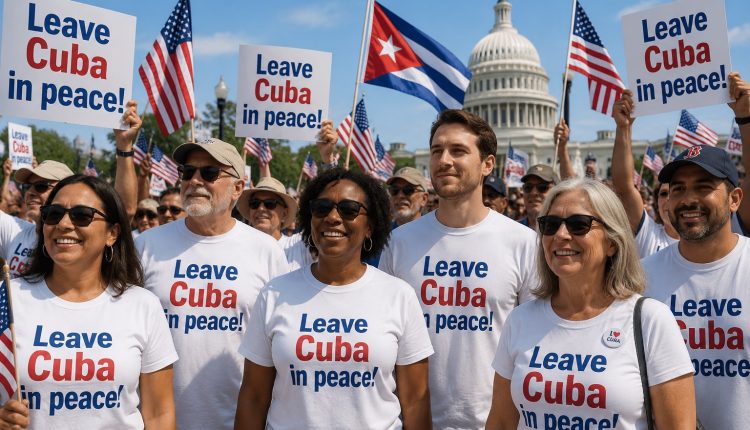
Americans do NOT want military action against Cuba, poll shows
Poll results suggest that escalating tensions with Cuba is not just a controversial policy—it is politically risky.
A recent YouGov poll clearly shows that the American public is not interested in going to war with Cuba. The survey indicates that 64 percent of Americans oppose military action against the island, while only 15 percent support it, and 21 percent are unsure. Among those with an opinion, opposition skyrockets to 81 percent.
That kind of consensus is rare and should not be overlooked. As foreign policy rhetoric heats up, the public is showing caution—and, more importantly, a wish to prevent another unnecessary conflict.
The poll, sponsored by the Center for Economic and Policy Research (CEPR), also highlights broader war fatigue. A solid majority of respondents—62 percent—believe the recent war in Iran has hurt both Americans and the wider world. Only 24 percent disagreed. This shows increasing skepticism toward what many see as costly and unnecessary military interventions.
“This should make President Trump think twice about another ‘war of choice,’” said Mark Weisbrot, senior economist and CEPR co-director. “Almost all of the experts on Cuba would laugh at the idea that Cuba presents a security threat to the United States. And the war against Iran has already cost Trump and his party significant support.”
Despite this, President Trump has repeatedly suggested the possibility of military action against Cuba. In March, he stated that he would “have the honor of taking Cuba” and claimed broad authority to act as he pleased. Less than two weeks later, he doubled down, indicating that although the military was meant as a deterrent, “sometimes you have to use it,” adding that “Cuba is next.” By May 1, he was again asserting that the United States could be “taking over” Cuba “almost immediately.
These statements have not occurred in isolation. On the same day as his latest remarks, the administration increased sanctions against Cuba, targeting not only the Cuban economy but also third-country companies and financial institutions—many likely based in Europe and Canada—that do business with it. This escalation builds on years of tightening restrictions that date back to 2017.
The human impact of these policies is becoming harder to ignore. Sanctions have led to severe shortages, especially in energy. Since over 80 percent of Cuba’s electricity relies on oil, restrictions on fuel imports have disrupted hospitals, emergency services, and essential medical equipment. Some analysts highlight a sharp increase in infant mortality in recent years as evidence of the wider humanitarian impact.
At the same time, the administration’s rhetoric on other conflicts has raised further concerns. In early April, President Trump issued a stark warning about Iran, describing a scenario in which “a whole civilization will die.” Human rights organizations, including Amnesty International, condemned the statement as dangerously extreme. Most Americans seem to agree: 58 percent of poll respondents described the remarks as a threat of mass destruction, and 54 percent said they believed he was not fit to serve as president.
What stands out in all of this is how consistent public opinion has become across political lines—especially among independents. These voters, often decisive in national elections, oppose a war with Cuba by wide margins. Their views suggest that escalating tensions with Cuba is not just a controversial policy—it is politically risky.
Taken together, the data tells a clear story. Americans are tired of war. They don’t see Cuba as a threat that justifies sending in the military, and they are cautious of policies that could provoke another long and damaging conflict. As political leaders continue to raise the stakes, the public is sending a different message: this is not a war they want.
