
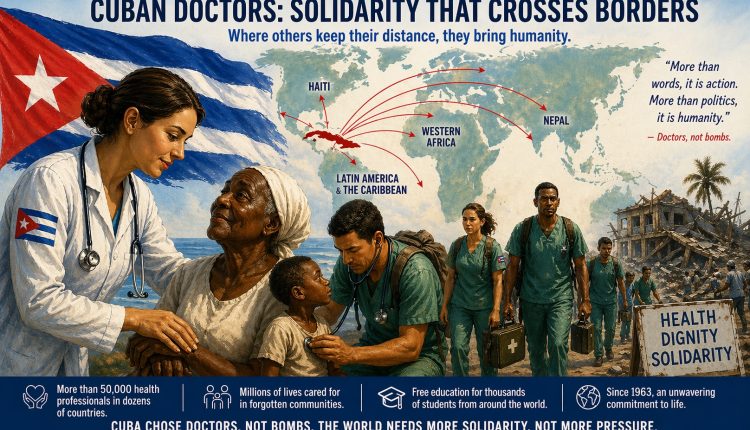
Cuban doctors: They serve where others will not
Cuba’s philosophy — often summarized as “doctors, not bombs” — is not abstract. It has been lived, repeatedly, in the hardest places on earth.
This Progreso Weekly editorial was inspired by an article by Kenneth Mohammed published in The Guardian.
***
There is a moral principle repeated endlessly across cultures: “Love thy neighbor as thyself.” It is quoted in sermons, speeches, and slogans. But when measured against real-world action, few nations in modern history have come closer to practicing it than Cuba through its doctors.
For more than six decades, Cuban medical professionals have gone where wealthier nations would not — into rural villages, disaster zones, and underfunded health systems that the global market ignores. They have treated the poor, the isolated, and the forgotten — not as an afterthought, but as a priority.
Let’s be clear: this is not charity. It is a sustained, organized commitment to human life.
When Ebola ravaged West Africa, Cuban doctors were among the first to arrive, risking their lives while much of the world hesitated. After the 2010 Haiti earthquake, they remained long after the cameras left, providing continuity of care in a country too often abandoned. When the 2015 Nepal earthquake struck, they mobilized again — quickly, efficiently, and without spectacle.
This is what solidarity looks like when it is real.
Cuba, a small island under the weight of the decades-long United States embargo against Cuba, made a deliberate choice: invest in doctors, not weapons; in global health, not global dominance. It trained those doctors free of charge — not only for itself, but for the world — including thousands of students from the Caribbean, Latin America, Africa, and even underserved communities in the United States.
In doing so, Cuba built one of the most extensive international medical networks in history. At its peak, tens of thousands of Cuban healthcare workers were serving in dozens of countries, often forming the backbone of primary care systems in places where no viable alternative existed.
And yet, today, many of these programs are being dismantled.
Under political pressure — particularly from the United States — countries across the Caribbean and Latin America are stepping back from agreements that have saved countless lives. The justification often rests on accusations about labor conditions, framed in moral language. But the result is starkly tangible: fewer doctors, fewer clinics, and fewer options for the poor.
The people who will suffer are not policymakers. They are patients.
In nations like Jamaica, Guyana, and across smaller island states, Cuban doctors have long filled critical gaps — staffing rural outposts, supporting overwhelmed hospitals, and delivering care in communities that would otherwise go without. Remove them, and the system does not adjust — it fractures.
Supporters of these medical missions point out an uncomfortable truth: many of the doctors being criticized were trained at no personal cost, unlike their counterparts elsewhere, who often carry decades of debt. They choose to serve abroad, gaining experience while contributing to both their country’s economy and global health. Imperfect? Perhaps. But dismissing the entire system ignores its undeniable human impact.
There are still voices willing to say this openly. Leaders such as Mia Mottley, the prime minister of Barbados, have defended the integrity and value of Cuban medical cooperation, especially during crises like COVID-19, emphasizing that healthcare should not be sacrificed to geopolitical pressure.
That stance is not just political — it is ethical.
Because strip away the rhetoric, and the question becomes simple: what replaces Cuban doctors when they are gone?
In many cases, the answer is nothing.
This is where the moral contradiction becomes impossible to ignore. Governments that have relied on Cuban medical professionals for decades are now distancing themselves at precisely the moment those contributions should be recognized and strengthened. It is not just a policy shift; it is a retreat from a proven model of care that has benefited millions.
Cuba’s philosophy — often summarized as “doctors, not bombs” — is not abstract. It has been lived, repeatedly, in the hardest places on earth. It has meant showing up first, staying longer, and asking for less.
That is rare. And it matters.
So before dismantling what has worked, before yielding to pressure dressed up as principle, countries in the region should ask themselves a harder question: what does solidarity actually require?
If “loving thy neighbor” is more than a slogan, then it must apply precisely when it is inconvenient — when it demands independence, courage, and a willingness to stand by those who have stood by you.
Cuban doctors have done that for the world. The real question now is who will stand by them.
