
The false prophets in American foreign policy
There is a structural commonality that helps explain not only why these voices recur, but why their analytical patterns so often converge.
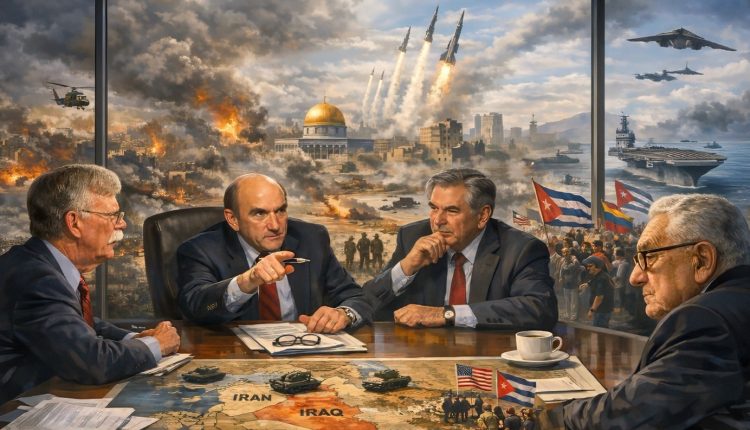
CNN has been featuring a political analyst that I thought had fallen into the dustbin of history: Elliot Abrams. It is also relying on another analyst, of whom it has been said that he never saw a war he didn’t like: John Bolton. Why, I wondered, does CNN seek the opinion of these individuals with respect to the war against Iran, the attack on Venezuela, and the Trump administration’s oil blockade against Cuba, when they have always been wrong in their analyses and predictions? Don’t the producers have new rolodexes?
Abrams entered government during the late Cold War, when U.S. foreign policy was shaped by the doctrine of containment—the belief that Soviet influence had to be resisted everywhere. One presumption dominated this environment, the domino theory: if one country fell to a hostile ideology, neighboring states would follow. This logic shaped U.S. policy in Vietnam, Central America, Angola, and Afghanistan, embedding in a generation of policymakers the conviction that local conflicts can engulf the world and that American intervention is not only justified but necessary to prevent it.
Abrams first rose to prominence during the Reagan administration, when he served as assistant secretary of state for human rights and later for inter-American affairs. In that role, he defended U.S.-backed governments in Central America at a time when those regimes were engaged in widespread and well-documented human rights abuses. He dismissed reports of atrocities such as the El Mozote massacre as exaggerated or manipulated—reports that subsequent investigations proved tragically true.
This was not an isolated misjudgment but an early indication of a pattern: a willingness to subordinate empirical reality to an ideological narrative.
By the late 1970s and early 1980s, a group of former liberal intellectuals—many originally Democrats—became disillusioned with détente and what they saw as American strategic retreat. This movement is what later became known as neoconservatism. Its leading figures—Irving Kristol, often called its “godfather,” Norman Podhoretz, its polemical voice, and policy operatives such as Richard Perle and Paul Wolfowitz—advanced a set of arguments that would come to define an era: that authoritarian adversaries were inherently unstable, and that the United States could shape political outcomes abroad through various forms of meddling.
Abrams is a classic interventionist strategist in that neoconservative tradition. His forecasts often assume that authoritarian regimes are internally brittle and relatively easy to overthrow. That narrative matured in the 1990s and early 2000s into a doctrine that would define his career: the belief that American power could and should be used to remove hostile regimes and that, once removed, something resembling democracy would follow. Abrams was among those who supported the push to remove Saddam Hussein well before the attacks of September 11, aligning himself with a school of thought that saw regime change not as a last resort but as a strategic instrument.
The results of that experiment are now part of the historical record. Iraq did not become the democratic catalyst its advocates envisioned. Instead, it descended into prolonged instability, sectarian violence, and regional realignment—outcomes that clash with the confident predictions made at the time.
Yet Abrams’s confidence in the fragility of adversarial regimes remained intact. When he returned to government during the Trump administration as special representative for Venezuela, he again advanced the expectation that a combination of sanctions, diplomatic isolation, and internal pressure would quickly lead to the collapse of Nicolás Maduro’s government. That prediction, too, proved wrong. Maduro remained in power until he was recently kidnapped by American special forces, while the opposition movement, once recognized by the United States, largely dissolved. And even though the government was decapitated, it is still essentially intact.
John Bolton operates from a closely related, though arguably even more blunt, set of assumptions. Where Abrams has often framed intervention in the language of democracy promotion, Bolton dispenses with such rhetoric and speaks unabashedly about power, supposed “threat” elimination, and preemption. Over the course of his career—as undersecretary of state, ambassador to the United Nations, and national security adviser—he has advocated military action or coercive pressure against Iraq, Iran, and North Korea, among others.
The predictive record here is no more reassuring. Iran’s government did not collapse under decades of sanctions. North Korea has not relinquished its nuclear program. The expectation that pressure alone would produce capitulation has repeatedly collided with the reality that authoritarian regimes, far from crumbling, often consolidate under external threat.
Nor are Abrams and Bolton outliers in this regard. They are part of a broader tradition of foreign-policy thinking whose predictive confidence has often exceeded its empirical accuracy.
Indeed, the modern history of American foreign policy is punctuated by failures of anticipation that cut across ideological lines. U.S. intelligence and policy elites did not foresee the fall of the Shah of Iran in 1979. On the contrary, Iran was widely regarded as a pillar of regional stability. These elites also did not anticipate the rapid collapse of the Soviet Union, long assumed to be a durable superpower. And they were caught off guard by the Arab Spring, which overturned the prevailing assumption that Middle Eastern authoritarian regimes were largely immune to mass political upheaval. These were not marginal errors but systemic failures to understand how and when regimes collapse—or endure.
Consider again the case of those who championed the Iraq War as a catalyst for democratic transformation across the Middle East. The expectation, articulated with clarity by officials such as Paul Wolfowitz, was that the removal of Saddam Hussein would trigger a wave of liberalization throughout the region. What followed instead was fragmentation, civil conflict, and the expansion of U.S. rivals’ regional influence—developments that bore little resemblance to the original forecast. The most prominent example of unintended consequences is Iran.
It was a stunning failure of these officials to connect the dots: Iraq is a majority-Shiite country, long governed under a Sunni-dominated regime that repressed Shiite political and religious expression. Many of the Shiite leaders who emerged after 2003 had spent years in exile in Iran during Saddam’s rule, where they developed institutional, ideological, and personal ties to the Iranian state. Parties such as Dawa Party and the Supreme Council for the Islamic Revolution in Iraq (later ISCI) returned to Iraq with Iranian backing, organizational experience, and, in some cases, armed wings trained or supported by Iranian entities. Ironically then, Iran’s influence entrenched powerful Shiite parties and militias for whom opposition to the United States became a central political and strategic principle.
An even more sweeping false prophecy was the post–Cold War optimism associated with Francis Fukuyama’s “end of history” thesis, which suggested that liberal democracy had effectively triumphed as the final form of political organization. That view, widely embraced in policy and media circles in the 1990s, underestimated both the resilience and adaptability of authoritarian systems. The subsequent decades—marked by the rise of China, the reassertion of Russia’s expansionism, and democratic backsliding across multiple regions—have rendered that confidence, to put it kindly, uninformed.
On the other end of the spectrum, realpolitik thinkers have fared no better at prediction. Henry Kissinger, for all his strategic acuity, did not anticipate the speed of the Soviet Union’s collapse and overestimated the durability of geopolitical arrangements, such as the viability of South Vietnam after U.S. withdrawal. Even George Kennan, whose long-term insight into Soviet decline proved prescient, misjudged how containment would be implemented and later warned—correctly, as some would argue—about consequences that policymakers chose to ignore.
There is, however, a structural commonality that helps explain not only why these voices recur, but why their analytical patterns so often converge. The figures most consistently elevated as authoritative interpreters of American foreign policy—Abrams, Bolton, Wolfowitz, Kissinger, Fukuyama—emerge from a strikingly narrow educational and institutional pipeline. Most were trained at a small cluster of elite universities—Harvard, Yale, Cornell, Chicago—during a period when the study of international relations was dominated by Cold War assumptions about ideological conflict, great-power rivalry, and the centrality of American leadership and “exceptionalism.”
Many of these figures also passed through the same professional circuits: the National Security Council, the State Department, the Pentagon, and a relatively small set of think tanks such as the American Enterprise Institute and the Council on Foreign Relations. Within this ecosystem, ideas circulate, reinforce one another, and acquire the authority of familiarity. Over time, this produces less diversity of perspectives and more groupthink.
The prevalence of legal training among some of these figures further sharpens this tendency. Lawyers are trained to construct coherent arguments, to press positions with confidence, and to impose order on complex fact patterns. These are valuable skills. But in the realm of foreign policy, they can foment an overestimation of how responsive reality will be to well-structured plans, and an underestimation of how resistant political systems can be to external pressure.
Layered onto this institutional continuity is a demographic one. The most prominent voices in this tradition have been, with few exceptions, white men aligned with Republican administrations or conservative policy networks. Thus, a relatively narrow set of experiences has shaped how problems are framed and solutions are imagined—particularly in regions where history, identity, and political culture do not easily map onto Western assumptions. The astonishing failure to anticipate that Iran would retaliate against the United States and disrupt the world by closing the Strait of Hormuz in the present war is a poignant example.
At the same time, the selection of such voices cannot be entirely separated from the pressures facing the media institutions that platform them. Major networks have spent years under sustained political attack for alleged liberal bias. One response—subtle but visible—has been to foreground figures associated with hawkish or conservative positions, as a way of signaling balance. Yet this effort at equilibrium can elevate analysts whose views align not only with a particular ideological tradition but also with entrenched institutional interests, including those tied to defense policy, national security bureaucracies, and the broader security-military-industrial complex. The result is a discourse that skews toward confrontation and coercion, even when the historical record offers little support for their effectiveness.
What characterizes Abrams, Bolton, etc., is that their errors follow a particularly consistent pattern: the repeated assumption that external pressure will quickly unravel regimes that prove far more resilient. At its extreme, their assumption posits the United States’ ability to dominate the world as it wishes by simply dropping bombs.
In sum, systematic error is not the exception but the norm, and confidence fouled by hubris is not a reliable indicator of accuracy.
Why, then, are these voices still given such prominence?
Part of the answer lies in the nature of television. Simplistic certainty sells better than nuance. Predictions delivered with confidence by former officials, generals, and various talking heads, even when repeatedly disproven, are more compelling than cautious assessments hedged with probability and free of braggadocio. Another part lies in the networks’ inability or unwillingness to consult a Rolodex of new voices.
A Trumpian twist to that habit is a castrated Congress and the substitution of diverse voices in the cabinet with servile sycophants that flock to the screen like moths to a lamp.
There is also an issue that extends beyond any single network. In American public discourse, foreign-policy accountability is remarkably thin. Analysts are rarely judged by the accuracy of their predictions. There is no ledger in which past predictions are tallied before new opinions are solicited. The result is a kind of perpetual reset, in which parroting explains the next crisis with the same confidence that attended the last.
This would matter less if the stakes were lower. They are not.
